Tarantino's Last Crusade take: is Indiana Jones boring?
From Sean Connery's Henry Jones to Paul Dano and Wes Craven, here is where I think Tarantino's movie takes go wrong, and where he has a point
 Breakdowns & Blockbusters (AI-assisted)11 November 2026Editor: Digital Fox Talent Editorial TeamOn YouTube since 2023 · more than 240,000 subscribers
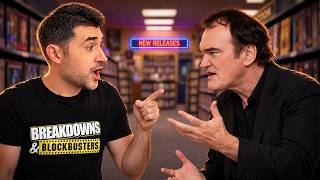
Quentin Tarantino thinks Indiana Jones and the Last Crusade is boring. He thinks Spectre is better than Skyfall, and he says the greatest movie of the 21st century isn't The Dark Knight, No Country for Old Men or There Will Be Blood. It's Ridley Scott's Black Hawk Down. I agree with him on plenty of things, but some of his movie opinions are wild, and I think several of them are wrong.
Tarantino knows a thing or two about movies. He's one of the greatest filmmakers of all time. Before that, he spent years working in a rental store, arguing with his coworkers about movies during his shifts, with customers occasionally joining in. I can relate, because I also worked in a rental store and did the exact same thing. Tarantino never stopped. He went from arguing with people behind a counter to sharing his opinions with millions of people around the world. So here are his wildest takes, and why I disagree.
Tarantino calls Indiana Jones and the Last Crusade boring
Tarantino doesn't only prefer Indiana Jones and the Kingdom of the Crystal Skull to The Last Crusade. He also said Sean Connery's character wasn't particularly interesting, and compared the relationship between Indy and his father to Stop! Or My Mom Will Shoot. That's a comedy starring Sylvester Stallone as a cop whose overbearing mother comes to visit, witnesses a murder and insists on tagging along while he solves the case. The movie is horrible. Schwarzenegger, who had a competitive rivalry with Stallone at the time, pretended to be interested in the film to trick Stallone into taking the role, knowing full well how terrible the script was. So that comparison is a pretty big insult.
I have no idea what movie Tarantino was watching, because to many fans The Last Crusade is even better than Raiders. What elevates it is the very relationship he hates. Connery isn't playing some annoying parent who keeps getting in the way of the adventure. He's playing an emotionally distant father who spent so much of his life obsessing over the Holy Grail that he neglected his own son. After years of barely speaking, they're forced on this adventure together, which leads to some of the funniest moments in the franchise. As capable as Indy is fighting Nazis and chasing artifacts, the moment his father shows up, he turns back into a frustrated little kid.
The relationship also gives the movie something the previous films didn't have: an emotional payoff. At the end, when Indy is desperately reaching for the Grail, his father finally calls him Indiana instead of Junior and tells him to let it go. This is a man who dedicated his entire life to finding the Grail, and now that it's within reach, he's willing to give it up because he realizes his son is more important. That's not a running joke about an annoying parent. It's a satisfying conclusion to both characters' stories.
Why Temple of Doom as Tarantino's favorite Indiana Jones movie is so strange
Perhaps the strangest part of Tarantino's opinion is that his favorite Indiana Jones movie is Temple of Doom. He considers it Spielberg's best movie after Jaws, which is a wild take on its own. It has some incredible set pieces, like the mine cart chase, but listening to Willie scream for two hours is more than my ears can handle. Of the original three films, it's arguably the one that feels least like an Indiana Jones adventure, because once Indy reaches the palace, the movie turns into a haunted house film.
So when it came time to make the third movie, Spielberg deliberately tried to recapture the tone of Raiders of the Lost Ark. That's why The Last Crusade brings back the Nazis, another biblical artifact, Sallah and the same globe-trotting adventure as the original, while introducing Indy's father to give the story something new.
I will give Tarantino this. The next two movies doubled down on the family dynamic by sending Indy on another adventure with a relative: his son in Crystal Skull, then his goddaughter in Dial of Destiny. Apparently Indiana Jones can't go looking for an ancient artifact anymore without a family member along for the ride. But just because the later movies kept recycling the idea doesn't mean it wasn't brilliant the first time. Personally, I think The Last Crusade would have been the perfect ending to the franchise. It ends with Indiana Jones riding off into the sunset, and you can't get much better than that.
Is Paul Dano the biggest flaw in There Will Be Blood?
When Tarantino ranked his favorite movies of the 21st century, he placed Paul Thomas Anderson's There Will Be Blood at number five. He thought it could have been number one or two if not for one enormous problem: Paul Dano. According to Tarantino, Dano is the film's biggest flaw. He called him "weak sauce" and argued that Daniel Day-Lewis completely overwhelms him in every scene they share.
If I'm being honest, I kind of agree. I remember thinking something similar when I first saw the movie. Day-Lewis gives one of the greatest performances in cinema history as Daniel Plainview, and whenever Dano shares the screen with him, he feels completely outmatched. Except I think that's kind of the point. The conflict revolves around a pathetic little preacher, completely out of his league, who somehow gets under the skin of a man vastly more powerful than he is. Isn't it brilliant that the actors themselves create a similar dynamic? Even if Dano isn't remotely in Day-Lewis's league, that reinforces the relationship between their characters.
What's even more remarkable is that Dano wasn't originally supposed to play Eli Sunday. He'd been cast in the much smaller role of Eli's brother Paul, while an actor named Kel O'Neill was set to play the preacher. A couple of weeks into filming, things weren't working out and O'Neill was fired. Anderson turned to Dano, who was only 23, and offered him the much larger role. He had just four days to prepare before filming resumed, opposite an actor who had spent months preparing and is arguably the greatest of all time.
Considering those circumstances, I think Dano does a pretty remarkable job. He might not have Day-Lewis's overwhelming screen presence, but he doesn't need it. Eli is supposed to be insecure, pathetic and desperate to convince everyone, including himself, that he's more important than he is. Dano captures that perfectly, whether by accident or not. So while I understand where Tarantino is coming from, I don't think Dano being overshadowed is necessarily a flaw. I think it's part of what makes the relationship work so well.
Did Wes Craven hold Scream back?
Tarantino was a big fan of the Scream script but wasn't impressed with Wes Craven's direction. He described Craven as the iron chain attached to the film's ankle, keeping it earthbound and stopping it from going to the moon. To be fair, I can see where he's coming from. Scream is one of the most influential horror movies ever made, but there's nothing particularly flashy about how Craven directs it. The camera work is straightforward, the lighting is fairly natural, and visually it looks like an ordinary movie about teenagers in a small American town.
Now imagine if Sam Raimi had directed it. Raimi has a much more distinctive visual style, which you can see in all its glory in his Evil Dead movies, and even in his Spider-Man movies, like the Doc Ock hospital scene. He uses Dutch angles, snap zooms, exaggerated close-ups of terrified faces and exaggerated lighting and shadows. Bring that energy to Scream and there's no question it would have been a more visually inventive movie. But would it have been a better one?
Scream is a commentary on horror movies and their ridiculous conventions. The characters have seen the same horror movies we have. They know the rules, mock the clichés and even discuss how to survive a horror movie while unknowingly starring in one. The screenplay is already constantly reminding us we're watching a movie. Flashy direction would have reminded us of the exact same thing. So Craven takes the opposite approach, filming in a conventional, grounded style that makes the characters and their world feel surprisingly believable. At times it's almost like a documentary about teenagers obsessed with horror movies.
Because the filmmaking isn't drawing attention to itself, you almost forget you're watching a horror movie, which is what makes it so terrifying when Ghostface shows up. Unlike Freddy Krueger or a supernatural monster, Ghostface is a guy in a Halloween costume with a knife, and that makes him feel strangely real. Tarantino himself did something similar with Grindhouse, where he and Robert Rodriguez recreated the look of cheap 1970s exploitation movies, complete with scratched film, missing reels and intentionally sloppy editing. That works because Grindhouse is meant to celebrate and parody those B movies. Apply it to Scream and you're making a spoof. A more stylized director might have made a more visually impressive movie, but I'm not convinced they would have made a scarier one, and for a horror movie that's an important distinction.
Tarantino has no interest in watching Denis Villeneuve's Dune
Tarantino has said he has no interest in watching Denis Villeneuve's Dune movies because he's already seen David Lynch's Dune a couple of times and doesn't need to see that story again. He went on to complain about Hollywood constantly remaking the same movies, pointing to the new adaptation of The Talented Mr. Ripley as another story he's already seen and has no interest in revisiting.
On a fundamental level, I agree with him. Hollywood has become so obsessed with remaking everything that sometimes you have to wonder what the point is. But I understand not wanting another adaptation of something already done extremely well, and Lynch's Dune wasn't. It was kind of a mess. Even Lynch wasn't happy with it and later disowned it after losing control of the final cut. Rather than trying yet again to cram Frank Herbert's enormous novel into a single movie, Villeneuve splits the story into two films, giving the material room to breathe.
So we're not watching someone remake Lynch's Dune with better special effects. We're watching another filmmaker interpret the same source material in a completely different way. Just because somebody has already adapted a book doesn't mean they've made the best possible adaptation. Sometimes another filmmaker comes along with a different interpretation that turns out far better, which is exactly what happened with Dune. Tarantino might have discovered that himself if he'd bothered to watch the movies.
Why I think Skyfall beats Spectre, despite Tarantino
Skyfall is considered one of the best Bond films ever made, while Spectre is considered one of the worst. Yet Tarantino prefers Spectre. He hated that Skyfall's third act was a shootout at a cabin, saying it didn't feel like a Bond movie and felt more like a rip-off of Straw Dogs, while Spectre, especially its opening sequence, felt like a Bond movie.
Except that was the point, and it's what makes Skyfall so refreshing. The Bond films were rebooted with Daniel Craig to ground them and move away from the series' clichés, which had been lampooned to death in Austin Powers. Skyfall turns the formula on its head. The Bond girl is essentially M, and rather than Bond infiltrating the villain's secret lair in the third act, the villain comes to Bond's. It's his childhood home, which he booby traps like Kevin McCallister. That's such a clever way to reinvent the formula.
That's also why Spectre is so frustrating. It brings back the old clichés, including Blofeld, who turns out to be Bond's long-lost brother, almost the same twist as Austin Powers in Goldmember, where Austin and Dr. Evil discover they're brothers. Tarantino might prefer Spectre because it feels like a traditional Bond movie, but that's exactly why I think Skyfall is better. And casting Christoph Waltz doesn't automatically give you another Hans Landa. Without Tarantino writing his dialogue, Waltz is another forgettable villain, even with one of the most iconic names in Bond history.
Is Black Hawk Down the greatest movie of the 21st century?
Tarantino thinks Black Hawk Down is the greatest movie of the century, praising Scott's ability to sustain its intensity for nearly the entire runtime. I agree with pretty much everything he says about it. It's like the opening of Saving Private Ryan stretched into an entire movie. Once the helicopters go down, it's two hours of non-stop combat, and it's exhausting. That's also the point. Unlike most war movies, where quieter scenes let you catch your breath, it makes you feel trapped behind enemy lines. It's relentless, chaotic, confusing and terrifying.
But does that make it the greatest movie of the century? I don't think so, and apparently I'm not alone. When Scott was asked about Tarantino ranking it number one, he responded, "I wonder what he was on. Because whatever it is, I want some." Asked whether he agreed, he said, "No." I feel like Tarantino is shooting from the hip, and what he's really saying is that Black Hawk Down is the greatest moviegoing experience he's had in the last 26 years. That's valid. But Grindhouse is one of my all-time favorite theatrical experiences, and I'd still rank it near the bottom of Tarantino's filmography. Experience alone isn't enough.
For the greatest movie of the century, I think we have to consider everything: the writing, the performances, the direction and what the movie is trying to say. If I had to pick one, I might go with There Will Be Blood. It examines two forces that helped shape modern America, oil and religion, through two charlatans. Plainview promises prosperity, Eli promises salvation, and both are after money and power. It's brilliantly written, beautifully directed, has one of the greatest performances in cinema history and says something about greed, capitalism and religion. It isn't just a great movie to watch. It's a great movie to think about.
That's why I have a hard time putting Black Hawk Down above it, or even in my top 10, even though I think Ridley Scott made an incredible movie. That's the great thing about arguing over movies: we can watch the same film, appreciate the same things and come away with completely different opinions. If Tarantino and I were working together at that rental store, I have a feeling we'd spend most of our shift arguing about it instead of doing our jobs.
What other creators are saying
More on Quentin Tarantino →Paramount and Skydance are reportedly building a brand new Star Trek film with the Dungeons and Dragons: Honor Among Thieves directors, a move that may have quietly ended Tarantino's gangster-in-space idea for good.
Tarantino's R-rated Star Trek: did Paramount's reboot kill it? →
From River Phoenix's Boy Scout prologue to the invisible bridge and a final shot borrowed from John Ford, Spielberg's most personal Indy film is packed with details that are easy to miss
Last Crusade leap of faith: how does the invisible bridge work? →
Watch the original
@breakdownsandblockbusters · YouTube
Adapted with AI from Breakdowns & Blockbusters' video of 11 November 2026 and checked against the video before publication. Editorial standards · Corrections
More from @breakdownsandblockbusters
All →

Make videos? Your next one could be an article here.
We turn your videos into articles under your name, linked back to the original. You keep 60% of what they earn, non-exclusive, and you can leave whenever you like.
Become a SubPlotter →