Agatha All Along Episode 7 Uses Lilia's Death to Rethink Time and Endings in the MCU
Lilia Calderu's out of sequence journey echoes Loki season 2, and its closing image suggests death may be a beginning rather than an end.
 Everything Always (AI-assisted)1 October 2026 · Editor: Digital Fox Talent Editorial Team
Episode 7 of Agatha All Along ties Lilia Calderu's ability to experience time out of sequence directly to what we saw from Loki in season 2, and it carries a bigger implication for the flow of time and what death means in the Marvel Cinematic Universe. By the end of the episode, Lilia's death plays as a metaphor for time itself, and I think it may say something about where the MCU was heading with Avengers: Secret Wars.
I love an out of sequence TV show or movie. It is something directors and storytellers have been playing with for quite some time, and what continues to amaze me about this show is that it presses forward with its own narrative, with its own meaning, while still tying into the wider MCU and doing some extensive world building. The previous episode did that by showing the fallout from the old WandaVision hex and establishing the origin story for Billy Maximoff and Billy Kaplan in the MCU. This time, the connection runs through Lilia and time. What follows is my attempt to break the episode down in its entirety, fill in the gaps (pun totally intended) where I can, and explain exactly what happened at the end.
Episode 7 opens exactly where Lilia's story ends
In true fashion of the circle of time, something established in Loki season 1 and explored again in Loki season 2, the episode starts exactly where it ends. We do not know it at the time, but the opening image is Lilia falling from the table after she reverses the Tower card and turns the ceiling of swords into a floor of swords to defeat the Salem Seven.
This whole episode is about Lilia's true reason for being on the road, which is facing her death, and about death as a metaphor within time. Death is supposed to be the end, yet at the true ending of this episode we see her at her very first lesson, early in her life. Again, this is the idea of time working as a circle.
We know from Loki season 2 that Loki destroyed the Loom in an attempt to turn time into more of a tree, one whose branches grow from the choices people make, instead of a deterministic road that leads us right back to where we began. That is why the phrase on the table matters: your path winds out of time. It is a double entendre. It can mean that time dictates what your path winds out of, but it can also mean that you run out of time, and in this case running out of time equals death.
Lilia Calderu is on the road to face her death, not to regain her power
Rio Vidal's presence in the series has meant a lot of things beyond the cosmic entity of Death now being present in the MCU. Specifically in this episode, we learn that Lilia is not on this path to regain her power. We see that in her lessons being redone as she makes her way up and down the timeline. Her true reason for being there is that she wants to face her death, and that is how she presses forward through the episode toward the tarot reading.
That is why she is asked what she sees. She is then able to recollect all of the signals and symbols she has been seeing the entire time she has been on the road with the others, and that allows her to fulfil her purpose.
In completing the task, her connection to her coven becomes one of the pillars of its success. She sacrifices herself by defeating the Salem Seven, using her tarot reading to turn the inverted Tower right side up. What was the ceiling of swords becomes the floor of swords, and with it we see her fall, just as we did at the beginning of the episode.
Lilia's time slipping mirrors Loki, but a witch is not a god
I think it is very easy to draw a parallel between what was happening with Lilia and what Loki was doing in season 2, sliding up and down the timeline even in what seemed like imminent moments of his own death. As he explains at the end of the penultimate episode of Loki season 2, controlling his time slipping lets him go back, learn things and then use them to his advantage.
The big difference is the amount of power each of them has. Loki was eventually able to control it and take his place as the God of Stories because he is a god, working with a lot more power than Lilia. She may be a powerful witch in her own right, but she is still just a witch, not a god. I think there may have been extreme similarities in what they were experiencing, but there is an enormous power chasm between a witch and a god. Maybe even someone like Doctor Strange with the Time Stone falls on the other side of that gap. Strange pulled off amazing feats as Sorcerer Supreme, but he might not be able to do anything like what Loki did at the end of season 2 with the Loom.
I think we need to remember that, because there has been a kind of power compression across the characters in the live action MCU. Their power sets are not always clearly defined, and the difference in their power levels is not always expressed, because there simply is not enough screen time to have every character fight every other character. To me, this episode is a stark reminder (pun, again, totally intended) of the difference between a witch and a god in the MCU.
Death as rebirth could be an allegory for the whole MCU
Where this gets even cooler is when we take the implication of death from this episode and apply it to storylines we have already seen, especially the number of characters who have, quote unquote, died across the Infinity Saga. Is it truly the end? At the end of Loki season 2, we saw him change the circular flow of the Sacred Timeline into more of a multiversal tree. That does not necessarily mean stories going forward cannot find a circular nature, or that earlier deaths, like those of Black Widow and Tony Stark, are truly the end. In an infinite multiverse, the one Loki season 1 may have implied existed, there would be infinite versions of anybody and everybody, and the possibilities would be endless.
That is why I think treating running out of time and death as a rebirth, the beginning of a new storyline, becomes an allegory at the highest level. It reflects what Marvel publishing has done in bringing characters back after their deaths and putting them in new circumstances, reimaginings and rebirths. It also reflects what has happened with Billy Maximoff and Billy Kaplan: the reincarnation of a character after their death, taking a different vessel.
Death may say that all roads lead to her, like a perfect deterministic circle, but now the show is applying a new function where death is not the end but the start of something new. In the same way, the death of the multiverse could be the rebirth of the MCU, once the multiverse is rebuilt and Doom has been defeated. It is a huge allegory, with multiple levels of metaphor built into the writing.
Agatha All Along delivered some of Marvel's best TV writing
You might not have expected it from Agatha All Along, but to me "the writing is absolutely perfect". Honestly, this has been "some of the best writing Marvel has displayed on their TV shows". I love that this episode drew so heavily on the lore of Loki season 2 and went even further with it, because Loki is another show that moves further up my Marvel all time list every time I revisit it.
It is crazy to me that this is already an amazing show on a 40 million dollar budget; with 40 million more, it could have been even better. My only real gripe is that in certain parts I do not like the set design, which looks a bit like a CW show. That pales in comparison to how good the writing has been and how meaningful the storytelling has been. It goes to show that if the writing and the story are good, it is all upside, and if they are bad, no amount of money or CGI effects is going to make anybody care.
I was also shocked to see Marvel reveal Death in her more traditional half skeleton form, and to do it in this episode. At the time, I wondered whether we might see more of her in Secret Wars as well.
Did Lilia's episode land for you the way it did for me, and do you read her death as an ending or as a new beginning?
Watch the original
@everythingalways · YouTube
Adapted with AI from Everything Always' video of 24 October 2024 and reviewed by Digital Fox Talent before publication. Editorial standards · Corrections
Also on Agatha All Along
10 creators, 32 takes →





More from @everythingalways
All →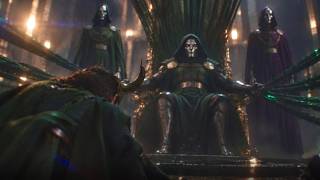


Make videos? Your next one could be an article here.
We turn your videos into articles under your name, linked back to the original. You keep 60% of what they earn, non-exclusive, and you can leave whenever you like.
Become a SubPlotter →