Agatha All Along episode 7 explained: Rio is Death
Death's Hand in Mine confirms Rio Vidal as Death and reorders Lilia Calderu's scattered life into one carefully built divination trial

Agatha All Along episode 7, Death's Hand in Mine, is a brilliantly constructed episode that reframes the entire series as a masterful act of divination by a forgotten witch. It also delivers the big confirmation that Rio Vidal is Mistress Death, the ex lover whose hand Agatha has been holding from the beginning. The Disney+ series (2024) stars Kathryn Hahn, Joe Locke and Aubrey Plaza.
The title comes from the second verse of the Ballad of the Witches' Road: "I stray not from the path. I hold death's hand in mine." This episode teaches that all paths lead to death, and that comes soon for Lilia. I think we learn there's a comfort in death accompanying us from the beginning, a relief that we don't have to control our destinies. We just have to accept and see the journey.
Lilia's ending echoes the tale of the three brothers
I'm reminded of the tale of the three brothers in Harry Potter and the Deathly Hallows, where the cleverest brother hides from death under a cloak of invisibility until he and Death can depart this life as equals. That's where I feel Lilia ends her journey: a witch of 450 years who hid from death her entire life, finally reaching relief and closing the loop of her very confusing life.
The opening seconds show Lilia's eyes waking in panic through a hazy yellow filter with a dark shadow moving in it. Is it the silhouette of the Scarlet Witch in the yellow glow of the Mind Stone? The part of the road Billy tossed her out of? The warm sun over her lessons with her maestra, or the murky yellow glow around the maestra in her death vision in episode 3? I think it's all of these things, but above all, it's death. Not a painful, violent death, but a gentle embrace.
Then Lilia falls through a black void, looking like Chris in Jordan Peele's Get Out falling into the sunken place. That's how she has felt during these lapses throughout her life, and her goal is to realize she's not falling down but up, like Miles Morales's upward dive in Into the Spider-Verse. Ironically, she's dressed as Glinda from The Wizard of Oz, who is not the witch who defies gravity. Glinda comes and goes by bubble.
Agatha dodges Billy's questions about Wanda and Rio
On the road, Billy can't read Agatha's mind, just as he couldn't when she babysat him and Tommy in WandaVision episode 7, and she calls herself his old babysitter here. Agatha seems almost desperate for Billy to depend on her. But when he asks where Rio is, the shot cuts away from Joe Locke and Kathryn Hahn's faces, which makes me wonder if the exchange was picked up in an ADR session and originally involved different questions. This is also the first close look at the back of Billy's sweater, where Joe Locke has said the costume designer stitched the Scarlet Witch's crown, and I think you can see it near the upper right shoulder blade.
In an interview, head writer Jac Schaeffer said the black heart text Billy received confirmed that Billy is the black heart Lilia drew on her coven list, and that Rio, aka Death, is the group's tourist. When Agatha calls herself his mom's ex best friend, Billy pushes back that he already has a mom. Since he pieced together his link to Wanda and Vision secondhand, it makes sense that his mother in William Kaplan's life is the most maternal figure he knows. The line also feels like a dig at Agatha's own mother issues with Evanora Harkness.
Asked if Wanda is dead, Agatha answers "Yes. No, maybe." The previous episode seemed to manage expectations that Wanda is permanently dead, but now it seems Marvel might want to keep the door open for her return beyond this show. Agatha says she saw a body, scored with three notes of Christophe Beck's WandaVision credits theme. I can't fully trust that answer, because the corpse only appeared in an Agatha illusion while she was under the spell. The common rule in TV and film holds: unless you see the body and the life leave the eyes, they aren't dead. Lines like "Ask a straight lady" show the series knows its audience and trusts them to let it be itself.
Lilia's castle fits my theory about the trial locations
The road's leaves are now yellow, making it a fitting yellow brick road, and the menacing trees recall the apple throwing trees from The Wizard of Oz, a scene I would always fast forward through. The medieval castle seems to confirm my theory that each trial location is the home, or inspired by the home, of the witch on trial, filled with something they dislike. Jen had a Martha's Vineyard beach mansion with poison wine, Alice had Lorna Wu's recording studio with the family curse, Agatha had her Salem cabin, and Lilia now has a 16th century Sicilian castle full of pop culture witch cosplay to irk her stance against the Halloween industrial complex.
Billy raises the theory we posed before, that Agatha might never have walked the road. I think he knows because much of its decor comes from his own bedroom, implying a true traveler contributes their creativity instead of showing up to parties someone else designed. Agatha looks shaken. I think she might have entered the road but never completed it, or took an escape hatch. Maybe Death even completed her final trial for her. I also think the distant castle is a practical miniature, perhaps 12 or 15 feet tall with backlit windows.
The drawbridge shows a waxing gibbous moon, a phase of refinement and preparation. Jen's trial had a full moon, Alice's a waxing crescent and Agatha's a blood moon. Unless Billy gets a quarter moon or a waning phase, I think his trial will be a new moon, the darkest time in the lunar cycle.
Agatha claims the Wicked Witch is based on her
Inside, Billy becomes Maleficent and Agatha the Wicked Witch of the West, with a pointed chin and nose like Margaret Hamilton's. When Agatha says "She's based on me, you know," she could mean L. Frank Baum's 1900 novel, but the MGM film she's dressed from came out in 1939, so I assume she means Hamilton's performance. The costume designer posted on Instagram that because Warner owns the 1939 film and the Disney villains are Disney animation, the designs had to be customized for clearance. Agatha's hat has a buckle and purple lace and her jacket has purple trim, which Hamilton's did not. I assume the chin and nose also avoid conflict with the Wicked musical's Elphaba, whose rights belong to Universal.
The dais reads "your path winds out of time," which I love as wordplay. It suggests a clock winding down, since every trial is on a timer and this one uses an hourglass, but also a path winding in and out of linear time, the way Lilia's does. Symbols beneath it match the table's outer ring of zodiac signs and inner ring of lunar phases.
Billy bluffs his way through the tarot trial
Once again Billy picks up the object that starts the trial, after the welcome card, the album and the Ouija board. He calls the Chariot a horse drawn carriage, the term of someone with Cinderella on the brain, then bluffs that it means Agatha is fleeing something. Upright, the Chariot actually represents success, ambition, willpower and control. Billy had tarot cards in his bedroom in episode 6, but he clearly hasn't learned the discipline.
Billy then reads the reversed Seven of Swords as truthfulness, but reversed it means impostor syndrome, self deceit and keeping secrets, which is what Billy shows by posing as an expert. Agatha flips cards at random as near mockery, the ceiling lowers in very Temple of Doom fashion, and Billy says he wishes Lilia was there.
Lilia becomes unstuck in time like Desmond in Lost
Heading into this episode, I speculated the series might structure Lilia like Desmond Hume in Lost's season 4 episode The Constant, whose consciousness flashes across his life before his mind scrambles, with a nosebleed as a warning sign. The theory seems correct, but this episode does something more technical. Rather than an emotional arc about love, it's a puzzle box connecting every unexplained phenomenon of Lilia, closer to The Bent-Neck Lady in Mike Flanagan's The Haunting of Hill House, where we revisit moments from a ghost's perspective as she falls through each memory.
Writers Gia King and Cameron Squires had to understand Lilia's objective chronology and reorder it so she reacts in real time, with each leap driven by emotional heightening and discovery. This is not an easy script to write, and they nailed it. When Lilia says "I was falling," she means her future fall, but Jen assumes she means the mud. Centered, Wes Anderson style framing shows Lilia focused only on each speaker's words, and the camera marks slips: a lateral pan, then a creepy dolly zoom as her warning, "Alice, don't try to save Agatha," finishes in episode 3 to the exact wrong person.
I've categorized this as type seven time travel, the unstuck mind, used for Billy Pilgrim in Kurt Vonnegut's Slaughterhouse Five, Wolverine in X-Men: Days of Future Past and Robin Hinton in Agents of S.H.I.E.L.D. Here it adheres to the MCU's general philosophy, what I call type four: this always happened. Unstuck mind is my favorite form because it suggests history changes us by giving us new insight, the way our minds relive memories we can't change.
Three visits to the maestra hold the structure together
Lilia loops back into her young body with her maestra, who senses she's "visiting." The garden matches Lilia's episode 3 vision but is full of life. The maestra says Lilia's belief that she was never good at tea leaves is a story she tells herself, calling it the easy road. Three visits, each about five minutes apart, mark the episode's three acts, so it's a very organized episode. I think the whole trial is the maestra teaching young Lilia her first lesson, which needs her older self to look down at the leaves with experience, like Wanda needing a vision of her future self in the Mind Stone's glow.
Back in the tunnel, Lilia states a rule: "The flow of time is an illusion, Jen." That's her take on Loki's season 1 finale, which sampled an Alan Watts lecture about time. Her line establishes that, for MCU characters whose wisdom is rooted in sorcery, we live on fixed, predestined paths we can step away from and revisit. We have to wonder if Lilia slipped only as a child because this journey loops back to give that girl her skills. Visually, a yellow root winds behind Jen's head, showing linear time, while Lilia is framed apart from it.
Lilia remembers Billy, and Agatha calls her Dory
Lilia lands pinned by Agatha, which pays off later when Agatha tackles her away from a falling sword. Seeing Billy for the first time since the mud, she calls him "teenager," as though it's his full name, a solid joke. Joe Locke and Jac Schaeffer have suggested Wanda's power brings emotional outbursts with collateral damage. Billy reads her thought that he should have saved Alice, and I love how much Lilia mourns her. With the sigil broken, she recognizes him from the bar mitzvah, and explains that she saw who he was and who he would become.
Agatha's Dory jab tells Lilia she's past her tunnel talk with Jen and has already urged everyone to forgive Billy, which explains his confusion. A flash to the kitchen scream from episode 2 shows her turning away from Agatha and Billy, and I love that these placeholders were planted from the beginning. On the second visit, Lilia says she's a fraud and a hermit with no coven. A Latin phrase on the table appears to mean be as swift as the wind in your sails, which makes me think of Lilia as a ship of Theseus. The maestra says, "Your task is not to control, but to see."
A champagne brunch gag hints that Lilia needs a coven. She finds Billy's lost spellbook, with moon phases on its band, and a bookshelf leads to the castle, recalling Interstellar's bookcase through time. For the first time she wills herself to a precise moment, her version of Gandalf arriving precisely when he means to: "Relax, baby. We're cool."
The safe passage spread and the Death card
Billy asks, "Am I William or am I Billy?" He'll likely have to be both. His Magician card, in a red robe and a crown like Wiccan's in the comics, suggests the potential to manifest reality, like Wanda. What's missing is the Sun, which could be wordplay on Tommy. Then the tackle sends Lilia through earlier scenes to her third maestra visit, the take step of Dan Harmon's story circle. She confesses she foresaw a fever, probably the great Italian plague, wiping out their coven. The maestra says "death comes for us all," which Lilia already said in episode 5. Her plunge is her future, not a memory.
Back at the first splat, Lilia rattles off everything she'd been fishing for. Chronologically it would be clunky exposition, but inverted it plays as catharsis. A WV Metro train, presumably Westview, seems designed as an escape hatch, which makes me think even more that Agatha was on the road before, but maybe took or built this early exit before she could finish the road. Lilia casts herself as the traveler, and each card recreates one seen all season: the Queen of Cups, the Three of Pentacles, the Knight of Wands for Alice, the High Priestess for Jen, the Three of Swords for a grieving Agatha, the Tower reversed for William, and finally Death. Aubrey Plaza holds the card's pose, half her face a skull but her iconic eyes kept, wearing a green crown as the original green witch.
Lilia chooses to let go of the path
A new tunnel of green roots opens, signaling a final battle of Agatha against Rio. Like the Wizard of Oz, Lilia leaves gifts: "When she calls you a coward, hit the deck." The midseason trailer showed Agatha ducking under some piece of debris that blasted out toward her in her fight with Rio. She returns Billy's spellbook, whose Latin phrase, it's not easy being green, the show's language consultant confirmed to me on Twitter was ordered by the producers. So I think it's a clue. She tells Jen she's the path ahead, and a promo poster shows Sasheer Zamata in a morgue trial.
Lilia sets the Tower upright, and the hourglass turns, suggesting she might have given herself more time. Only five of the Salem Seven are seen hitting the swords. I think all are probably dead, but the crow and cicada can fly, and the Tower card shows two figures exiting. Like Natasha Romanoff, Lilia lets go, her hand on the word path. She doesn't fall in panic now. She ascends into clarity, then returns to the maestra's "Let us begin." Jim Croce's Time in a Bottle in the credits nods to Evan Peters's Quicksilver scene in Days of Future Past.
The Constant is about finding purpose in the middle of life to love another. This episode is about finding purpose in the twilight of one's life. We all fear we're past our prime, but the wisdom we bequeath on the way out can be the most important thing we ever do. Dylan Thomas urged us to rage against the dying of the light. After this episode, I prefer the maestra's version.
Watch the original
@newrockstars · YouTube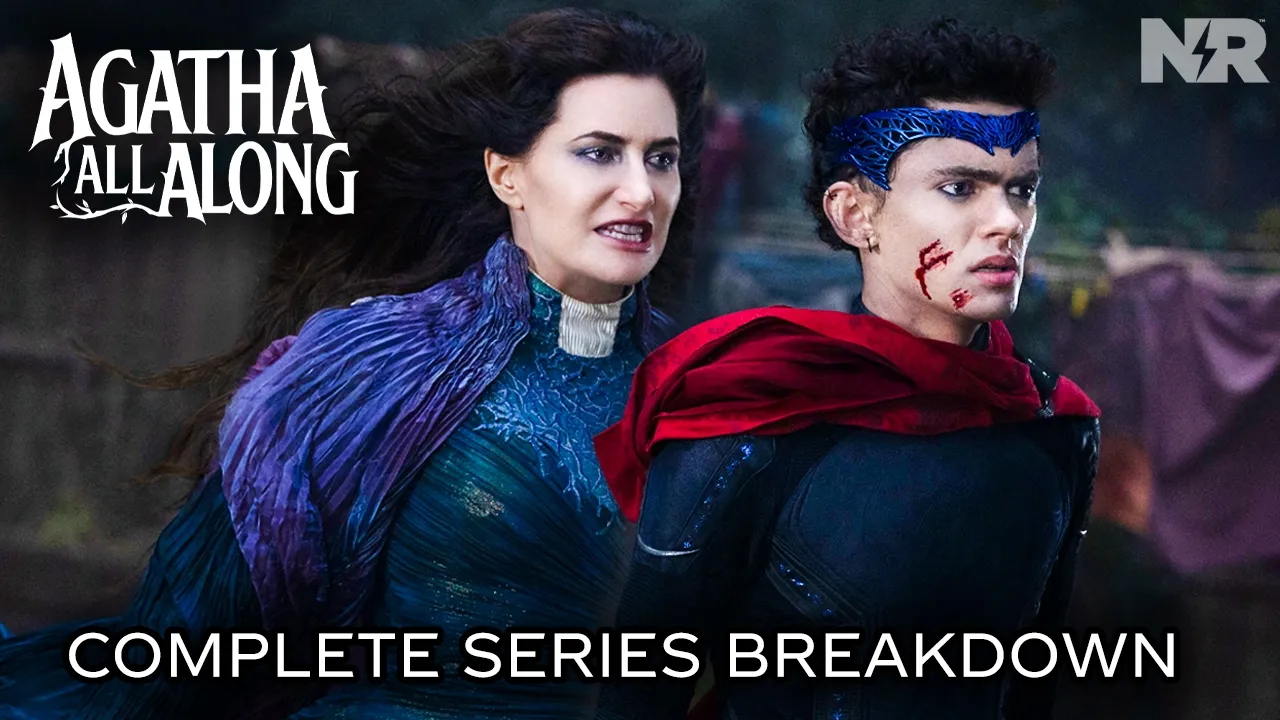
Adapted with AI from New Rockstars' video of 25 October 2026 and checked against the video before publication. Editorial standards · Corrections
Also on Agatha All Along
10 creators, 50 takes →


More from @newrockstars
All →
Make videos? Your next one could be an article here.
We turn your videos into articles under your name, linked back to the original. You keep 60% of what they earn, non-exclusive, and you can leave whenever you like.
Become a SubPlotter →