Fallout super mutants explained: who made them and why?
From FEV vats and Vault 87 to the Enclave and Ron Perlman's arrival in the series, the lore shows super mutants were made on purpose
 Film Paradise (AI-assisted)3 November 2026Editor: Digital Fox Talent Editorial TeamOn YouTube since 2023 · more than 58,000 subscribers

The first time you understand a super mutant, it isn't when one roars and swings a rebar club. It's when one speaks calm and sad, and your brain goes, there's still somebody in there. That's why the Fallout series (the show that debuted in 2024 starring Ella Purnell, Walton Goggins and Aaron Moten) dropping a real super mutant into its story hits so hard. To me, the scariest part of a super mutant isn't the muscles. It's the fact that somebody chose to build them.
The Fallout show's super mutant blames the people who made him
In the show, Cooper is busted up and half feral, and this massive stranger drags him to shelter like he's hauling a wounded dog off a highway. Then the giant says, "They call us abominations, but they created our kind."
He doesn't blame the wasteland. He points at people, at planners, at the ones who turned living bodies into projects and then tried to erase the evidence. That's what super mutants are in Fallout. They're not just big green enemies you farm for loot. They're the franchise's most brutal idea because they aren't an accident. They're a product, a living before and after photo of what happens when human beings treat other human beings like raw material.
FEV, the Forced Evolutionary Virus, is where super mutants begin
Super mutants begin with three letters that show up in Fallout like a curse: FEV, the Forced Evolutionary Virus. Even the name sounds like something a prewar boardroom would cheer for. Evolution, but faster. Evolution, but controlled. FEV is a manmade virus created before the bombs fell, tied to US military research and West Tek, with the dream of improving humans into super soldiers with bodies that keep going when everything else collapses.
The simplest picture is to think of DNA as an instruction manual. FEV doesn't flip one switch. It rewrites whole pages at once, then forces your body to follow the new instructions at top speed. That's the forced part. Your body doesn't get a vote.
By early 2077, the FEV project was moved into a hardened military facility at Mariposa, and human testing was part of what happened there. Fallout has always been blunt that the people running the world were willing to sacrifice lives for something useful. Then the Great War hits and civilization burns, but the virus survives in labs and bunkers like a loaded trap. That's when Fallout asks its nastiest question: if the world ends, do the people who caused it stop doing evil, or do they do it with fewer rules?
The Master's FEV vats and the sterility that doomed his plan
Super mutants happen when a human is exposed to FEV in a way that rewrites them. In the classic West Coast story, the most infamous method is dipping: submerging a person into FEV vats like dunking a tool into paint. The image is ugly on purpose. It turns a human life into an industrial step. In the earliest big super mutant storyline, a figure known as the Master builds a whole movement around this, taking humans, often by force, as part of a plan to unify humanity into one stronger species.
The Master's dream has a fatal flaw. Super mutants are sterile. That means every super mutant is cut off from the normal rhythm of life: no children, no natural future. It also means any group trying to build a race has to keep making new mutants the hard way, by taking someone else's humanity. In a brutal sense, a super mutant is always somebody's stolen son or daughter.
Even if a mutant finds a quiet life, there's a shadow over it: no legacy, no next generation. That's why the Master's plan falls apart. You can't replace humanity by accident. You have to keep forcing it.
Vault 87 turned a promise of safety into a mutant factory
Different Fallout stories show different pipelines for this horror. Sometimes it's vats, sometimes injection or exposure inside a sealed facility. In Fallout 3, the Capital Wasteland super mutants trace back to Vault 87 and its FEV experiment, where people inside the vault were turned into mutants after the war.
That's what makes it cruel. A vault is supposed to be a promise of safety, and Vault 87 turns that promise into a machine that manufactures monsters. It's like buying a life jacket and finding out it's made of concrete.
What FEV does to a super mutant's body and mind
On the outside, the changes are obvious: huge muscle growth, thick skin, heavy bone changes, and that hulking shape that makes a human look small standing near them. FEV is built to reinforce the body for extreme conditions, so super mutants tend to be tougher than humans in almost every way that matters in a fight. But it's not a superhero glowup. It's more like your body becomes a construction site that never shuts down. Your face warps, and your voice deepens and cracks into something harsh.
If you picture this happening gently, don't. Fallout loves its dark humor, but it also loves reminding you the apocalypse hurts. A human doesn't step into FEV and come out smiling. Even when a mutant survives the process, they often carry the feeling that something was taken that can't be returned.
FEV doesn't guarantee intelligence or stability either. Some mutants can talk, plan and feel regret. Others end up with reduced reasoning, shorter tempers and a mind stuck in one gear. Fallout lore ties that to strain, exposure and the subject's starting condition, especially how much radiation damage they had before the mutation. That detail is quietly brutal. Cleaner bodies tend to take the mutation better, which is why certain factions obsess over vault dwellers and other protected populations.
Why super mutants feel manufactured, unlike deathclaws and ghouls
Deathclaws feel like runaway predators. Radscorpions feel like nature turned up too high. Even feral ghouls feel like tragedy plus time plus radiation. Super mutants feel manufactured because they are. They exist because someone decided human beings were acceptable sacrifices, and the people doing it usually had a neat excuse: progress, defense, purity. Different mask, same face underneath: control.
That's why the show's super mutant calling himself and Cooper kin hits. Ghouls get treated like disgusting mistakes of the wasteland. Super mutants get treated like disgusting weapons. Both get blamed for what they are, while the real authors of the horror hide behind doors and titles. The show goes further by having the mutant heal Cooper with a glowing, radioactive looking substance, something like concentrated uranium or green radiation medicine. It's a reminder that in Fallout, some bodies adapt so hard to a poisoned world that the poison becomes food, or at least fuel. That's a power fantasy on the surface, but it's also body horror, because your survival is now tied to the thing that killed the old world.
Why super mutants are so strong, and why some keep growing
Super mutants are strong in a way Fallout makes feel unfair: swinging scrap metal like a bat, carrying heavy guns without shaking, shrugging off damage that would drop a human. Much of that is raw biology. FEV boosts muscle density, bone structure and resilience. It also tends to make them less vulnerable to sickness and harsh environments, which matters where infection can kill you faster than a bullet. Some strains also seem to keep changing over time. Fallout lore connects certain mutants to a growth pattern where older individuals become larger and more dangerous, which helps explain giant variants like behemoths.
The deeper danger is psychological math. If you were turned into something the world hates, can't go back, can't have children, and most people shoot on sight, you stop living like you have a future. Much of the violence in Fallout is grief that learned how to punch. Even their blunt way of talking isn't always a joke. Sometimes it's what happens when you wake up in a new body with missing memories, no schooling, and a world that only talks through a rifle barrel.
West Coast, East Coast and Commonwealth super mutants are not the same
People talk about super mutants like they're stamped from the same mold, but the truth is messier. Super mutant is more like a label slapped onto multiple waves of FEV experiments across different places and decades. The core idea is the same, human plus FEV equals something bigger and harder to kill, but the details depend on who made them and what strain they used.
West Coast mutants tied to the Master's era include more individuals who can reason and organize, because his plan depended on building a functioning society, not a pack of brutes. East Coast mutants, especially the Fallout 3 wave, often come off more savage and single minded, shaped by the Vault 87 pipeline and the brutal environment around it.
Then there's the Commonwealth, where Fallout 4 reveals that a secret scientific faction, the Institute, was experimenting with FEV, turning abducted people into super mutants, then dumping them back into the world once the project didn't give them what they wanted. Those mutants didn't migrate from anywhere. They were made locally in a basement lab and discarded like failed prototypes. That pattern, make the monster, lose control of it, pretend it isn't your fault, is the Fallout mission statement.
Marcus, Jacobstown and the nightkin show not every super mutant stays a monster
Here's what gives super mutants emotional weight instead of only fear: not all of them stay violent or lose themselves. Fallout keeps circling back to rare mutants who hold on to personality and purpose, who can lead, negotiate and try to protect others. In New Vegas, a settlement called Jacobstown was built as a refuge, especially for mutants and nightkin who are struggling. Its leader, Marcus, isn't portrayed like a cartoon villain. He's an old soldier exhausted from being treated like a mistake, trying stubbornly to build something better. Sometimes the monster is what happened to them. Sometimes it's what the world keeps doing to them after.
Nightkin are a special kind of super mutant tied to heavy use of the Stealth Boy, the tech that lets them turn invisible. Fallout lore is direct that prolonged Stealth Boy exposure can cause serious mental problems, including paranoia and symptoms like schizophrenia. So you get huge invisible fighters hearing voices, splitting personalities, sliding in and out of reality. It's terrifying from the outside and heartbreaking from the inside: addiction plus trauma plus mangled brain chemistry inside a body that can tear a door off its hinges. Jacobstown treats nightkin like patients, not just threats, with a push to help and stabilize them, because that community knows what it feels like to be written off as hopeless.
The Enclave and the Curling-13 strain
If super mutants are the weapon, the Enclave is one of the groups that treats the weapon like a holy tool. They're the worst parts of prewar power refusing to die: militarized, secretive, obsessed with control, and obsessed with the idea that they are the real America and everyone else is contaminated. Fallout 2 lore includes the Enclave developing a tailored FEV strain known as Curling-13, designed as a genocide weapon to wipe out mutated life outside their own protected population. That's not saving the world. That's burning the world and calling the ash clean.
It puts super mutants in a nightmare position. They're hunted as threats, but they're also living proof of what these pure factions did behind closed doors. They're the receipts that breathe. So when the show's super mutant points to the Enclave and says they created his kind and then tried to forget them, it doesn't feel random. It feels like Fallout lining up a theme it's always loved: the powerful commit a crime, then brand the victims as the problem.
How Fallout season two pulled FEV back into the story
What's exciting, and a little terrifying, about the show's approach is that it isn't treating super mutants like a single creature feature. It ties them to the same big forces haunting the story: secret factions, corporate power, and the idea that the end of the world wasn't only a tragedy, it was managed.
Season two flashed FEV into the story like a door swinging open. Norm accesses a terminal at the old Vault-Tec headquarters and sees FEV described as a gene altering agent for organism supercharging, but he's interrupted before he can learn more. That's classic Fallout: a glimpse of the truth, then somebody slams the door, because knowledge is power and power is hoarded. Episode 6 went further, teasing that FEV is an active thread in the present and suggesting somebody out there still has the recipe. Once FEV is active again, it isn't only more monsters. It's more people deciding who gets to be human and who gets to be something else.
The show put a face on that escalation with a perfect piece of casting: Ron Perlman as a super mutant. The man who is the voice of Fallout's famous war never changes line is now physically in the wasteland as a living consequence of that war.
Super mutants are living evidence of a choice
Mechanically, a super mutant is a human exposed to FEV. Thematically, it's a warning label written in flesh: proof that progress can be a horror story when the people in charge stop seeing human beings as people, and that the wasteland's worst monsters were built by hands that wore suits and carried badges. This new super mutant isn't just there to look cool or scary. He's there to remind you that the outcasts didn't forget who did this. If Fallout is setting up what it looks like when ghouls and mutants stop being hunted and start pushing back, the wasteland might get a whole lot louder.
Super mutants aren't only enemies. Somebody built them on purpose and told the world to fear the result. If the show is pulling FEV back into the spotlight, the next wave won't be some random wasteland accident. It'll be a choice, made behind closed doors by someone who thinks they're saving the world while they're breaking it all over again.
What other creators are saying
More on Fallout →From a cushy bunker childhood built on her father's lies to a mercy killing that changes everything, Lucy's journey takes her from naive to wiser without losing her kindness
Bethesda confirms Obsidian is working with it on a new Fallout project, reportedly led by the director of New Vegas, but layoffs, cancellations and a lot of unknowns mean the excitement comes with caveats.
Watch the original
@film_paradise · YouTube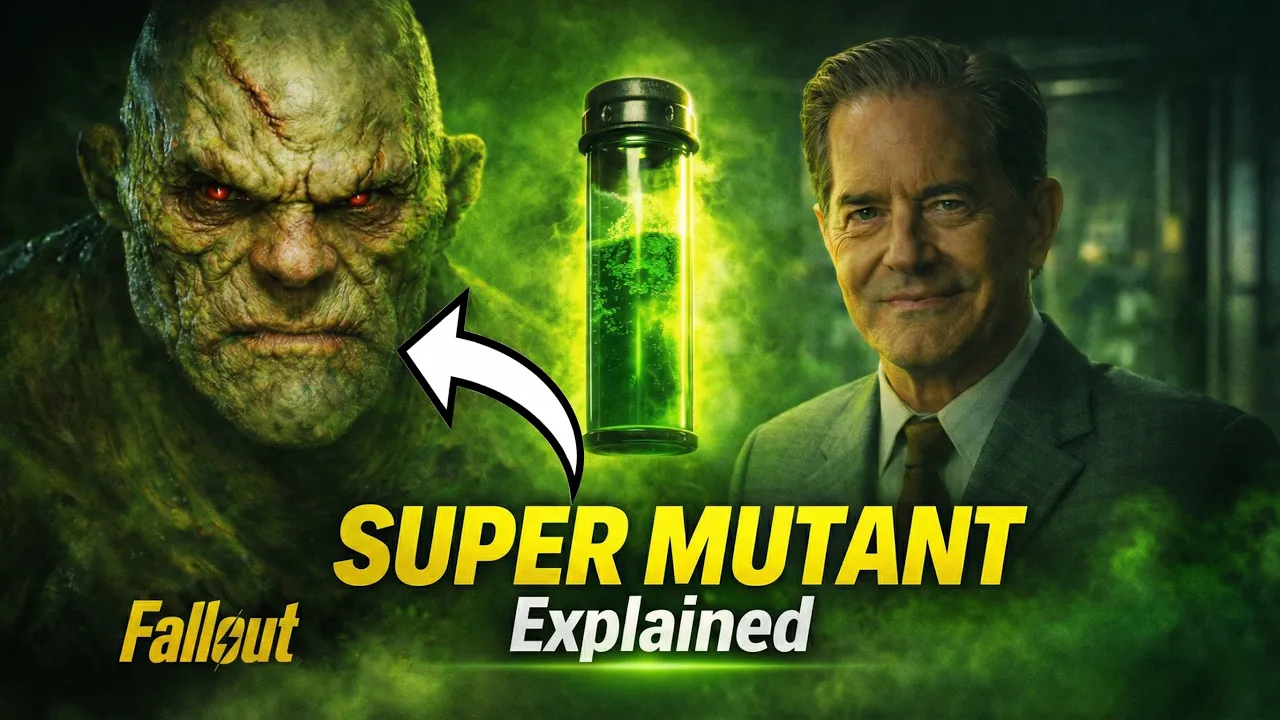
Adapted with AI from Film Paradise's video of 22 January 2026 and checked against the video before publication. Editorial standards · Corrections
More from @film_paradise
All →


Make videos? Your next one could be an article here.
We turn your videos into articles under your name, linked back to the original. You keep 60% of what they earn, non-exclusive, and you can leave whenever you like.
Become a SubPlotter →