The Enterprise-E May Never Have Fully Fixed History in Star Trek: First Contact
Cochrane's stories, Borg wreckage in the Arctic and centuries of temporal meddling suggest the timeline Picard saved was quietly changed

What if the crew of the Enterprise-E failed to save history? I don't mean in the way most people think. Earth wasn't assimilated and the Borg didn't win, but my theory is that restoring history and restoring a timeline aren't necessarily the same thing, and that the Enterprise-E may have saved humanity while also changing history forever.
In Star Trek: First Contact (1996), starring Patrick Stewart, Jonathan Frakes and Brent Spiner, Zefram Cochrane still launched the Phoenix. The Vulcans still arrived, and humanity still began its journey toward the Federation. On paper, everything worked exactly as it was supposed to. For nearly 30 years, Star Trek fans have treated those events as a closed loop. The Borg traveled back to 2063, Picard followed, the invasion was stopped, history was preserved, end of story.
Except the story doesn't quite end there. After First Contact, Star Trek begins leaving behind clues that something may have survived the incursion. Cochrane somehow remembers stories about cybernetic aliens from the future. Borg technology is left behind on Earth, and almost a century later those Borg are discovered in the Arctic and begin assimilating people long before humanity is supposed to know they exist. Temporal conflicts become increasingly common, and entire factions start treating history itself as a battlefield.
Individually, none of those things prove anything. Together, they raise an uncomfortable possibility: that history was restored just enough for the Federation to exist while countless smaller details quietly shifted beneath the surface. This isn't a theory about what's canon, and it isn't an argument that one Star Trek series counts and another doesn't. It's the opposite. What if every Star Trek series is showing us the same timeline, just not the timeline Picard left behind?
In Star Trek: First Contact, the Enterprise-E crew took part in 2063 rather than observing it
To understand this theory, we need to go back to the moment everything supposedly went right. In First Contact, the Federation is losing. The Borg launch a direct assault on Earth, Starfleet is overwhelmed, and the battle is turning into a disaster. Then, just as defeat seems inevitable, the Borg change tactics. Instead of conquering the Federation in the present, they decide to erase it from history.
Their destination is April 5th, 2063, the day Zefram Cochrane launches the Phoenix, the day humanity makes first contact with the Vulcans, the day the future begins. If that moment is erased, everything that follows disappears with it. No Federation, no Starfleet, no Enterprise. The Enterprise-E follows the Borg through the temporal vortex with a straightforward mission: stop the Borg, protect Cochrane and restore history. By every obvious measure, they succeed. The Borg are defeated, the Phoenix launches, the Vulcan survey ship lands.
But when you look closely at what happens during the film, the situation becomes much less tidy. Geordi helps Cochrane repair the Phoenix. Riker spends time with him. Troi shares drinks with him. Lily Sloane walks the corridors of a 24th century starship. Cochrane sees technology centuries beyond his own era and meets people who know exactly who he is and why history remembers him. This isn't the sort of accidental interaction Kirk stumbled into once or twice. The future practically moves into Cochrane's front yard.
Most people come away from the film believing history was restored because the important events still happened. But history doesn't have to be rewritten overnight to be altered. Sometimes all it takes is a conversation, a memory, a story told years later, and First Contact is full of those moments. What's striking is that Star Trek never shows history correcting itself afterward. We assume everything returned to normal because that's how time travel stories usually work. If history truly snapped back into place, there shouldn't be any trace that the Enterprise-E was ever there. Yet as the franchise moves forward, traces appear anyway.
Star Trek: Enterprise's Regeneration suggests Zefram Cochrane may have remembered the Borg
Every theory reaches a point where it has to stop asking questions and start producing evidence. If First Contact truly left a mark on history, we should be able to find proof that something from the future remained behind after the Enterprise-E returned home. In Star Trek: Enterprise, we may have been given exactly that.
Enterprise has an episode called Regeneration. Most fans remember it because it brings the Borg into Archer's era, but before the episode reaches the Borg, it quietly drops a detail that should be impossible. Archer recalls finding "the speech Zefram Cochrane made 89 years ago" in a database, in which Cochrane talked about what really happened during first contact. "He mentioned a group of cybernetic creatures from the future who tried to stop his first warp flight when he was living in Montana," Archer says, adding that Cochrane said they were defeated by a group of humans who were also from the future.
It's an easy line to overlook, but it creates a problem. How does Cochrane know any of that? The historical Cochrane wasn't supposed to know what the Borg were, that humans from the future visited him, or enough to spend years talking about those experiences. The simplest explanation is that Cochrane remembered it all, and there's no reason to believe he didn't. His mind wasn't wiped. Perhaps he doesn't remember every detail or every conversation, but he remembers enough for those stories to survive nearly a century later. And if that's true, then history wasn't restored to its original condition. Something remained.
Calling First Contact a predestination loop doesn't make the problem go away
Some fans would argue this is perfectly normal. Maybe Cochrane was always supposed to tell these tales. Maybe these events were always part of history, and First Contact isn't changing the timeline at all but completing a predestination loop. I'll grant that's a reasonable interpretation. But notice what happens when we accept it. The problem doesn't disappear. It just changes shape.
Now we're saying the Federation was always built on information that originated in its own future. Cochrane was always influenced by people who hadn't been born yet, and the future was always shaping the past. Whether you call that a changed timeline or a predestination loop, the result is remarkably similar. History is no longer self contained. The future has entered the equation.
And Cochrane isn't just anyone. He's one of the most influential individuals in human history. Entire generations study his work, engineers build on his discoveries, and Starfleet Academy teaches his legacy. The Federation itself traces its origins to a flight he made from an old missile silo outside Bozeman, Montana. When someone like that gains knowledge they were never supposed to have, the consequences are more likely to be subtle than dramatic. Maybe he asks different questions or funds different projects. Maybe a story he tells inspires a future scientist, or a casual conversation changes someone's career.
History rarely changes through a single grand moment. More often, it changes through countless small decisions made by people who have no idea they're altering the future. That's why Cochrane matters so much here. Not because he invents Borg technology or transforms humanity overnight, but because he represents proof that information crossed the boundary between future and past and stayed there. And if memories can survive a temporal incursion, it becomes much easier to imagine that something far more dangerous survived as well.
Borg wreckage under the Arctic ice is the smoking gun
If Cochrane's memories are the first clue, the Borg are the smoking gun. When the Enterprise-E leaves 2063, it doesn't take the entire future back with it. At the end of First Contact, Borg drones die on Earth and pieces of Borg technology are scattered across it. Portions of the destroyed Borg sphere crash onto the planet's surface. In most time travel stories, those details would disappear into the background. Star Trek doesn't let that happen.
Almost a century later, Enterprise returns to those wreckage sites. Buried beneath Arctic ice, researchers discover the remains of the Borg incursion, and that's where the theory stops being about memories. Memories can be dismissed. Artifacts can't. Humanity's first encounter with the Borg is supposed to happen in Picard's era, which is part of what makes them so terrifying in The Next Generation: they're unknown, mysterious, an enemy from beyond the Federation's experience. Yet in Archer's century, Borg drones are thawed from the ice. They begin assimilating people, steal a vessel and attempt to contact the Collective. Unlike Cochrane's stories, this isn't secondhand information. It's a documented historical event.
The common explanation is usually one of two things: either Enterprise created a continuity problem, or this was always part of the timeline. For this theory, it doesn't matter which you prefer, because both create the same result. If it was always part of the timeline, humanity's history was always influenced by a future Borg incursion. If it wasn't, the Enterprise-E changed history. Either way, the line separating past and future has already been crossed.
The Borg don't need to assimilate Earth or conquer humanity. Their mere presence creates consequences. A signal is sent toward the Delta Quadrant. Knowledge enters the historical record. Questions are raised that would never have existed otherwise. Even if those effects are small, they're still effects, and that's the heart of this theory. The timeline wasn't restored to its original condition. It continued forward carrying baggage from the future. Small things, I'll grant, but the sort of things nobody would notice immediately.
The Temporal Cold War and Admiral Janeway show a timeline under constant pressure
Maybe Cochrane remembering the future and the Borg being discovered early were just the first visible signs of something larger. If the Enterprise-E altered history, we shouldn't expect the effects to appear immediately. For generations, everything would appear normal, which is what makes the theory so difficult to spot. A timeline doesn't need to collapse to be changed. Most changes hide beneath the surface, buried inside events that seem unrelated until enough of them accumulate. Time travel becomes easier, temporal interference becomes common, and entire sections of history begin attracting attention from people who haven't been born yet.
Throughout Enterprise, Archer repeatedly finds himself caught between factions from the future manipulating events across centuries. Entire civilizations are influenced by people who exist hundreds of years ahead of them. The future isn't merely observing history anymore. It's competing for it. Now, the Temporal Cold War doesn't prove First Contact damaged the timeline. That would be a stretch. But it does reveal that by the 22nd century, temporal interference is significant enough that multiple factions are fighting over the shape of history itself. That's not the environment you'd expect in a perfectly stable timeline.
Consider Admiral Janeway. Not captain, admiral. In the finale of Voyager, she does something that would have horrified most Starfleet officers a century earlier: she deliberately changes history. She travels into the past, changes the fate of her crew, changes Starfleet's future and destroys a Borg transwarp hub that originally survived. What's striking isn't that she succeeds. It's that by this point, the idea feels almost normal, because we've seen history rewritten too many times already.
That's where the pattern emerges. The Enterprise-E intervenes in 2063. The Borg become part of Earth's history. The Temporal Cold War turns history into contested territory. Janeway rewrites the future. The Department of Temporal Investigations is created to manage a growing list of temporal incidents. Each event can be explained individually. Together, they paint a picture of a timeline being repeatedly touched, altered, defended and rewritten. Maybe that's what we're seeing: not one catastrophic collapse, but a small disruption in 2063 followed by centuries of additional interference, until the cracks are no longer hidden.
Discovery, Strange New Worlds, Picard and Lower Decks may be symptoms of a drifting timeline
If the Enterprise-E truly altered history, the timeline wouldn't become unrecognizable. It would become different. The Federation still forms, Starfleet still explores the galaxy, and Kirk, Picard and the Dominion War are all still there. That's exactly what makes this theory so difficult to disprove. Yet the farther we move from 2063, the more signs we see that the timeline is accumulating change. I see the later eras of Star Trek not as proof, but as symptoms.
Enterprise, which should have been a straightforward story about the birth of Starfleet, takes place in a century already influenced by future events. The foundation itself has already been touched. For seven seasons of Voyager, the crew repeatedly encounters temporal anomalies, alternate futures and timeline disruptions, and the series ends with one of the largest deliberate alterations in the franchise's history. By the end of the 24th century, changing history is no longer a theoretical possibility. It's something Starfleet officers actively do.
Viewed through that lens, the later series become fascinating. Discovery presents a Federation facing challenges earlier generations never imagined. Strange New Worlds often feels familiar while also feeling a little different from the future The Original Series seemed to promise. Picard shows a Federation that is older, more cautious and less certain of itself than the one Picard once served. Even Lower Decks, despite its comedy, treats temporal incidents as something bordering on routine.
Again, none of it proves the theory. The goal isn't to argue that one show is right and another is wrong. It's to ask whether these differences might be exactly what we should expect if history has been absorbing temporal interference for centuries. The timeline doesn't need to break or split into a dozen alternate realities. It only needs to drift, and over hundreds of years those small differences compound until the future looks familiar without being identical. Not a different timeline, a changed one. If the Enterprise-E altered history in 2063 and those changes kept spreading for centuries, how would anyone know the timeline had ever changed at all?
What other creators are saying
More on Star Trek →I rank William Riker as Star Trek's best first officer, edging out Spock for the top spot because he handles nearly every part of the job, from routine crew management to challenging Picard when necessary. Spock comes close but his struggles leading emotional crews cost him the edge.
Star Trek first officers ranked: is Riker better than Spock? →
One card plays artifacts from the top of your library, and the other rewards facing a dilemma with free spells
Zefram Cochrane and the Caretaker among Magic: The Gathering Star Trek preview cards →
A Romulan War buildup, a Mirror Universe miniseries, the Borg Queen's origin and a refitted NX-01 were all part of the plans for a season that never got made
Tomorrow's Enterprise plays less like classic Kirk and Spock and more like Next Generation's All Good Things, and the people who made it are calling the future we saw continuity.
Strange New Worlds finale: the original series' lost ending →
Watch the original
@lorereloaded · YouTube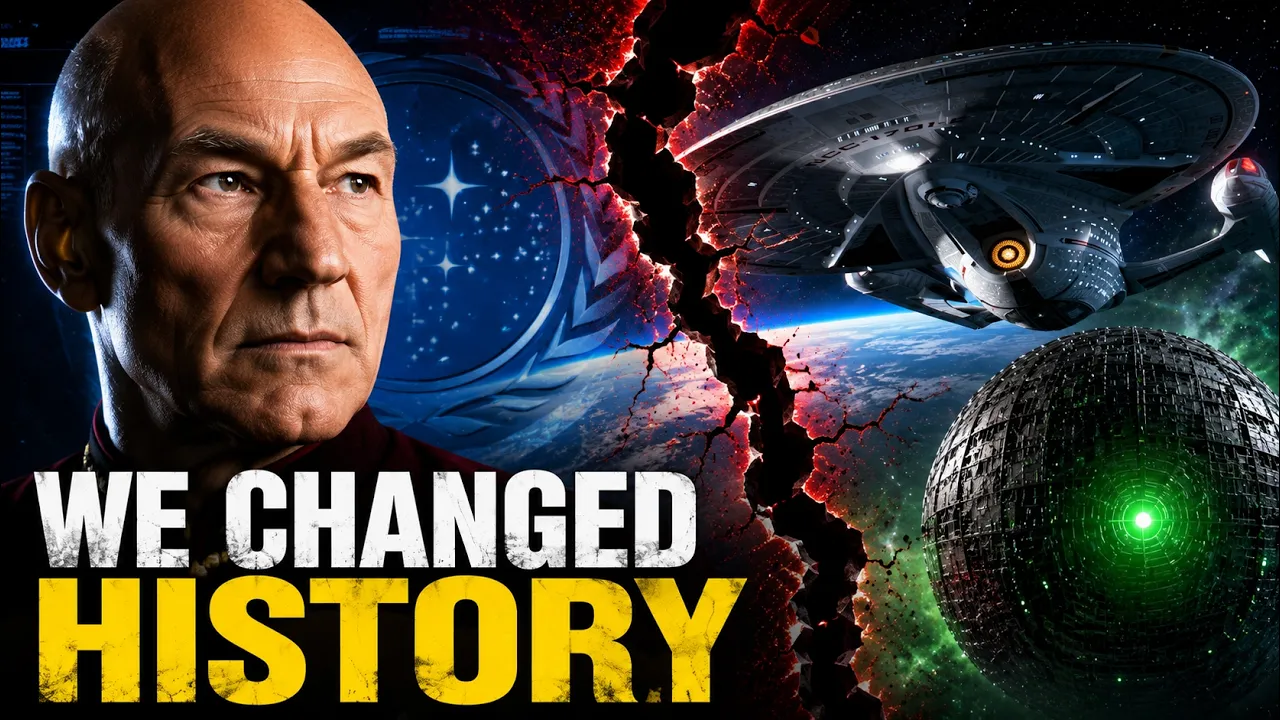
Adapted with AI from Lore Reloaded's video of 7 June 2026 and checked against the video before publication. Editorial standards · Corrections
More from @lorereloaded
All →


Make videos? Your next one could be an article here.
We turn your videos into articles under your name, linked back to the original. You keep 60% of what they earn, non-exclusive, and you can leave whenever you like.
Become a SubPlotter →