Star Trek theory: did Q's snap start the Dominion War?
A Star Trek theory traces a chain from the Borg and Wolf 359 to Benjamin Sisko, the Bajoran wormhole and the Dominion
 Lore Reloaded (AI-assisted)16 November 2026Editor: Digital Fox Talent Editorial TeamOn YouTube since 2016 · more than 140,000 subscribers

The Dominion War may not have begun in the Gamma Quadrant at all. My theory is that its roots stretch back to 2365, to the moment Q snapped his fingers and hurled the Enterprise into the path of the Borg. From that moment forward, a chain of events began that would eventually lead to the largest war the Federation had ever fought.
The war is at the heart of Star Trek: Deep Space Nine (1993), starring Avery Brooks. It's one of the most brutal conflicts in Starfleet history, and there are many reasons why it happened. Some are obvious and some are not.
The usual explanations for the Dominion War, and the one people miss
Some point to Cardassia's betrayal of the Alpha and Beta Quadrants, which gave the Dominion the foothold it needed to wage war. Others argue the Federation's ambition played a role: Starfleet refused to respect Dominion claims and failed to truly pursue diplomacy. Then there are the Founders themselves, whose fear and bigotry toward solid species made conflict almost inevitable.
But history is rarely shaped by a single catastrophic failure. More often, great events are the result of smaller decisions. These are moments that seem insignificant at the time but slowly cascade into something much larger. That raises an uncomfortable question. What if the war that erupted in 2373 didn't truly begin in Bajoran space or at the wormhole, but years earlier, with Q?
Q's 2365 lesson: the Federation wasn't ready for the Borg
In 2365, Q had one defining opinion of humanity and, ultimately, the Federation. They were arrogant. Worse, they were not ready for what was coming. When Q tells Picard, "You're not prepared for what awaits you," Picard answers that he knows they are ready to encounter it, because that's why they're out there. Q's reply says it all: "Oh, the arrogance."
Picard seemed to embody that arrogance. He believed humanity had advanced beyond its past mistakes and that the Federation had matured enough to face whatever the galaxy might throw at it. But Q and Guinan knew better. Starfleet had judged itself by the enemies it already understood. It did not imagine the ones it had yet to face.
So Q changed everything. The Enterprise found itself 7,000 light years away, near the system J25, face to face with the Borg. They were an alien species both organic and cybernetic, driven by a singular goal: perfection through assimilation. Q would eventually return the Enterprise home, but the lesson was unmistakable. The Federation had no idea what waited in the darkness beyond the borders of explored space.
Wolf 359 broke Benjamin Sisko in 2367
The next lesson came two years later, in 2367. It arrived in many forms, to many people and institutions, but one of the hardest fell on a single Starfleet officer, Benjamin Sisko. Sisko believed in the Federation dream so deeply that he brought his family aboard his ship, convinced Starfleet was a safe place for them to live and grow.
That belief died at Wolf 359. When the Borg cube tore through Starfleet defenses, Sisko arrived too late to save the one person who mattered most. During the battle he found the body of his wife, Jennifer. Her future, and the future they had planned together, was extinguished in less than an hour of combat.
That moment changed him. The officer who had once built ships for exploration would now dedicate himself to building ships and weapons for war, not for science or discovery, but to destroy the beings who had destroyed his life. Disillusioned with Starfleet and the dream he once believed in, he withdrew from the future he had imagined for himself. Eventually Starfleet reassigned him to a forgotten station on the edge of Federation space, Deep Space Nine.
No matter how much time passed, Sisko never truly left that moment. When the Prophets later encountered him in the Bajoran wormhole, they told him, "You exist here." He was still living in the moment his world ended. He was capable, intelligent, tactical, compassionate and broken. Sisko was not a victim of Wolf 359. He was the consequence of a lesson Starfleet and humanity had to learn.
How Sisko found the Bajoran wormhole in 2369
In 2369, Sisko found himself on a shattered frontier world. Bajor had suffered for decades under brutal Cardassian occupation, leaving behind a wounded society, a fragile government and a population struggling to rebuild. In the larger scope of the Alpha and Beta Quadrants, Bajor was not considered particularly significant.
Sisko took the assignment seriously. As commander of Deep Space Nine, he worked to stabilize Bajor and guide it toward a future where it might one day join the Federation and take its seat on the Federation Council. Yet his mind was not on Bajor, diplomacy or governance. He intended to resign his commission once his work was complete and return to civilian life.
Then the man who had watched the Borg kill his wife discovered something extraordinary: the Bajoran wormhole, a stable corridor connecting the Alpha Quadrant to the distant Gamma Quadrant. Almost overnight, Bajor became one of the most strategically important locations in known space. Trade expanded, exploration surged, and Bajor became a center of commerce, diplomacy and cultural exchange. For a brief moment, the future seemed bright.
The Dominion came through the wormhole
But the Gamma Quadrant was not empty. The Federation soon encountered an enemy it had never imagined: the Dominion, a powerful empire built on control and fear. It believed peace would only exist if every government, civilization and species existed under its authority. Like the Borg, the Dominion believed in a kind of perfection. Unlike the Borg, it did not simply assimilate its enemies. It manipulated them.
Through espionage, infiltration and careful political pressure, the Dominion worked to isolate the Federation from its allies. It drove wedges between established powers, weakened relationships with the Klingons and spread suspicion throughout the quadrant, including among the Romulans. Tensions escalated until they erupted into open conflict, a war that would claim hundreds of thousands of lives and leave entire regions of space scarred for decades.
It all began with the discovery of a single doorway between two quadrants. That doorway might never have been opened if Sisko had never been assigned to Deep Space Nine. And that assignment may never have happened if Q had never decided humanity needed a lesson.
Did Q know his Borg lesson would lead to the Dominion War?
The central question in this theory is whether Q knew what the consequences of his actions would be. Q has never openly claimed to be truly omnipotent or omniscient, but his abilities make one thing clear: the Q are not bound by time the way humans are. They move through it, observing events, altering them or occasionally nudging them in new directions. Because of this, it's difficult to imagine Q would not understand the ripple effects of what he did. He likely understood the consequences would spread far beyond that single encounter.
Many have argued that without the Borg, the Federation would never have been prepared to defeat the Dominion. There is truth to that. The Borg forced Starfleet to rethink its defenses, its tactics and even the design of its ships. But the Borg attack also changed Sisko and ultimately placed him on Deep Space Nine, the one place where the Dominion would eventually enter the Alpha Quadrant.
Without the wormhole, the Dominion and the Federation may not have encountered each other for hundreds, perhaps thousands, of years. Someone else might eventually have found it. But Bajor had been occupied by the Cardassians for decades, and during that entire time the wormhole stayed hidden. It was only discovered after Sisko deliberately went searching for the strange readings that revealed its location.
Who are the Q? Punishment or preparation
So why would Q set these events in motion? Perhaps that's the wrong question. A better one is: who are the Q? They are never entirely forthcoming about their nature. When they interact with Picard, Janeway or others, their explanations often border on unreliable. They don't necessarily lie, but they frequently leave out important truths and let others draw their own conclusions. Sometimes they act as judges of humanity, sometimes as mischievous tricksters meddling for their own amusement.
There may be another possibility. Perhaps the Q see humanity and the Federation not as a curiosity or a toy, but as something worth guiding. Before sending the Enterprise into the path of the Borg, Q warns Picard that the galaxy is far more dangerous than the Federation understands. Perhaps this was never truly a punishment. It could have been preparation, and the theatrics may serve a purpose.
History suggests humanity rarely learns from warnings alone. Picard himself demonstrates this. Time and again he insists the Federation listens and adapts, yet it often continues down the same path until it is forced to confront the consequences directly. Q may have recognized that you can't simply tell humanity the truth. They have to experience it, both the Borg and the crushing devastation of the Dominion. From Q's perspective, humanity may have been heading toward annihilation, and that was something he would never allow, even if humanity had to get a bloody nose first.
The Prophets of Bajor and Sisko, the Emissary
Q may not have been the only force shaping these events. The Prophets of Bajor also have powers that border on the divine. They never called Sisko commander or captain. To them, he was the Emissary. And they were not merely involved in his life; they were responsible for it. Through their influence on his mother, they ensured that Benjamin Sisko would be born. The man who would discover the Bajoran wormhole was the man the Prophets had already chosen.
Their influence didn't end there. During the Dominion War, when a Dominion fleet tried to pass through the wormhole to reinforce Cardassia, Sisko asked the Prophets for help. They simply removed the fleet from existence, something no fleet, empire or government in the Alpha Quadrant could have done. From that moment on, no additional Dominion fleets ever emerged from the wormhole.
So two immensely powerful entities both shaped Sisko's life. One ensured he would exist; the other ensured he would be exactly where he needed to be. Were they aware of each other? There is no evidence the two groups worked together, and it's entirely possible each acted independently. But if so, the result is even more remarkable: two godlike powers that perceive time differently than we do both placed their hands on the same piece of history. When powers like that move in the same direction, even unintentionally, entire quadrants can change.
Q's two-part lesson: the Borg, then the Dominion
The stated reason, at least indirectly, for introducing the Enterprise to the Borg was simple. Q believed Starfleet was not prepared. Humanity believed it understood the galaxy; Q disagreed. There were civilizations out there that were not merely different but dangerous. That had to be demonstrated and experienced, and tragically, it had to cost lives.
It's entirely possible that Q already understood the chain reaction that would follow: the Borg, Wolf 359, Sisko, Deep Space Nine, the Bajoran wormhole and eventually the Dominion. If so, the lesson had two parts. The first was the Borg, a cybernetic collective from the Delta Quadrant. The second was the Dominion, an empire from the Gamma Quadrant. Both were slaver states in their own way, two existential threats from opposite ends of the galaxy.
The effects of that lesson can't be overstated. After the Borg, ships like the Defiant class, the Akira class and the Intrepid class reflected a Federation no longer building vessels solely for exploration. They were designed to survive and, if necessary, fight. The Dominion War accelerated that, turning an organization that once placed families aboard its ships into a force blending science, diplomacy and military necessity.
When all of this comes together, it becomes difficult to ignore the possibility that none of it was accidental. Starfleet did need to learn a lesson, and Q made sure it did: first when it met the Borg, and very likely when it met the Dominion as well. If that's true, the Dominion War didn't begin at the Bajoran wormhole. It began the moment Q snapped his fingers.
What other creators are saying
More on Deep Space Nine →A weapon never seen on screen, an earlier name, and a close call in First Contact
Star Trek (2009) and The Force Awakens share a director, a reboot mission and the start of a trilogy
J.J. Abrams Played an Almost Identical Role in Star Trek and Star Wars →
One card plays artifacts from the top of your library, and the other rewards facing a dilemma with free spells
Zefram Cochrane and the Caretaker among Magic: The Gathering Star Trek preview cards →
A Romulan War buildup, a Mirror Universe miniseries, the Borg Queen's origin and a refitted NX-01 were all part of the plans for a season that never got made
Watch the original
@lorereloaded · YouTube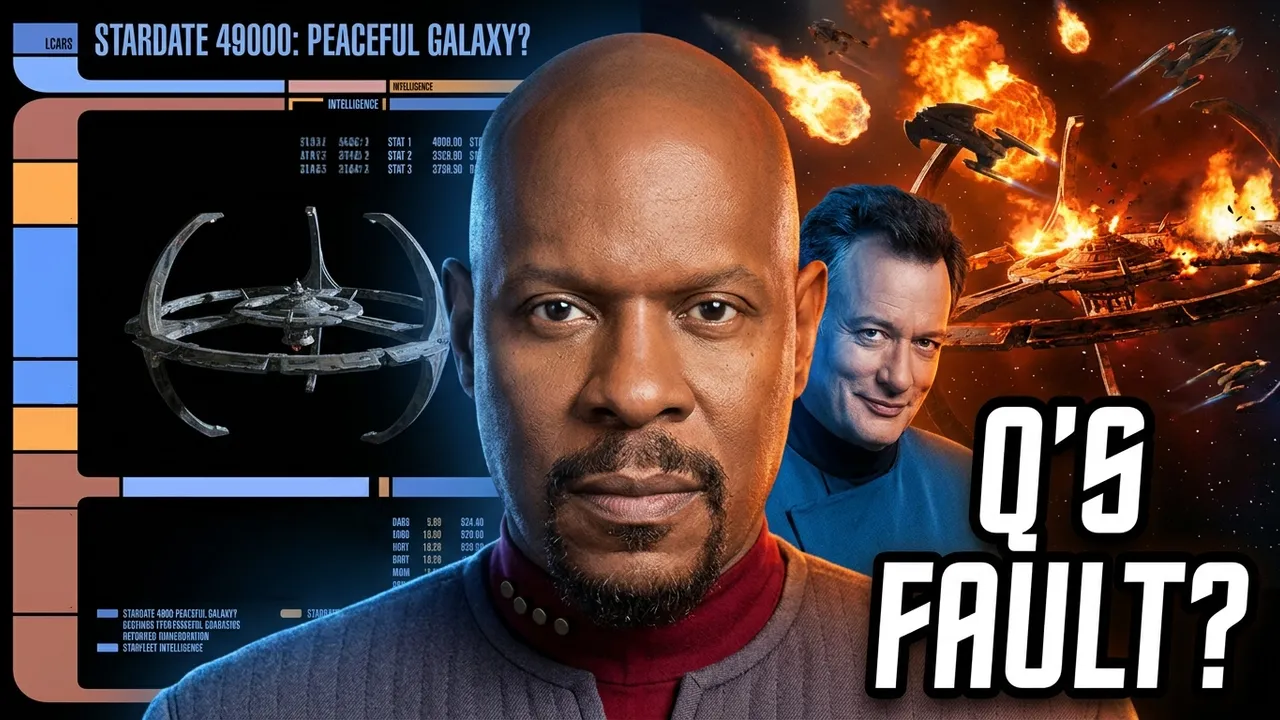
Adapted with AI from Lore Reloaded's video of 15 March 2026 and checked against the video before publication. Editorial standards · Corrections
More from @lorereloaded
All →


Make videos? Your next one could be an article here.
We turn your videos into articles under your name, linked back to the original. You keep 60% of what they earn, non-exclusive, and you can leave whenever you like.
Become a SubPlotter →