X-Men '97 Finale Breakdown: Magneto's Journey, Apocalypse's Return and the Hidden Details in Tolerance Is Extinction Part 3
From a Byrds song about seasons to Gambit's Queen of Hearts, the season one finale is built around water, reflections and the shared shame of Charles and Magneto
The X-Men '97 season finale, Tolerance Is Extinction Part 3, is truly Magneto's journey, and it explains why Apocalypse sorted the X-Men the way he did. I gave this one an extra day because what it does with Magneto needs a full day to sit with and fully realize.
I cannot begin to explain what it has meant to me to see my point of entry to the Marvel world come back, grow up with me, and bring in so many other corners of Marvel. This season gave us Daredevil, Iron Man, Black Panther, Wanda and Quicksilver, Mr Fantastic, Doctor Strange, Peter Parker and MJ, Cloak and Dagger, and Apocalypse possibly resurrecting Gambit as his Horseman of Death. As you read on, I invite you to think of this finale in terms of three things: Charles and Erik's shared shame, the power of water, and reflections.
Magneto owns X-Men '97's finale from the very first seconds
The Magneto theme begins in the opening seconds. The "previously on X-Men" recap is narrated in the voice of Magneto, which fits a finale that is ultimately his story. Then comes the intro, which I never skip, because these episodes only truly land after a proper Ron Wasserman theme. I can't believe I overlooked this all season: the opening outer space shot has been updated from the '90s run. It is no longer Earth beside two other bodies. It is just Earth with our moon, and the moon has been redrawn to accentuate its Blue Area, explored in the season 3 Phoenix Saga arc and revisited here.
Among the insert shots, the shot of Cable with Apocalypse from season 4 episode 18, Beyond Good and Evil Part 1, now carries greater weight, since En Sabah Nur and Apocalypse both reemerge in this finale. There is also a new shot of Charles and Magneto in white lab coats using their powers on armed militants. That comes from season 1 episode 3, when Charles recalls working with Magnus in the '60s at a hospital in the unnamed country where Magnus was orphaned by war. Back in 1992, the animated series could not reference the Nazis or the Holocaust, but this season has been more overt, and the opening scene does some clever things to bridge the two.
As I pointed out last week, the fleeing humans between Magneto's mutants and Charles's X-Men in the opening sequence have been turned into pink skinned Prime Sentinels. That includes the guy in the P letterman jacket with the flat top and goatee, a character design reused everywhere. I think it actually might be Beau DeMayo's rendering of his high school self.
Turn! Turn! Turn! sets up Charles's plea for a time of peace
We open with The Byrds' 1965 recording of Turn! Turn! Turn!, written by Pete Seeger in 1959 with lyrics taken almost verbatim from the Book of Ecclesiastes: a time to be born and a time to die, a time to kill and a time to heal, a time to break down and a time to build up. Seeger's additions include the phrase turn turn turn and the closing line, a time for peace, I swear it's not too late.
The Old Testament verse is often interpreted as a plea for balance in life, typical of King Solomon's wisdom, suggesting God knowingly designed a world with all things good and bad as part of a cycle. Seeger turns that into a hopeful call to transcend the forever wars of the '60s. Similarly, Charles swears it's not too late for Magnus to rediscover that time for peace, but this finale ultimately swings back to the time to die, the time to kill and the time to break down. It's also interesting to note that in 1999 Seeger arranged for 45 percent of the songwriting royalties to be donated to the Israeli Committee Against House Demolitions, which opposes the demolishing of Palestinian homes in the occupied territories, which probably includes whatever royalties Disney paid to use it here.
The bar scene between Charles and Erik plays like two men coming out
Magneto and Charles are in the bar Magneto brought up a few times this season, where they first shared their dream as younger men. Since they begin unaware of each other's mutations, this would be set before the season 1 episode 3 flashback. I think this war torn area is East Germany, because even by 1965 the Soviet backed East German government did very little to repair the damage from World War II, and parts of the country saw heavy military presence. I wondered about Austria, because a photo on the wall shows a bodybuilder who could be an 18 year old Arnold Schwarzenegger when he won the 1965 Junior Mr Europe, though Arnold would have been popular in East Germany too.
Another photo shows a man in a wide brimmed hat, which I wondered might be Charles from Uncanny X-Men 321, when he wears an Indiana Jones style hat in Israel in the past. The woman beside him could be the Israeli Holocaust survivor Gabrielle Haller, mother to David Haller, also known as Legion.
Charles and Erik discuss the hypothetical of being a mutant, clearly an analogy for being queer, the way the early Fox films used mutant kind as a metaphor for gay rights. I love how delicately this is handled. Charles says if indeed mutants exist, and Erik quickly cuts him off with "they don't" right as clunky metal tanks roll by and the ice shakes in his drink. He is clearly still triggered by tanks targeting him for being different as a kid. Then Charles boldly reveals himself telepathically, and it plays like two men coming out to each other. When one asks if he has met others, the animation direction is so good, like two men asking if they've ever been with anyone else. These little moments make X-Men '97 so good.
Charles forcing his way into Magneto's mind echoes the birth of Onslaught
We learn this is actually a memory Charles reconstructed to manipulate Magnus's mind. Magnus's hair regrows long, and the street outside turns into a stormy sea with a boat Charles clearly placed there, later revealed to hold Magneto's loved ones just out of reach. Charles threatens to force his way in, and Magneto warns that such psychic penetration risks leaving both their minds shattered.
Our prediction last week that Onslaught would arrive here does not seem to have physically materialized, but Onslaught's initial arrival is not a physical materialization. Notice the way Charles unleashes his psionic energy into Magnus's mind: it looks like the exact moment after Magneto pulled out Wolverine's adamantium in the Fatal Attractions run, which was later confirmed to be when Onslaught spawned.
The lights come back on with cameos from Daredevil to Doctor Strange
Charles uses Magneto to restore Earth's electromagnetism, and it's cameo galore. Silver Samurai appears in Tokyo as the city lights back up. At the White House, Captain America Steve Rogers and Iron Man Tony Stark stand beside President Robert Kelly. This Iron Man armor is the design from the 1994 Iron Man animated series, the one with the really unnecessary 3D portion of the suit up sequence. And this is a small thing, but the placard to the right of President Kelly just reads Senator.
In New York, looters are clotheslined by Daredevil, in a suit that looks like it's from the unproduced 1999 Daredevil animated series pitched to Fox Kids by Marvel. Reportedly, Marvel halted production because they were developing the film that would later star Ben Affleck. In a hospital, backup generators kick on while Doctor Strange uses spells to perform open heart surgery, having been using floating candles before. Since Strange began as a surgeon, it's nice to see that is how he decided he could be most useful during the blackout. He's using magic to maneuver the scalpel, so I wonder if this version never got his hands fixed, and I wonder if the person behind him might be Christine Palmer.
Bastion just doesn't get how tides work
Bastion relishes Charles reactivating his Primes, calling it a dream as crippled as its dreamer, built to die. It's worth noting that all living things are, in a way, born with an expiration date, and that is really what gives life meaning. Bastion doesn't understand that because he is mostly machine. He says all this while Jean sinks into a pond, reminding us of her moment with Wolverine in the pond by the mansion earlier this season.
It aligns with Bastion's description of mutant kind as "buggy stillborns flapping up stream draining yourselves dry so that the tide can more easily drown you." He is suggesting mutants are poorly designed and destined to drown, but ironically Jean is using her aquatic submersion to reactivate the Phoenix, while Charles is begging Erik to let the tide take him in and cleanse him with spiritual renewal. When Bastion chokes Storm, I love how Forge growls for him to get his filthy paws off her. It's definitely giving Charlton Heston in the 1968 Planet of the Apes, which I only bring up because both conflicts come down to which sentient race represents the rightful evolutionary order of succession.
The Primes go after world leaders, including in Wakanda
The Primes crash into the White House as Bastion plans to do what Master Mold began in season 1 episode 13, The Final Decision: replace the brains of world leaders with robot brains. We see them reach Wakanda, smashing in at a Black Panther flanked by the Dora Milaje. The Black Panther we saw in the '90s Sanctuary arc, when Asteroid M shuttles depart from Africa, was also caped like this. This Black Panther is not T'Challa but his father, King T'Chaka, with gray added at his temples. I assume this might be because Marvel Animation got Chadwick Boseman for T'Challa in What If season 1 and maybe didn't want someone else voicing the role. Beau DeMayo said he couldn't speak to the T'Chaka versus T'Challa decision, so I assume it came from a Marvel executive.
Back in New York, we see Josie's bar, frequented by Matt Murdock and Foggy Nelson. Daredevil gets hit from the side, and on the ground are broken pieces of glass that look like a dagger, preceding the arrival of Cloak and Dagger. Ty teleports them in with his cloak and Tandy creates a dagger of light. They appeared in 2012's Ultimate Spider-Man, voiced by Phil LaMarr and Ashley Eckstein, and in their 2018 live action Freeform series starring Aubrey Joseph and Olivia Holt.
The Russian president is protected by Omega Red, Crimson Dynamo and Darkstar. Darkstar joined Omega Red in season 2 episode 4, Red Dawn, and in the MCU, elements of Crimson Dynamo were merged with Whiplash for Mickey Rourke's Ivan Vanko in Iron Man 2. On Genosha, we see the real Psylocke, not Morph, along with the Canadian team Alpha Flight: twins Northstar and Aurora, Puck, plus Cecilia Reyes. We saw Aurora briefly at Remy's funeral, and we still haven't really gotten an explanation of their history.
Cable's 200 loops may explain his impatience with Cyclops
Bastion asks Cable how many times he failed to stop him: 200 times. Last week Beau DeMayo tweeted that we should revisit the Star Trek: The Next Generation episode Cause and Effect to prepare for this finale. It ends by revealing Captain Morgan Bateson, played by Kelsey Grammer, of the USS Bozeman had been caught in a temporal loop for about 90 years. I think that's the idea with Cable: he has been in dozens of loops with knowledge we didn't realize. Along with Patrick Stewart and Kelsey Grammer having joined the X-Men film franchise, there are other reasons DeMayo pointed us to that episode, which I'll get to below.
We don't know how far Cable got on each loop. Imagine we're just seeing the final loop of Edge of Tomorrow; some loops he made it all the way, some he died in the first minutes. I presume most of Cable's loops only reached the night of Genosha before he got pulled back, because it was an absolute point. But 200 loops suggests there may have been loops where he got further. He might have already looped through his conversations with Cyclops and Jean in the second half of the season, which could be why he always growled at Cyclops to skip the father son small talk. He's already had that conversation.
Bastion also says this interesting line about Jean Grey and Madelyne Pryor: never Phoenix, just dead. I'm not sure, but they might be saying Madelyne was never Phoenix, which would mean Sinister swapped Jean and Madelyne sometime after the Phoenix Saga and Dark Phoenix material in season 3. Either way, I think the swap happened more recently than we think, because it would be crazy to say it was Madelyne the entire time of the five seasons of the '90s run.
Jean's return finally earns Cable's acceptance and Sinister's comeuppance
Cable, as a telepath, senses Jean's return, and I love that despite having said Jean wasn't his mom, he now accepts her as his mother. The Phoenix empowered Jean reassembles the Demonic Scrambler and reverses the nanotech virus in the Primes, set to a wondrous choir cover of Wasserman's theme.
I love how Jean drains Sinister of all the mutant DNA he used to tape himself together and keep himself young. We saw the beginning of this in the Sinister origin, season 5 episode 9, The Descent, when Nathaniel Essex experimented on mutants who looked odd and were implied to become the Morlocks. That episode featured Jean's ancestor, so this might be a history Jean understands through her own ancestry. Saying the Phoenix burns away the obsolete, the underbrush of fears and insecurities, she makes Sinister rapidly age, like an Indiana Jones villain, into a roughly 150 year old Victorian with whiskers and liver spots. Even the pond water at his ankles ripples away, too shaken to calmly reflect him. So he runs to the nearest metamorph to be a mirror for him, and Morph shows him the same face. Sinister totally deserved this. Then he runs away on foot, on an island. Where is he going to go?
Cable goes techno organic as Cyclops reminds Wolverine what makes him special
Bastion rips off Cable's arm, smacks him with it, and squeezes it until it pops open into gross squid like tendrils, an insane visual reminding us part of Cable's anatomy came from the original techno organic virus. His new armored form with wings comes from the Second Coming arc, where he is infected with the virus, and those wings were inspired by Archangel in the comics. Bastion's plan now is to hurl Asteroid M back to Earth for a quick extinction, essentially what Ultron planned with Sokovia in Avengers: Age of Ultron.
Cyclops tells a recovering Wolverine not to break Jean's heart: be the best of what you do, heal. I love that Scott acknowledges how much Logan means to Jean and reminds him it wasn't the adamantium that made him special but his healing ability, playing on Logan's catchphrase about being the best at what he does. Charles joins Scott and Jean's telepathic link to explain he must restore Magneto's shattered psyche, even at the risk of losing himself. At the time I felt this was a moment the show would circle back to whenever Onslaught arrived. Listen closely and the Newton Brothers mixed in classic X-Men music from the '90s run.
Jean links everyone on Asteroid M to warn that Bastion is more than flesh or metal; he is the future incarnate. Thematically, the X-Men are fighting a representation of their future and how humanity is destined to be supplanted by AI, which is interesting because by the end, Apocalypse represents a timeless threat from the distant past. Rogue tells Roberto the odds may be bad but the cards are always in the X-Men's favor, reminding us of Gambit, whose Queen of Hearts returns after the credits.
Rogue avenges Gambit
The first to confront Bastion at the core is Rogue: "his name was Gambit remember it." The animation is a feast. Her fist smushes Bastion's cybernetic cheek, and she does the Man of Steel Kal El versus Zod speed punching, ramming him through debris. Her eyes emit teardrops, but she turns away from them, another visual of mutants in tidal waters, except this mutant is turning the tide.
She throws Bastion into the Blue Area of the Moon, seen in the Phoenix Saga, which has breathable air and has been home to Uatu the Watcher. That's why Rogue and Sunspot can breathe there. I love how she raises Bastion's head just enough to hit him with a thunderclap that dislodges his jaw. When Bastion flies her out of the breathable atmosphere, Sunspot comes in to help, and I love the shot framing him in his fiery glow as sunlight appears from behind the Earth.
The Magneto Protocol dossier is packed with nods
President Kelly talks with world leaders, including T'Chaka, and at the upper right that might be Nelson Mandela, since this is 1997 and Mandela was president of South Africa from 1994 to 1999. The Russian president, however, was not Boris Yeltsin, so they're picking and choosing, which is okay.
Kelly reads Magneto's dossier, which lists his real name as Magnus, also known as Erik Lehnsherr, also known as David Hemblen, the late actor who voiced him in the '90s series, plus Ian redacted and Michael redacted, nods to Ian McKellen and Michael Fassbender. His affiliations are Brotherhood of Mutants, Acolytes and X-Men, and he is listed as widowed. His children are Quicksilver, Scarlet Witch and a redacted P, referring to Polaris, Lorna Dane, who appears on the boat later. The deceased wife I think might be Magda, mother of Wanda and Pietro at this point before retcons changed that. His height of 6'2" and weight of 190 lbs match his trading cards, but the power ratings do not match at all, and I love that they added energy level and global danger, which is off the charts. And when Kelly flips the page, a yellow sticky note reading codes is taped over what looks like a nuclear missile. Are those the launch codes casually written on a sticky note?
Water heals Magneto, but he still cannot see his parents' faces
Charles tells Magneto that "while the tide of our past can drag us under it also carries us to others who are fighting their own current." I love this concept of all of us linked on a shared current. Those carrying waters are spiritually significant to stories like Black Panther: Killmonger wanting to be buried in the ocean with ancestors who knew death was better than bondage, which I maintain is the best line to date in the MCU. In Black Panther: Wakanda Forever, water is also a healing force, as it was for Shuri, and DeMayo did confirm this connection.
On the boat are Rogue, Polaris, Quicksilver and Wanda Maximoff, the Scarlet Witch, but their faces are in shadow, matching Magneto's inability to see his parents' faces. In the Remember It flashback to the Holocaust, we did not see his parents' faces, and we're reminded of Jean being unable to see faces when her memory was scanned in Fire Made Flesh. It's a tragic thing that happens as we grow older: the faces of people we lose begin to fade. But for Magneto, it's because as a kid he could not look up at his parents; he could only look down at the boots of the soldiers who took them. Magneto says the German words for mother and father, then transitions into English as he gets angrier.
Cyclops faces Bastion, and only true heroes keep their reflections
Nightcrawler bamfs Bastion into the main hall, and for a moment I was very worried he might bamf with Bastion's arm through his chest. Cyclops hits him with a full optic blast, and it's so satisfying to see a true Cyclops battle. Jubilee adds plasmoids and crashes a Sentinel head on him. Bastion's wrecked face looks gnarly for a few frames, eye hanging out, before the machinery pieces a crude version back together. He's like the T800 refusing to die, including when a Sentinel stomps on him, the one Forge and Beast hotwired. Beast's line that the Greeks did love horses and irony is an obvious nod to Odysseus and the Trojan Horse. Morph turns into Sauron, Dr Karl Lykos from the Savage Land, just for a two second flight across the room, like Morph just hadn't done Sauron yet.
Cyclops recognizes it's time to stop fighting the future. He tells Bastion that parents are human too and that they mess up, and that he knows what it feels like when the future you were building crashes down on you. We get a great shot of Bastion's eyeball reflected in Scott's eyepiece, but it doesn't last, because humanity proves Scott's hope wrong: the Magneto Protocol arrives. Bastion said humans would rather die than have babies like them, and Bastion would rather die than live in a world where the X-Men were right. Asteroid M blows up and begins to fall. Morph turns into Reed Richards for a second to avoid being sucked out, while Jubilee does get sucked into space. I guess DeMayo said they're in the upper atmosphere so there's some air. Sunspot's warmth would have warmed her. It's a cartoon; we have to let it go.
I love the scene so much as Cyclops and Jean talk to their son Cable
Scott prepares to stay behind and blast the asteroid apart, but not wanting to repeat Corsair's mistake of not saying goodbye to his son, he has Jean project both of them to Cable in the diner. Cyclops is reflected in the diner window, so even as an astral projection, they want him physically in that booth. I love this visual motif: true mutant heroes have reflections, while vampiric opportunists like Sinister and Bastion have short lived reflections that vanish. Characters with souls have reflections.
Scott says Madelyne told him baby Nathan had his eyes, and Jean warps Nathan's irises so he can see his father's eyes as his own reflected back. Jean knows what Scott's eyes look like from season 1 episode 5, Captive Hearts, near Leech. Scott says his eyes belong to Cable now. It's so sweet that the conversation is rendered in a blue glow, the truest form of familial love Cable would have felt, because it is the color of the memory Madelyne left in his mind as a baby. As they fade, the last part of Cyclops to go is the tears welling in his eyes, the same tears still in his eyes back on Asteroid M as he rips off his eyepiece and lets his optic blast go.
Peter Parker finally finds MJ
Two guys on Earth hear the news on a car radio on station 19966, which might be for June 1996, when Onslaught was introduced. Then comes the craziest shot of the finale: through the broken storefront of Crazy Eddie's are Peter Parker and MJ. It's a huge deal, because the '90s Spider-Man series ended with Peter realizing he had been with a clone of MJ who died, and he joined Madame Web to find the real MJ, who wouldn't know he's Spider-Man. That huge cliffhanger is so satisfying to see resolved here, and it gives Madame Web a bit of redemption after a rough 2024.
Passing Peter's left shoulder could be Felicia Hardy, the Black Cat, while entering from the right is Flash Thompson in an E letterman jacket, for Empire State University. I also love that the cracks in the glass form a spiderweb pattern.
Morph speaks for Logan while Charles restores Magnus
Morph turns into Jean to say "she can't say it but I can I love you Logan." This is beautiful, because back in episode 1, Morph haunted Logan by turning into a pregnant Madelyne, but we know Morph has always had feelings for Logan, shown in little details throughout the season. Here Morph gets to express themselves truly.
As Nightcrawler prays over them, Charles tells Magnus there's a power in seeing yourself in another. Forcing Magnus to look him in the eyes, Charles restores his psyche through their shared dream, naming them both: Professor Charles Xavier, and Erik Magnus Lehnsherr. I love how Magnus's eyes grow wider on each name. But was this just Charles giving a good speech, or is something else at play? I'll get to that below. Magneto awakens, reverses Asteroid M's polarity, and raises it back toward the moon, and then it vanishes in a blip, like the island on Lost in the season 4 finale, because it has become unstuck in time.
Six months after E Day, Forge's board shows who is left
We jump six months to news calling the event E Day. I assume E is for extinction, and the fact that society remembers it as a near extinction event tells us what it thinks about mutants. The mansion gates are covered in tributes, with a large chained X padlocked to the bars. Graydon Creed, a presidential candidate from the Operation: Zero Tolerance storyline who ties into Bastion's conspiracy to turn society against mutants, has edged ahead in the polls. Protesters in Santo Marco, a fictional South American republic introduced in X-Men #4 in 1964 and at times taken over by Magneto's Brotherhood, preach the second coming of Magneto.
Forge's board of missing mutants lists Cyclops, Jean, Storm, Beast, Magneto, Nightcrawler, Charles, Morph, Rogue and Wolverine as missing presumed dead. Jubilee, Sunspot and Cable are AWOL, while Scarlet Witch and Quicksilver are offworld. Archangel is also missing presumed dead, and I assume that's for a different reason; he could be displaced in time by Apocalypse to be turned into one of his Horsemen, as in the comics. Forge, Colossus, Dust, Magik, Iceman, Havoc, Exodus, Kitty Pryde and Emma Frost are still alive on world and available in case Forge is assembling an X Factor lineup. Jubilee and Sunspot are kids who may not want to keep fighting, especially under Forge, whom they don't know well.
Wolverine, Storm and Morph are missing but absent from the final scenes. DeMayo said they are in one of the two timelines, which I think means 3000 BC or 3960 AD, and when someone guessed 3960, he tweeted no prize, a reference to Marvel letters pages confirming a correct answer with no prize to expect. So they're somewhere in the background of 3960 AD. Wanda and Pietro being offworld is the most interesting, since Forge knows where they are. I think they might be on the moon, because Quicksilver in the comics briefly marries the Inhuman Crystal in the city of Attilan, and maybe Wanda uses the trip to search the Blue Area for clues to their father. Bishop also returns, hinting he and Forge are friends in the future, with another good guy mutant reflection.
I believe Apocalypse split the X-Men between 3000 BC and 3960 AD
The final scenes intercut between ancient Egypt in 3000 BC, with Rogue, Nightcrawler, Beast, Charles and Magneto, and 3960 AD, with Cyclops and Jean. Pyramids still stand behind Scott and Jean, and young Nathan emerges from ruins with hieroglyphs, so they're in Egypt after some future war, with snow or perhaps dust billowing over the desert. I think taking them to En Sabah Nur's stomping grounds was intentional by Apocalypse, splitting the X-Men between his past and his future.
Cyclops and Jean meet Cable's rebel friends, including Mother Askani, leader of Clan Askani, who is Rachel Summers, Scott and Jean's daughter. We saw a version of Askani reassembling the Golden Gate Bridge in Cable's story in episode 8. They recognize young Nathan by his eyes; this is where he grew up alone after Bishop brought him to the future and was sucked away, probably by Apocalypse. How is Askani alive? I think Scott and Jean might have conceived her at some other point in the future, or maybe these rebels are time displaced loners from various points in history. Her phrase Crest Coast Sapien caste sounds like Cloud Atlas speak, suggesting changed topography and a caste system where people like Scott and Jean are a lower, or maybe higher, class. She is voiced by Gates McFadden, Dr Crusher in The Next Generation, another reason DeMayo pointed us to Cause and Effect.
The other group meets En Sabah Nur, the original name of Apocalypse: a nomadic warrior in ancient Egypt, the first known mutant, with pale gray skin and blue lines on his face. Marvel writers chose the name intending it to mean the seven lights, though we're not sure the translation is accurate. The Uncanny X-Force comics explore how the Celestials recruited him to ensure evolution takes its natural course, enhancing him with their technology. He became Apocalypse, worshipped as a god, hibernating and seeking new host bodies, always recruiting Four Horsemen, and the comics imply he was the Old Testament God. Oscar Isaac played him in 2016's X-Men: Apocalypse; here he's voiced by the actor who played Mr Eko's brother Yemi on Lost, with a subtler form of the distortion given to John Colicos and James Blendick in the '90s run. There, he appeared from season 1 episode 9 and the plot against Robert Kelly, through the season 2 Time Fugitives arc, the end of the season 4 Sanctuary arc taking Fabian Cortez, Beyond Good and Evil, and season 5 episode 5, The Fifth Horseman. The golden dome in the distance could be Celestial technology, perhaps used to guide the pyramids' construction. Immortus, also known as Kang, exists in this continuity in the Nexus of time.
Gambit's Queen of Hearts points to a Horseman of Death
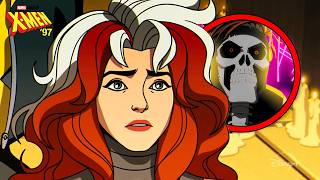
After the credits, in the ruins of Genosha, Apocalypse in his familiar form laments the pain and death of his children and recovers Gambit's Queen of Hearts. That's another nod to Cause and Effect, where Data flipped over two queens for Dr Crusher, one the Queen of Hearts, contributing to her déjà vu about the loop. The takeaway is that Apocalypse, as in 2006's Blood of Apocalypse arc, is recruiting Gambit as his Horseman of Death, foreshadowed in episode 7 when a giant Gambit appeared to Charles in the astral plane and turned into a skeleton. That would leave War, Famine and Pestilence.
I don't think Apocalypse had anything to do with Bastion or the evil of this season; I think he completely disagrees with Bastion. But I believe Apocalypse knocked Bishop off course, probably to ferry Nathan into the future and set Cable on his trajectory, and that he unstuck Asteroid M from time and took most of the X-Men to 3000 BC and Jean and Scott to 3960 AD. He might have sent Scott and Jean forward because he had encountered Cable before. At the time, my theory was that if Gambit is Death, maybe Apocalypse wanted Magneto for War, Storm for Famine and Jean Grey for Pestilence, targeting Omega Level mutants. Notice how much this season wanted us to think of Storm, Jean and Magneto as Omega Level. Apocalypse is all about the letter A, the alpha, and with the omegas they would complete the Alpha and the Omega, a truly godly force. His plan was probably what it always is: wiping the planet clean of humans and mutants he believes unfit to survive, using the suffering under Bastion to argue for a clean slate.
That's why I focused so much on how easily Charles and Magnus repaired their psyches. After a season stressing that Magneto was right and Charles is a flawed teacher, does it really make sense that Charles's smug confidence won the day with a great lecture? I think what really brought these old friends together was the cold chaos of the stormy seas, a darkness I suspected would one day be named Onslaught. The finale began with a call for peace drawn from an Old Testament verse and ends with an answer from an Old Testament God. Apocalypse could have separated Charles and Magnus, but he kept them together, and I think he knows what truly bonds them.
Do you think Charles really saved Magneto with a speech, or was something darker already stirring between them?
Watch the original
@newrockstars · YouTube
Adapted with AI from New Rockstars' video of 16 May 2024 and reviewed by Digital Fox Talent before publication. Editorial standards · Corrections
Also on X-Men '97
4 creators, 20 takes → Review
Marvel Animation Panel at NYCC Offers Looks at X-Men '97 and Spider-Man Season 3; New Series Zodiac Is Coming
AR
 Review
Lenore Zann Tells Everything Always Rogue Is in for a 'Bumpy Ride' in X-Men '97 Season 2
EV
 Review
X-Men '97 Episode 7 Breakdown: Bastion, Operation: Zero Tolerance and the Messiah Complex Clues Hidden in Bright Eyes
HE
More from @newrockstars
All →


Make videos? Your next one could be an article here.
We turn your videos into articles under your name, linked back to the original. You keep 60% of what they earn, non-exclusive, and you can leave whenever you like.
Become a SubPlotter →