Dune: Part Two review: why it's the model book adaptation
Real locations, smart structure and a reworked Chani all served Frank Herbert's intentions, and the sequel has aged well with critics and audiences
 The Gold Man (AI-assisted)22 November 2026Editor: Digital Fox Talent Editorial TeamOn YouTube since 2014 · more than 170,000 subscribers

Dune: Part Two stands out to me as a great film and a great adaptation, at a time when so many adaptations feel cash grabby and soulless. Many considered it one of the best films of 2024. I think the reason is Denis Villeneuve's philosophy: protect the theatrical experience, make the worlds feel real, and change the book only to serve Frank Herbert's vision.
Dune: Part Two (2024), starring Timothée Chalamet, Zendaya and Rebecca Ferguson, finished the story Villeneuve began in Part One. To see why it worked, it helps to look at how hard Dune has been to adapt.
Dune's long history of failed adaptations
Frank Herbert's Dune was written in 1965. Many considered the novel unadaptable because of the depth and richness of its story. The first attempt came in the '70s, within a decade of the book's release, when Alejandro Jodorowsky acquired the rights to make a 14 hour adaptation. Whatever the final product, it would have been something to see, but the project failed to secure funding and was never made.
Then came David Lynch's version in 1984. It may have had fans, but it was not widely praised. Lynch wanted it to run three hours, but it was trimmed to just over two, and covering Dune in that time simply isn't possible. The film failed to develop its characters, and frankly the effects have aged terribly. Lynch, may he rest in peace, famously disowned it.
In 2000, a television adaptation aired on the Sci Fi Channel. It was the most successful version to that point, but it still didn't live up to Dune's potential. The miniseries felt handicapped by its limited budget, and others argued it was too faithful to the book, making it awkward as television. When Lord of the Rings and Harry Potter became hugely successful book adaptations in the 2000s, there was hope Dune could join them. Peter Berg was hired to direct in 2008, but he left a year later.
How Denis Villeneuve fought for Dune and for theaters
While Dune lay dormant, Villeneuve rose with films like Prisoners and Sicario, then moved into science fiction with Arrival and Blade Runner 2049. In 2016, while making Blade Runner, he expressed interest in adapting Dune, which he considered one of his favorite books ever written. In January 2017, shortly after his Oscar nomination for best director, he was chosen to direct. In March 2018, it was revealed he had made a deal with Warner Bros. to split Dune into two movies.
From the start, it was understood that getting the story right was his top priority. If that meant two movies, it would be two movies. He didn't look at or take inspiration from earlier adaptations; he wanted his Dune to be his own vision. Principal photography on Part One began in March 2019, aiming for an October 2020 release. Then the pandemic delayed it a full year, and the more controversial decision was to release it in theaters and on streaming at the same time.
Villeneuve was furious. There were concerns a weak box office would mean Part Two never got made, since it wasn't officially greenlit. Maybe more important, he wanted to protect moviegoing. He's gone on record saying how much he hates dialogue; to him, movies tell stories through visuals and sound. Arrakis is almost a character, and watching Dune on a TV, or worse a phone, doesn't do it justice. Still, Part One grossed over $400 million despite sharing its audience with HBO Max during a pandemic, which I find seriously impressive. It scored 83% on Rotten Tomatoes, a 90% audience score and 8 out of 10 on IMDb. Part Two was greenlit, and Villeneuve returned on one condition: an exclusive, guaranteed theatrical window. Warner Bros. accepted.
Building Arrakis, Giedi Prime and worlds that feel real
The behind the scenes material makes it clear Villeneuve had two priorities: visual spectacle and honoring Herbert's story. Like Christopher Nolan, he loves IMAX, and he shot Part Two with the widest IMAX lens possible. Cinematographer Greig Fraser spoke about the spirituality of Dune and how its planets had a richness and depth that needed to come across, which was done through sets and locations.
The designers drew on real architecture. The city of Arrakeen was inspired by the Great Pyramids and brutalist architecture, but Villeneuve wanted it to feel real, not just look cool. Sloped walls deflect sandstorm winds. A lack of windows keeps heat out, while small slit windows let some light in. Concrete makes for a strong defense. Builders in the Middle East spent centuries designing for extreme heat. These details may seem obvious, but you'd be surprised how many science fiction and fantasy movies care more about looks than function.
Other planets got the same care. Caladan has a distinct style compared to Arrakis, and for the Emperor's world the crew filmed at a cemetery in Italy; real places by real architects add culture to a set. My favorite new location is Giedi Prime. It was briefly shown in Part One, but Part Two gave it so much life, or lack of it. Villeneuve wanted it to feel as unnatural as possible, contrasting with Arrakis, and different lenses gave it that look. The lack of color is a visual beauty.
Part Two also showed the world of the Fremen for the first time, with architecture carrying Arabic influences, like Middle Eastern castles built into mountains. Rock-heavy wide shots were filmed in Jordan, where desert scenes from The Rise of Skywalker were shot. Moving a crew of 1,000 across a desert with no water for miles is hard, and the crew zoned off entire areas to avoid footprints and tire tracks. Open desert scenes were filmed in Abu Dhabi, home of the Jakku scenes in The Force Awakens. The crew used its sunrises and sunsets, and when a partial solar eclipse happened during filming, they shot it and used it. That's a real eclipse. That effort pays off.
Villeneuve's changes serve Frank Herbert's vision
Villeneuve did change the source material, no question. But unlike adaptations where writers change things out of ego or other silly reasons, he only had Herbert's vision in mind. He famously said Herbert was frustrated that so many readers saw Paul as a hero, when he was meant to be a tragic figure and a warning about the power of leaders. Villeneuve has said most of his changes were made to emphasize that goal.
The biggest is probably Chani and her view of Paul and the war, which gave her depth and hammered home Paul's turn toward darkness. Even if you don't like it, you should appreciate that the change was made to better the story. It also says a lot that so many of the cast and crew have nothing but good things to say about this production. Filming ran from July to December 2022, and the film arrived in March 2024. Seeing it in IMAX was the talk of the month. We can debate the movie's quality, but I think it's safe to say it did so much for moviegoing.
Why Dune: Part Two is an unusual sequel
The Empire Strikes Back and The Dark Knight are true sequels: the first film tells a complete story, and the second builds a new one on it. Dawn of the Planet of the Apes, maybe the most underrated sequel ever made, belongs there too. The Two Towers and The Desolation of Smaug are different, because each comes from one story split into multiple films. Dune: Part Two is in that category. It's the second half of the same book, so a film of Dune Messiah, the third movie, would technically be the real sequel.
Splitting a story isn't as simple as cutting a five hour movie in half. Each film needs a beginning, middle and end. Peter Jackson ended The Two Towers earlier in the story than the book does, at Helm's Deep, because it felt like a natural place to stop. Part One ended right after Paul killed Jamis. The story had reached a mini climax with the Harkonnen attack, and could have ended there. Instead, Paul meeting the Fremen and fighting Jamis, the first chapter of the second half, became a tease. When Chani says "this is only the beginning," it points to what Part Two is about: Paul's relationship with the Fremen. That gives Part Two momentum.
Holding back the Fremen, Feyd-Rautha and the Emperor kept Part Two fresh
A good sequel sets up new conflict, new stakes, new characters and new places. Because so much was introduced in Part One, the smart move was holding parts of the book's first half for Part Two. We meet a few Fremen in Part One, including Stilgar, but Part Two shows how they live. Chani appears in vision after vision, yet we only learn who she is in Part Two. The prophecies about the Lisan al Gaib are mentioned early but fleshed out later.
I don't believe Feyd-Rautha was even mentioned in Part One, so his introduction is captivating. Giedi Prime's colorless sequence reminds me of Minas Tirith, glimpsed in The Fellowship of the Ring but properly introduced in The Return of the King. Meeting the Emperor, his daughter and his home world adds something fresh too. The ending also changed: the film closes with Paul's holy war beginning, while in the book Paul wins the battle and the holy war comes in the second book. That lends more weight to his decision and better serves Villeneuve's themes. Villeneuve wanted the film to stand on its own. I think that's a little silly for a movie called Part Two, but it mostly does, helped by an opening that summarizes Part One.
Paul Atreides' arc and the tension pulling him apart
The real reason the film stands on its own is Paul's arc. The external conflict is retaking Arrakis, freeing the Fremen and getting revenge on the Emperor and the Harkonnens. The internal one is whether Paul realizes his visions. Every scene advances one of them, and most stories forget to hammer home the internal conflict. Early on, Jessica tells Paul they need to feed the prophecy to the Fremen, but Paul doesn't want to become a power hungry tyrant.
He's then tugged back and forth. Jessica becoming the Reverend Mother, supposedly part of the prophecy, builds expectations. Chani's disbelief pulls him away. His feats, winning a battle and riding a sandworm, convince more people, especially Stilgar. His dreams of death pull him back. I like that his visions show a possible future rather than a fixed one. A future set in stone limits a story and takes agency away; here Paul has a choice, and the question of other futures with peace makes the tragedy stronger. When he's forced to go south, it's like a rubber band stretched closer to snapping, until he chooses to become the Lisan al Gaib.
Timothée Chalamet's acting sells that transformation. Paul starts as a timid, nervous kid and ends giving speeches to thousands. He goes from being silenced by the Reverend Mother to silencing her. One of my favorite details is Paul stomping his foot as he demands the Emperor relinquish the throne; I can't picture Part One Paul doing that. The external conflict has buildup too. A 20 minute sequence introduces Feyd-Rautha, making us question how Paul will hold up, much like Vader killing his own men in The Empire Strikes Back makes us fear for Luke. Gurney mentioning the Atreides family atomics builds tension for the third act.
Why changing Chani was an excellent decision
In the book, Chani supports Paul through and through. In the film, she's very much against him becoming the Lisan al Gaib, and I think that was an excellent decision. It adds depth to a character who was quite one dimensional in the book, and who is arguably the second most important character in the film. It also deepens the Fremen. I appreciated that not every Fremen thinks the same way, like denominations in real religions. I don't entirely remember if this was in the book, but it was a welcome addition.
Most notably, it shapes Paul. Herbert was disappointed some readers missed that Paul's inner conflict was the heart of the book. With Chani opposing the prophecy, the last shot of her crying tells us we're not supposed to feel good about Paul's path. In the book, nobody pulls Paul the other way except his visions. Here Chani, someone we care about, does, while his mother, Stilgar, Gurney, most of the Fremen and his lust for revenge pull him toward it. She's the angel on his shoulder, an underdog given as much narrative weight as everyone else combined. I'm stunned some Dune fans dislike this change so much.
Netflix's Avatar: The Last Airbender is the contrast. Its showrunner made big changes because the characters supposedly felt dated, removing Sokka's sexism arc and Katara's feminine qualities. That's an awful way to adapt a story. Had Villeneuve changed Chani out of ego or virtue signaling, that would be ridiculous. He changed her to serve Herbert's vision. We can all agree adaptations should change some things; the motivation behind those changes is what matters.
The visuals and how Dune: Part Two has aged
Villeneuve repeatedly spoke about practical effects, real sets and real locations, and that's without question felt in the movie. He and Fraser did all they could so every frame could be a computer wallpaper. This is without question one of the most visually striking movies ever made, especially for a blockbuster.
Part Two scored 92% on Rotten Tomatoes with a 95% audience score, and 8.5 out of 10 on IMDb, all improvements on Part One. IMDb's best movies list placed it 56th, two spots above my favorite movie ever, WALL-E. It grossed $714 million, the sixth highest grossing movie of 2024. There were also reports that some Oscar voters refused to watch it because they didn't like Part One, and they were slammed by the public for skipping one of the best movies of the year. That says a lot about how well this movie has aged so far and how much people love it.
What other creators are saying
More on Denis Villeneuve →I think casting Pattinson as Bond was a great, genuinely unpredictable choice, and with Villeneuve directing I believe we might be heading into a generational Bond era that wouldn't have happened with any other actor.
I think the 151 minute runtime is perfect, and despite strong IMAX presales I still doubt Dune Part Three hits a billion dollars with Doomsday competing, though I expect it lands around 800 million.
Dune Part Three: will it reach $1 billion against Doomsday? →
Watch the original
@thegoldman25 · YouTube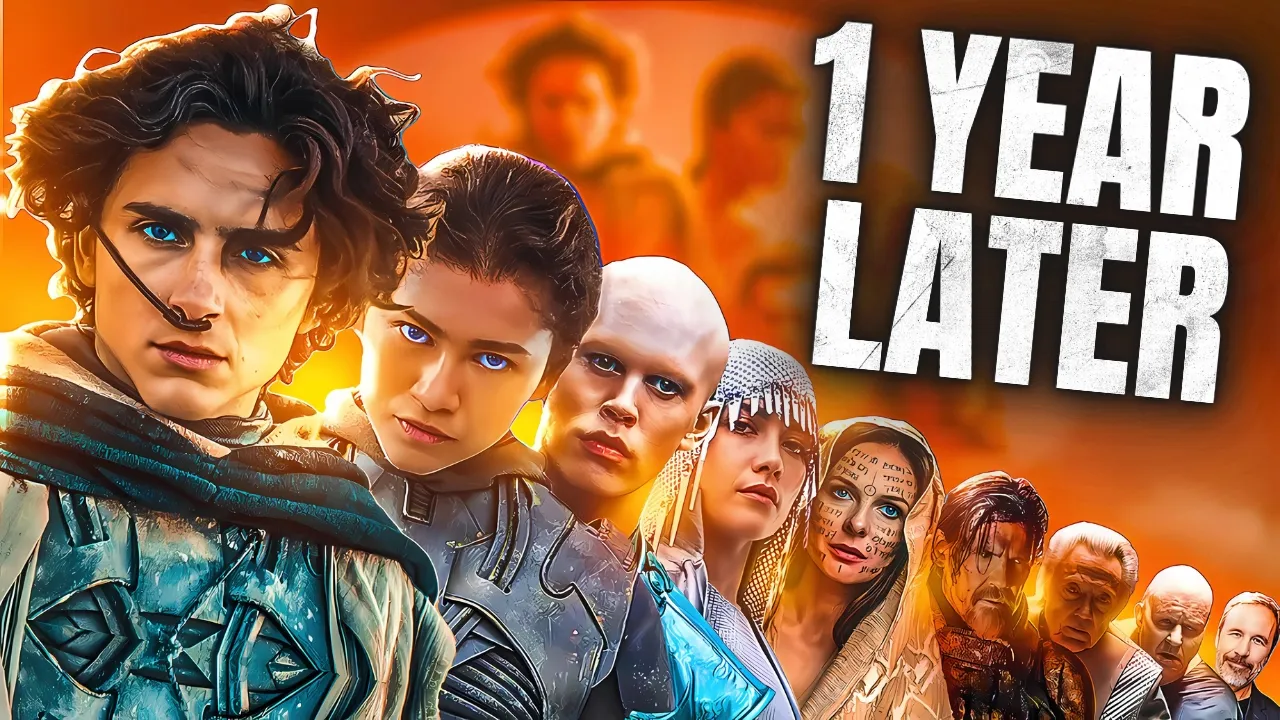
Adapted with AI from The Gold Man's video of 1 March 2025 and checked against the video before publication. Editorial standards · Corrections
More from @thegoldman25
All →


Make videos? Your next one could be an article here.
We turn your videos into articles under your name, linked back to the original. You keep 60% of what they earn, non-exclusive, and you can leave whenever you like.
Become a SubPlotter →