The Penguin review: how the Oswald Cobb mystery works
Looking back at the 2024 Batman spin-off through Oz, Victor and Sofia, and what the show says about inequality in Gotham
 The Gold Man (AI-assisted)15 November 2026Editor: Digital Fox Talent Editorial TeamOn YouTube since 2014 · more than 170,000 subscribers

The Penguin was released roughly a year before I wrote this, and it was without question one of the best shows of 2024. The crime drama, starring Colin Farrell, Cristin Milioti and Rhenzy Feliz, is everything you want from a darker, more mature DC story. It's also an excellent spin-off to 2022's The Batman, and that is important.
Both The Batman and The Penguin explore a handful of themes: trauma, hope and vengeance. The one that resonates most strongly with me in both stories is inequality. The divide between the wealthy and the poor in Matt Reeves's Gotham arguably influences every character in some way, and the show's three main characters, Oz, Victor and Sofia, are each shaped by it.
The Penguin's reception and what came next
The Penguin was an overwhelming critical success. It scored 95% on Rotten Tomatoes, with an 85% audience score. On IMDb, the season scored an 8.6 out of 10. The highest rated episode was the finale, A Great or Little Thing, at 9.5 out of 10, and the lowest was the second episode, Inside Man, at 8.4 out of 10.
The season was nominated for 24 Emmys, making it the second most nominated show of the year, and it went on to win nine of them. That included outstanding lead actress for Cristin Milioti as Sofia Falcone. At the time I wrote this, there were no official plans for a second season, but conversations had been had with Matt Reeves and showrunner Lauren LeFranc. Colin Farrell was set to return as Oswald Cobb in The Batman Part II in October 2027.
The Penguin built the most well-realized live-action Gotham
The Batman explored inequality excellently, but The Penguin took it to the next level. There are things you can do in an eight-hour miniseries that you can't do in a two and a half hour movie. Gotham and its neighborhoods are given so much depth and life: the run-down streets, the trash around the corner, the graffiti on the walls, the soul-draining apartments.
The people living in Crown Point and the other neighborhoods feel like they live like rats, and all of it is contrasted with the luxurious lives of the Maronis and the Falcones. In behind-the-scenes material, Lauren LeFranc talked about how important it was for her to emphasize this contrast. As a result, we have arguably the most well-realized Gotham we've gotten in live action. Like any good character study, though, the setting and themes exist to support the characters.
The series asks who Oswald Cobb really is
The approach the writers took with Oz is very interesting, and it's not like anything I've seen in comic book storytelling before. The series is simply asking who Oswald Cobb is, and why. In The Batman we learn he's smart, quick and scummy, but despite his strong presence, mostly thanks to Colin Farrell's excellent work, he isn't in the movie all that much.
So the series digs into what motivates him and what his real goals are. Is he a villain, an anti-hero, a tragic villain or a misunderstood hero? That's a risky approach, because it banks on people being invested enough to find out. An eight-hour miniseries has to hook its audience from the start. Thankfully, people loved Colin Farrell's Penguin in The Batman, and if they hadn't, this series probably would never have been greenlit. Because we already had an idea of the character, we were invested almost immediately.
As the series goes on, the writers show different sides of Oz's personality, often framing them one way before the ending reframes them entirely.
Oz's pride and his insecurity about his disability
Maybe Oz's key defining characteristic is his pride, and that's the point of the first scene. News reports tell us Alberto Falcone is going to be the next head of the Falcone family, so we assume he must be important. Then Alberto disrespects Oz, and Oz impulsively kills him. It wasn't smart, but Oz's pride was hurt. He refuses to feel belittled or insulted in any way, and someone like that is deeply vulnerable and insecure.
From the start we can assume he's insecure about his physical disability. A few scenes later, when Oz and Victor board a train, the director highlights that the handicap seat is open, but Oz refuses to sit there. Later he yells at a waiter for finishing Victor's sentence. To Oz, an acknowledgement of a disability is disrespectful. Deep down he's so afraid of feeling inferior that he does whatever it takes to feel superior. For roughly the first half of the season, though, the writers only give us pieces of the puzzle.
Manipulation is Oz's superpower
Oz's strength is discerning what people want and why. He grew up on the poor side of Gotham, so he knows those people want what he wants: to not feel like a rat, and to feel respected and important. His first target is Victor, who he catches trying to steal the rims off his car. From the stutter alone, Oz senses Victor shares his insecurity about a disability.
That raises the essential question of the series: does Oz help Victor because he sees himself in him, or is Victor a pawn? Initially we're led to believe the former. Oz is fairly kind to him. But when Oz talks with Victor about his father in the third episode, he uses it to dig into Victor's desire to do better than his father could. That's peak manipulation, planting the seed that leads Victor to abandon his girlfriend.
The dichotomy with Bruce Wayne is fascinating. Bruce means well, but his privilege makes him ignorant of how normal people in Gotham live. Oz is perfectly aware of how people feel, if anything too aware, and he uses it to exploit them. Because his points about inequality are fair, we root for him as an underdog. He manipulates the people around him and the audience. Sofia even admits she trusted Oz despite everything in her body telling her not to.
Episode 7 reveals Oz murdered his brothers
His apparent weakness is his mother, Francis. At first his care for her seems like the sign of a decent man. He has Victor check on her. The writers give us enough reasons to wonder whether there's a good person in Oz. We'd heard his two brothers died, and I assumed it was a tragic backstory, maybe a brother killed by crime or by the Falcones.
Instead, the flashbacks show that Oz didn't have a tragic backstory, at least from his perspective. He grew up with a struggling single mother, but she was loving, his brothers weren't abusive, and he even got support for his club foot. We never see anyone bully him for it. I'm sure he was teased at school, but it's critical we don't see it. His awareness led to paranoia, and an obsession with his mother, likely because she never teased him.
When his brothers tell him he has to climb down a ladder to win a game, Oz locks them inside. I don't think he planned to leave them there to die. But he goes home, has his mother to himself, and as the rain gets heavier he realizes he could live in a world without his brothers. He does nothing. He knew they'd drown, and he never apologizes. He's not an underdog or an anti-hero. He's a monster.
Why Oz killed Victor and kept his mother alive
From there, Oz perpetuates the system that caused him so much pain. He makes himself seem smaller to those in power so they underestimate him, and for those without power he creates an illusion of opportunity. He manipulates the lieutenants through their own quest for power, and he tells the councilman to scapegoat Sofia because it would help the councilman too.
He helped Victor because he could exploit Victor's dreams. When Victor says he sees Oz as family, that's the worst thing you could say to a sociopath like Oswald Cobb. I think Oz did care about Victor; there are so many scenes between them it can't all be an act. But power matters more, and family is a weak link.
The ending reframes his mother too. She's a tool for approval. Oz drove a Maserati and lived well while promising her somewhere nice, and he sacrificed her finger to keep up his lie. Her tirade about hating him doesn't affect him. You'd think it would break him, and that was my assumption too, but he only cares about how she makes him feel. She once asked to be put down if she lost her mind, but he keeps her alive because she makes him feel powerful. I find it freaky that he has Eve dress like her. If you want to talk about toxic masculinity, watch this show.
Oz has no arc, and Gotham's system made him
Oz didn't go on an arc. The series was a mystery, and the writers masterfully led us to how truly evil he is, creating one of the best comic book villains ever put to screen. He also ties back to the class theme. In a system where the higher-ups only cement their status, kids look for anyone who seems to have a plan. For Oz, that was Rex Calabrese, a wealthy, respected and feared local leader. Francis gives in to that influence and uses what Oz did to motivate him.
Oz is a terrible person, no sugarcoating it, and I'm not saying everyone impoverished ends up in crime. But when a system suppresses millions of people, a significant number will choose this life. Not all of them are evil, but a lot are. Even though Oz perpetuates the system, he's also a victim of it.
Victor's story shows crime as an addiction
Victor is the most tragic character in the show, and his death gave the ending its emotional impact. He lost his whole family in the flood at the end of The Batman. In the first three episodes, a girl he likes plans to leave for California, and he intends to go. It's what his father would have wanted. Then Oz shows him the apartment, the car and the women, a taste of what he could have.
Many don't see it this way, but Victor's entry into crime can definitely be seen as a descent into addiction. That lifestyle is attractive, especially to lost young men. In the third episode he lets the girl go, runs over a man, and stays with Oz. People like Bruce at the start of The Batman think these people choose this life, but Victor was forced into it, and by the time he could escape he was hooked.
Victor is a good kid. He was kind to Oz and Oz's mother. When he first killed someone, Squid, he burst into tears. Had he lived, I'm sure it would have gotten easier. Oz killed him not because he was a threat but because he got too close, then threw Victor's ID into the sea so he'd likely never be identified. No character exemplifies the show's themes better.
Sofia Falcone is a victim of Gotham's system from the top
Sofia represents the wealthy side, the way The Batman had both Bruce and Selina. One of my favorite shows of the year was Andor, which shows how fascism eventually comes for those in power too. Sofia kind of represents that, though she's by no means an oppressor; she was born on the side of the people in power. In episode 4, maybe the season's best, she asks questions about her mother's supposed suicide, and her father Carmine frames her for the murders of eight women, including her mother. She spends 10 years in Arkham, tortured and abused, with no court hearing.
Once out, she tries to clear her name, but by the end of episode 4 she gasses her entire family. The showrunner explains that her more modest outfits give way to bolder clothes and hair as she rejects the family, and I thought that was an excellent dimension to her character. She kills Johnny Viti in front of the syndicate and renames the family Gigante to honor her mother and spite her father. She made her choices, but she was funneled into them.
She's a perfect foil to Oz. Her backstory comes in episode 4, his in episode 7, and both become ruthless players. But Sofia realizes that by killing Gia's mother she put Gia in a prison, like her father put her in Arkham. She has a heart, and she's ready to leave the game. Her revenge on Oz still pulls her back, and she ends up in Arkham again. Sofia tried to break the cycle and was punished. Oz perpetuated it and ended up on top. The finale is tragic through and through: Oz wins because of how truly awful he is, and Sofia loses because there was a glimmer of hope for her.
What other creators are saying
More on The Penguin →I give The Penguin's premiere a solid 8.5 out of 10, impressed by Farrell's range and the show's Batman-matching tone. I believe Oz is heading toward becoming the fancy-club, top-hat Penguin, with a turf war and a new drug fueling his rise, though I'm not fully certain.
Actor discusses whether Matt Reeves' Batman universe could coexist with James Gunn's new Superman film
The Penguin's Rhenzy Feliz on Robert Pattinson's Batman in the DCU: 'I Don't Think So' →
Watch the original
@thegoldman25 · YouTube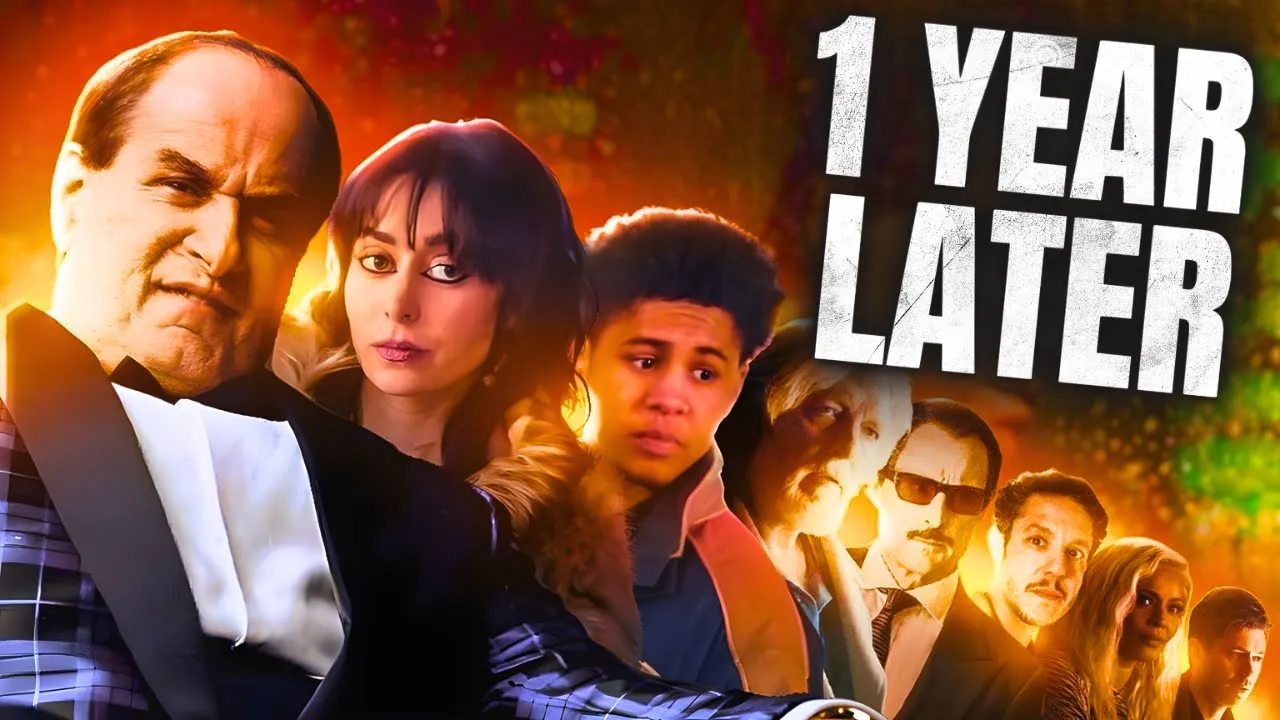
Adapted with AI from The Gold Man's video of 12 October 2025 and checked against the video before publication. Editorial standards · Corrections
More from @thegoldman25
All →


Make videos? Your next one could be an article here.
We turn your videos into articles under your name, linked back to the original. You keep 60% of what they earn, non-exclusive, and you can leave whenever you like.
Become a SubPlotter →