Digger Ending Explained: Why Tom Cruise's Film Turns Out to Be a Play, and What That Final Shot Means
The big twist, Jesse Plemons' Kenny Rockwell reveal, Maggie the cat and the masked crowd spilling into an apocalyptic city, unpacked with full spoilers
 Beyond The Trailer (AI-assisted)3 October 2026 · Editor: Digital Fox Talent Editorial Team
The big twist in Digger, and one of the reasons it has been so hard to advertise, is that the whole movie is in fact a play about something that did actually happen. Tom Cruise and Alejandro González Iñárritu are not idiots, so I kept thinking they must have made that choice for a reason.
As I said in my spoiler free review, it's a mean film. Not so much mean hearted, but in that it doesn't hold back and nobody is safe, and I respect that about it quite a bit. I waited a little longer than usual to dig into spoilers because I wanted to preserve the film's secrets. It seems not to be doing very well, so maybe this walkthrough will make some people more inclined to see and appreciate what Cruise and Iñárritu are doing here.
Digger Is a Play So a Real Tragedy Can Be Processed, or Merely Applauded
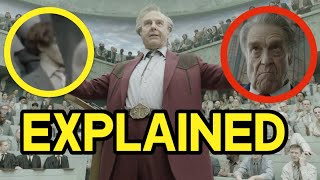
I had heard the twist before I went in. Not the extent of it, but I knew Cruise was an actor playing Digger, so it wasn't a total surprise. When it was first revealed, I wondered whether that meant none of it actually happened. Thankfully, this is a play, Fossil Fools, about a real life tragedy that has brought about an apocalyptic future. While watching, I kept asking why it was a play. Cruise and Iñárritu are not whimsical; they don't make a choice like that just because it would be cool.
I feel it's a play for two reasons, story and filmmaking. Story wise, it's about remembering a real event and keeping it in the public consciousness, and the movie discusses whether you can even make a play about something so horrible. On one hand, a play lets the public process the tragedy. There's a great moment when the director tells Cruise's character that two other actors lost people in the disaster and can still laugh at the jokes, which underscored that it was helping them heal. Art therapy is literally a thing.
On the other hand, I think Iñárritu was pointing out that the play might not accomplish anything. That was one of the most surprising and, I think, aggressive parts of the movie: everyone patting each other on the back for having processed it. Was it making people think about how to stop it happening again, or just letting them decide it was all Digger's fault?
The Play Format Gives Iñárritu an Absurdist, Dreamlike Freedom
Creatively, the play gives the film an absurdist, dreamlike quality that I loved. What's stuck in my head are the aerial shots, with clouds on little sticks, and the bombers hitting the iceberg: you'd get a very realistic shot, then the same bombers on little sticks. I thought that was so fun.
It also let the space itself carry meaning. The best example I can think of is the ornate side room during the speeches to Europe, falling apart with water dripping through the ceiling and a tilted chandelier. When Cruise went back in, the room seemed to have gotten smaller. You couldn't do that in a realistic story bound by time, space and physics. I think it identifies the distortion of history, not just in the history books but in how people perceive events, and I loved that element very much.
Jesse Plemons' Kenny Rockwell Shows the Rich Simply Evolve
Jesse Plemons' character is revealed to be Kenny Rockwell, Digger's nephew. I suspected as soon as they showed Digger had a nephew with red hair styled exactly like Plemons'. It was such a distinct hairstyle and colour against the movie's palette that I think that's probably when Iñárritu wanted you to get an inkling. It made it even more interesting that Cruise's actor character had dismissed the tie Kenny gave him, clearly one of Digger's actual ties. To some degree that shows the dismissiveness of an actor toward anyone backstage.
Kenny is as powerful as Digger was. The female roles here are very underserved, but his mother, played by Sandra Hüller, kept her half brother Digger from selling the environmentally friendly company they had formed together, even when they were exiled and badly needed cash. That was Kenny's lifeline. I also found it interesting that he didn't hate his uncle; he recognised what Digger did was horrible and unforgivable, but he was still his uncle. In a society that demands you pick a side, that felt like a beautiful, complex moment, because the world is mostly gray.
Kenny was just as eccentric, secretive and in control as Digger, and everyone in that room, on stage, backstage or in the audience, existed at his will. The Rockwells had simply pivoted out of a situation they created. I'm not saying this is good, but you can only affect change if you truly understand the system you're operating in.
Cruise's Actor Character and His Missing Daughter Reveal a World of Who You Know
Again I asked myself why make Cruise an actor. I did love the shot of the Digger face masks; if it really is just a mask slid over his head, it's remarkably effective. Two instances with his actor character felt particularly important. First, his real life daughter has gone missing in one of the storms after taking off from a tiny airport. I think that shows this environmental danger affects even a big star; no one is immune. It ties into the idea that nothing is more powerful than Mother Nature, yet everyone keeps needing oil, believing we'll show her who's boss.
Kenny is able to find the daughter and says it's no big deal. But you have to wonder how many people weren't found because they didn't know Kenny Rockwell. It's still, sadly, a world of who you know. I didn't see Kenny volunteering to find everybody who was lost; he did it for another famous person.
Plemons' Monologue Is the Thesis: It Is Absurd and It's Also Horrible
The second instance is on the fake Air Force One, where Cruise's character doesn't understand why a very serious moment is played as farce. He's at odds with the director, and Plemons steps forward and reveals he's Kenny Rockwell. I loved it when Cruise later tells the director she couldn't have told him, and she says Kenny wanted it to be a secret.
Kenny tells them they're both right, and that is maybe the thesis statement of the movie: two things can be true at once. He says, "It is absurd and it's also horrible." In that moment it was all of those things, and boiling it down to one does reality a disservice. As I read it, the tension between Cruise pushing for a serious scene and everyone else pushing for farce creates something more realistic. It's so sad that all you can do is laugh, and I think Fossil Fools is supposed to personify that.
The Masks and the Final Shot Are About Complacency
When the play ends, we learn the world never got better after Digger's oil rig exploded. People just built on what was left. There's horrible pollution and, by implication, military on every street corner, though we only see one. The technology, like the screens built into the mirror in Cruise's dressing room, made it feel like a future we're very close to. Then an alarm calls level four, and everyone takes out an advanced mask and sets it to level four before leaving. I don't think it's an anti COVID message; it's asking what comes next if you don't learn from COVID. And no one's upset. It's just the world they live in.
The final shot, which Iñárritu holds on, is one of the most powerful in the movie: the crowd spills out like any Broadway audience into their apocalyptic new normal. My interpretation is that it's about complacency. The people seemed very proud of themselves for seeing such a hot play, something for social media, as Digger said in his speech, without much thought for what it was warning about. Maybe some were talking about it a little, but I found it very damning.
The Applause at Digger's Death Felt Performative
Digger ends up exiled onto one of his own oil rigs, which I thought was such a clever parallel to Napoleon, who wanted to conquer the world and almost did and was exiled to an island rather than killed. After Digger takes his own life, his family gets to leave because Kenny is so successful.
Iñárritu holds on so many audience members during the thunderous applause as Digger dies. They're applauding Digger taking his own life, and you can feel their hate for him. Maybe the play lets them let it out. But to me the hate felt performative. It reminded me of how much everyone hates on Donald Trump, yet he got reelected. If you hate someone but do nothing about it, who cares? Everybody hated Digger, but they still used the oil that created the problem and treated their apocalypse as normal. That's a very bold statement for this movie to make.
Did Maggie the Cat Really Hate Digger?
Digger keeps one long fingernail on his pinky to feed his beloved cat Maggie, the only personal relationship he really had. In her final moments she attacked him, leaving a big scar, and he's haunted by why, after decades of sleeping in his bed, she made that their final moment. He cremates her, carries her to the very end, and pours her into the ocean before joining her.
He asks the doctor played by Riz Ahmed, who first lies to comfort him, then, because Digger keeps him around for his honesty, says he thinks Maggie hated him and probably died from mercury poisoning. Since Iñárritu establishes that character as truthful, one has to assume that's what Iñárritu feels. I didn't feel that way, though. The cat could have clawed him much earlier. I think Maggie just wanted to die; Digger was keeping her alive, and as his own daughter says, put that thing out of its misery. Still, I have to defer to the truthful character.
Digger Is a Tragic Figure, Mirrored by John Goodman's President
I thought Digger was a tragic figure and a product of the world. If nobody bought his oil, he wouldn't be who he was. And his luck held out until it didn't, which echoes his speech to Europe about people sucking down oil, assuming things would always end up okay after every near miss. Digger personifies that sentiment of humanity.
John Goodman's President Thompson, sick with cancer, declares that the world is his body and what's happening to him is happening to the world. He made a somewhat compelling case, and I felt Digger also represented the world. These two men represented it not because they were chosen but because they inflicted their will on it and the world let them. The film also highlights money over people. When Digger's rig first blows and he hears there are casualties, he asks if the rig is okay. You can admire business leaders' accomplishments, but don't kid yourself about how they feel about you.
Digger Makes the Case for Separating Business and State
As I touched on in my spoiler free review, I think the movie makes a compelling case that the combination of business and state has become the real issue, when the state is supposed to moderate business. We're in a new Gilded Age. The first came from the industrial revolution and the explosion of infrastructure, energy, railroads and steel; now it's funded by tech. It only ended because government stepped in with regulations and huge taxes.
Now government is so in bed with business that I don't think it will regulate it. I think Trump just said he wanted AI companies to regulate themselves. AI companies are asking government to regulate them, but I think they're only doing that to avoid culpability and pass the buck, and Trump passed it right back. At the end of the day, no one cares about us.
The Tuna Story and the Speech to Europe Are Digger's Best Moments
It's a fabulous performance, and on the private plane Digger asks the doctor his favourite drink, then says, "How would I know that?" and gives him something else. I loved Ahmed in the movie. Then Digger offers him raw tuna, which the doctor refuses as unsustainably farmed. Digger spins a story about an old man responsibly farming it, and the doctor eats it. Afterwards Digger says he made it all up but it still tasted good. I think that illustrates that people might know the facts but not the story, and most won't give up short term gain for long term gain. I would not have eaten that tuna. I'm not eating raw fish on a plane. And I don't think Digger was trying to beat the doctor; I felt he respected him.
In the speech to Europe, Digger goes viciously through everything people won't give up that relies on oil. It reminded me of how people want products made at home with fair wages yet shop at the dollar store. I laughed out loud when he called the room "a bunch of hypocrites" and noted their private jets were fueling up to leave. He was right, and it made me think of celebrities who preach about the environment while flying private. I was shocked when he got hit with that shoe; George W. Bush ducked, Digger didn't. He went down, popped right back up and, I think, kicked some lady.
Digger Rockwell Is Business Personified, Neither God nor Devil
I feel Digger is meant to be business personified in Cruise and Iñárritu's eyes, and as Kenny says, he's not all good or bad. Social media tends to portray business people as gods or as sinister devils, but how would they accomplish what they do without some positive qualities? Digger was a real charmer with a lot of interesting and accurate things to say.
Speaking of the Gilded Age, I've been wondering where today's equivalent public works are. We have so many new titans of industry, unlike the Rockefellers or the Mellons, and Rockefeller Center, built by Rockefeller, is a big part of New York City that everyone can enjoy. George Lucas at least just built a museum, but where are the libraries and stations? It's sad that today's titans aren't giving back that way, and I wish they were inspired to.
The Production Design Turns the Play Twist Into a Visual Treat
The play twist added so many layers visually. Seeing how shots were constructed was so fun. The movie opens on Digger's bedroom window, and I wondered how they did it; having the camera step back to show the tricks was an extra element of enjoyment. I was blown away by the mechanics of Digger's death scene, with him floating through the water and the actors rising from below the stage for their bows, using rigging harnesses and projection.
I'm a huge fan of miniatures; I even have a little tableau of my own. One shot set the exterior of Digger's estate on fire, and because the flames were regular sized against very good miniatures, it created such a dynamic visual. I also loved how the floor moved during the European speech, so the camera and Digger could move against the Europeans behind them. I'm planning to see it again this weekend, because I'm sure there are visuals I missed.
So, would you have eaten the tuna, and do you think Maggie really hated Digger?
Watch the original
@beyondthetrailer · YouTube
Adapted with AI from Beyond The Trailer's video of 3 October 2026 and reviewed by Digital Fox Talent before publication. Editorial standards · Corrections
Also on Digger
6 creators, 12 takes →




More from @beyondthetrailer
All →


Make videos? Your next one could be an article here.
We turn your videos into articles under your name, linked back to the original. You keep 60% of what they earn, non-exclusive, and you can leave whenever you like.
Become a SubPlotter →