Texas Chain Saw Massacre symbolism: why is it so unsettling?
A scene by scene look at how Tobe Hooper's 1974 horror film uses sound, real remains, astrology and a dying industry to build its dread
 Heavy Spoilers (AI-assisted)21 November 2026Editor: Digital Fox Talent Editorial TeamOn YouTube since 2009 · more than 1.6 million subscribers

I think The Texas Chain Saw Massacre is up there as one of the most famous films ever made. It's an amazing piece of American cinema, and one of the most influential movies ever made. Released in 1974 and directed by Tobe Hooper, it follows a Scooby-Doo gang of teenagers who come across a family of deranged cannibals. Everything in it feels designed to attack the audience with shock and terror, yet it's filled with subtle details and symbolism, and that is what pulls us into its psychotic world.
I didn't see it until I was in my 20s, but I heard about it endlessly on the playground. For most people, the word chainsaw instantly conjures up Leatherface. The film also leaned heavily into marketing itself as a true story, a gimmick that shocked audiences worldwide at the time.
How 1970s America and Vietnam Shaped Tobe Hooper's Film
The 70s were one of the most tumultuous decades in history. The Manson murders brought a violent end to the 60s, the Vietnam War was in full swing, the Cold War was still hot and Watergate was unfolding. All of it was being broadcast into everybody's home. Horror followed: Psycho introduced the idea of people as monsters, Night of the Living Dead took it further, and The Last House on the Left in 1972 pushed the boundaries of onscreen violence. Critic Christopher Sharrett wrote that Hooper's film "carries this exploration to a logical conclusion, addressing many of the issues of Hitchcock's film while refusing comforting closure."
Hooper, a young film student from Texas, was inspired by the "lack of sentimentality and brutality" of Vietnam news coverage. He thought man was the real monster, just wearing a different face, so he put a literal mask on his. He wrote the script with Kim Henkel, and investor Bill Parsley put in $60,000 for half the profits, a detail that matters later. The budget was $140,000, with unknown actors and Texas locals.
The Opening Crawl Uses Hitchcock's Bomb Theory
The narration tells us a tragedy befell five youths, in particular Sally Hardesty and her brother Franklin. It plays like one of those car crash films they show you in school. We go in knowing they're doomed, which fits Hitchcock's bomb theory: a bomb under a table makes an ordinary conversation tense. Hooper applies it to the whole movie, so even the teenagers driving down the road becomes worrying. The Blair Witch Project used the same trick to great effect.
The poster claimed "What happened is true," and many believed it. The story is fake, though Hooper said marketing it as true was his way of commenting on how society was constantly being lied to by governments. Some elements do draw on real crimes, including those of Ed Gein and a Texas teenager who was an accomplice in a series of murders.
Wayne Bell's Secret Sound and the Real Remains
Each flash of body parts in the opening comes with a shrieking sound composed by Wayne Bell, meant to mimic a chainsaw or a squealing pig. No one knows how he made it, and he refuses to reveal the secret. I kind of hope nobody figures it out, because it adds to the mystique. Much of the score also uses industrial noise to reflect what animals would hear in a slaughterhouse.
Then comes a decaying corpse posed on a grave, which a news report calls a grisly work of art. I see a parallel with the film itself as a grisly piece of art Hooper presents to the world. I couldn't fully confirm it, but I'm pretty sure these are real skeletons, at least according to the rumors, with art director Robert Burns adding the rotting flesh. Real skeletons were cheaper than convincing fakes back then. The report also says police link the crime to elements outside Texas. That's probably incompetence, but it could also be a comment on violence spreading like an infection. The credits that follow supposedly show telescopic photographs of solar storms, which makes sense, because the sun becomes its own character.
The Armadillo, the Van and Franklin's Roll Down the Hill
The first shot lingers on a dead armadillo. I feel it shows how the family sees no difference between animal and human. It was originally a dead dog, but that felt too gruesome, which shows our own hierarchy of acceptable death. The crew also found a dead horse but passed because of the smell. Burns was annoyed, calling it a gift, though I side with the crew. He found an armadillo, read a taxidermy book and stuffed it himself.
The van belonged to one of the sound crew, and it was reportedly so hot they couldn't shoot for more than a couple of minutes at a time. Franklin's tumble down the hill was shot on the last day, when production had run out of money. Paul Partain reportedly demanded $300, so the production manager wrote him a personal check, which Partain kept in his shirt pocket during the scene.
The Slaughterhouse and the Chainsaw Family's Lost Industry
Pam's astrology, from a 1910 horoscope book, describes Saturn as signifying evil, darkness and loss, which fits a family turned psychotic by losing their industry. Franklin mentions their grandfather sold cattle and an uncle works in a slaughterhouse, so I think the Chainsaw family is a dark reflection of a typical American family. Sally's side embraced new technology; the Chainsaw family refused it, were pushed out, and are stuck in an America that no longer exists. The hitchhiker even argues the old sledgehammer was better than the bolt gun.
Shots of sick cows crammed together are cut against the friends huddled in the van, showing they'll soon be the cattle. Franklin describes hitting cows two or three times, almost exactly how Kirk later dies, and skinning them before they're dead, foreshadowing Leatherface wearing his victims' skin.
The Hitchhiker's Blood Mark Brands the Van
The hitchhiker is proud of slaughter, while Franklin recoils despite describing it in brutal detail. To me, that represents how people avert their eyes from how meat gets made. Head Cheese was one of the original titles; the final one came from Texas Film Commission president Warren Skaaren, and when a friend said he'd never see a film called that, Hooper knew it was perfect. Critic Alexandra Heller-Nicholas likens the hitchhiker's photos to Rembrandt and Francis Bacon, and I have to imagine that parallel was intentional.
After he slices Franklin's hand, he smears a symbol on the van in blood. I don't think it's a cult symbol, but a mark branding them as the next victims, like cattle. The cook at the gas station looks at that side of the van, and the window washer leaves the blood alone.
From the Gas Station to Leatherface's Door
The gas station sign reads "we slaughter" in a different font, which you could read as an admission. In hindsight, the barbecue is most definitely human meat, and I feel this is when the cook decides they'll be victims. Franklin running the bloodied knife along his hand shows violence spreading.
At the house, I feel bad for Franklin, left behind while everyone laughs upstairs. Partain stayed in character and kept his distance, and the cast reportedly didn't warm to him until years later. Near the Chainsaw house the sun shots grow more intense, and a watch nailed through the middle could symbolize the family punching out the clock. When a tooth falls on the porch, I wonder if Leatherface threw it as a warning, calmly trying to scare off intruders from his home.
Red Imagery And The Hell Mouth Behind Kirk's Death
Red is used in the film to represent death or evil in general. It's in the red wall, the red sun of the opening credits and the gas station grill bathed in red light. Yellow suns show the outside world, but also how evil keeps following the group, and yellow sits opposite red on the color wheel. Film critic Alexandra Heller-Nicholas compares the film's red to Hieronymus Bosch's paintings of the Hellmouth, where a creature with a gaping red mouth leads souls to hell. In a way, the red wall of the slaughter room acts as that hell mouth, and it leads Kirk to his death.
That scene always shocked me. It comes out of nowhere with no buildup and instantly changes the tone. The skulls are real, gathered by art director Robert Burns from animal corpses farmers left in their fields. On this rewatch I noticed that Leatherface makes the pig noises as he steps out from behind the door. I think this is where the movie took a turn for audiences at the time, who'd never seen such a viscerally brutal death on screen. Night of the Living Dead had opened the door to more brutal violence, but a body spasming like this was much more intense, and it still holds up because it looks and feels real.
Tobe Hooper was adamant about including it because he felt it was more realistic. He said a blow from a heavy hammer would send bone fragments into the brain and cause involuntary spasms. He'd hung around with medical students in film school, which is probably where he picked that up. The hammer also slipped from Gunnar Hansen's hand and hit the actor who played Kirk, which Hansen apparently felt terrible about.
Pam Enters The Bone Room In The Chainsaw House
Pam's walk up to the house, under a blue Texas sky with only the generator and her footsteps, is full of dread because we know what's waiting. Outside looks beautiful, while inside is a nightmare of feathers, bones and furniture made from human remains, including a whole couch. It feels real because it is. Burns built the props from real bones, and makeup artist Dorothy Pearl, who also worked as a vet, got him access to more exotic ones. Burns said the idea was to make it look like an insane person's house, "not what an art director thinks an insane person's house looks like."
The room was also inspired by Ed Gein, who made human skin and body parts into furniture. Burns nails it. Mixing human and animal remains drives home that the family kills indiscriminately. They see no difference between a broken turtle shell on the wall and a lamp made from a human arm, which is my personal favorite.
Pam On The Meat Hook In Broad Daylight
Leatherface dragging Pam back inside is probably one of the most famous scenes in the movie. I feel like it changed the status quo for audiences, because it happens in broad daylight. Until then most horror killings happened at night or behind closed doors, and sunlight usually brings relief. Here the terror plays out in the open, and no one comes to help. Teri McMinn is brilliant, gasping in shock rather than screaming her head off, which feels genuine and even more brutal.
For the hook, Burns made a saddle padded with sanitary napkins and held on with crisscrossed nude stockings, which created the jerk as she's hung. McMinn could only hang for about a minute, so it was shot in spurts. There's no blood beyond what's already on the walls, and Burns takes pride in that. Hooper originally wanted the hook coming out of her chest with blood spurting, but Burns convinced him no blood would be more effective. "That scene has not one drop of blood in it," he said.
Jerry's Death And Leatherface As A Big Baby
Jerry walks toward the house under the most drastic sun shot yet, framed as though stepping straight into the sun, which brings us close to the chaotic red sun from the opening. He finds Pam in the freezer, a great jump scare, and turns to find Leatherface. Hansen was kept away from the cast so their reactions would be genuine, and the actor who played Jerry was so scared on the first take that he broke free of his restraints and ran out screaming. McMinn believed Pam survived and escaped the freezer, which I highly doubt since her body goes limp.
Afterward Leatherface flips out, then sits with his head in his hands, and I think this scene reveals more about him than any other. He's genuinely confused and seems terrified. The original Leatherface was never meant to be truly evil. Hooper described him as "a big baby" who knows he's in trouble, not with the law so much as with his older brother, and drew on the cartoon duck Baby Huey. Hansen called him the strongest, most violent and most scared member of the family, and spent two days at a children's psychiatric hospital observing behavior for the role.
Ed Gein, The Cadaver Mask And Leatherface's Faces
Many believe Leatherface is mainly inspired by Ed Gein, which is partially true. Hooper said he knew the case only in passing and wasn't familiar with the details until after the film, so Gein's influence starts and ends with the furniture. The skin mask traces back to a college Halloween party where one of Hooper's medical student friends apparently wore a cadaver's face as a joke. Hooper later told actor William Butler it was the most disturbing thing he'd ever seen.
Co-writer Kim Henkel said Leatherface assumes the personality of the mask he wears: a killing mask, an old lady mask for cooking, a pretty woman mask for dinner. Hansen said that without a mask he was essentially devoid of identity, which I definitely think also influenced Halloween. Burns said later masks look like something an art director made, and I agree. The original is by far the best, and I think Leatherface is probably the most interesting and complex of the famous horror slashers.
Sally's Chase And The Dinner Scene
The darkness of the woods was a happy accident, because the crew couldn't afford to light the scene properly, but I think it worked out for the best. I'm also starting to wonder whether the humming we've heard throughout is Leatherface's chainsaw rather than the generator, a signal that he's coming. Sally finding the grandparents in rocking chairs is a shout out to Psycho, and I feel Leatherface sawing at the door could have potentially inspired Jack Torrance's famous scene in The Shining. At the gas station the broom the cook uses was real, Hooper wouldn't let actor Jim Siedow pull back, and Marilyn Burns was injured. Robert Burns said her black eyes at dinner were real.
The dinner was hell for everyone. A blood pump failed, so they really cut Marilyn Burns's finger. The shoot took 27 hours, though some said 36, and a rotting chicken under the lights made people vomit. Pearl even brought in dead dogs and cats as set pieces. The jump through the window was a 10 foot drop through sugar glass that injured Burns again.
The Chainsaw Dance, The Mafia Deal And The UK Ban
Sally laughing in the truck is a sigh of relief, but I also feel she might have been broken. Leatherface swinging the chainsaw against the sun is a beautiful bloody ballet. Marilyn Burns claimed the laughter wasn't acting, and Hansen said the chainsaw dance was partly improvised from frustration. The film was sold to Bryanston, which was owned by the Colombo crime family, for $225,000. From its 35% share, Vortex made $5,734 to split among the cast, so Hansen's first royalty check was $47, even though the film brought in $30 million. Bryanston had gone bankrupt by the time it was sued.
The BBFC banned it, with director James Ferman calling it "the pornography of terror." He found no single scene unacceptable, just its cumulative frenzy. I've always enjoyed the movie, but I don't think I fully appreciated it until this rewatch. Few horror films, even in the franchise itself, recreate the raw and unrelenting fear of this one, and against all odds it became one of the most influential movies ever made.
Watch the original
@heavyspoilers · YouTube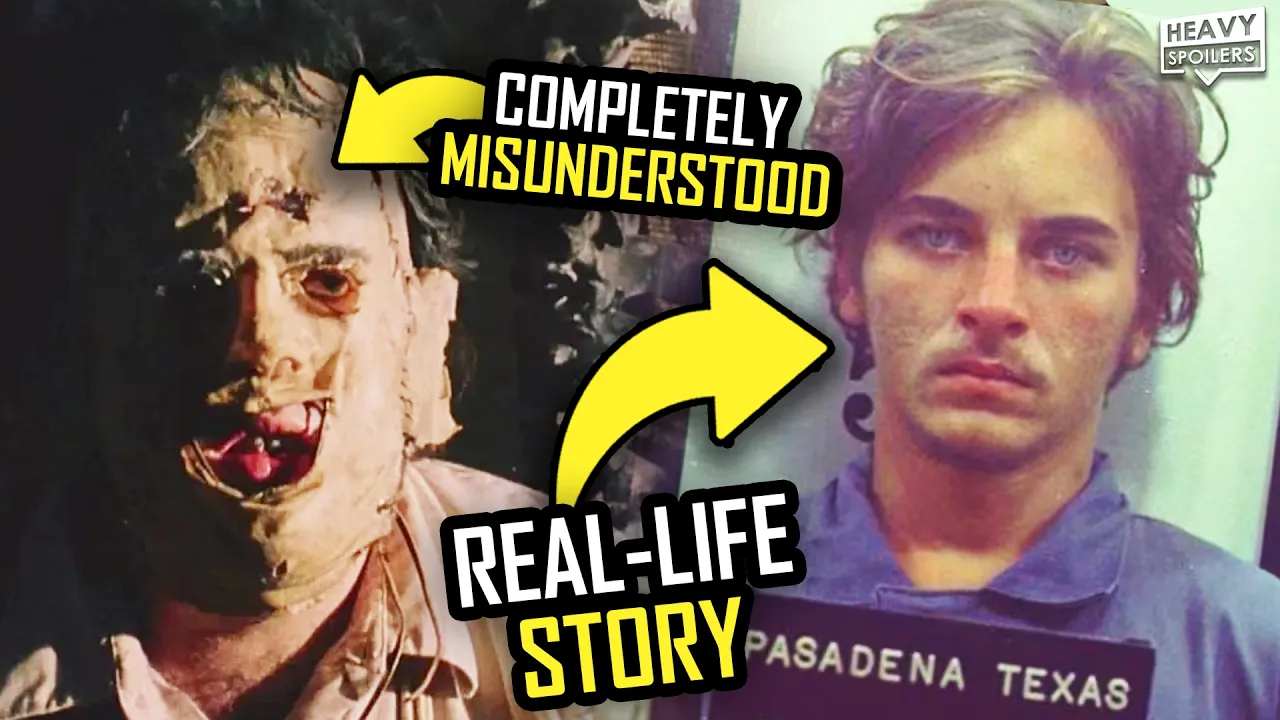
Adapted with AI from Heavy Spoilers' video of 20 December 2025 and checked against the video before publication. Editorial standards · Corrections
More from @heavyspoilers
All →


Make videos? Your next one could be an article here.
We turn your videos into articles under your name, linked back to the original. You keep 60% of what they earn, non-exclusive, and you can leave whenever you like.
Become a SubPlotter →