X-Men (2000) Breakdown: The Hidden Details, Casting Twists and Symbolism Behind the Film That Changed Superhero Movies
From Rogue's foreshadowing postcards to Magneto's stringless Newton's cradle, here is what the first X-Men film hides in plain sight, and how it was made
 Heavy Spoilers (AI-assisted)2 October 2026 · Editor: Digital Fox Talent Editorial Team
The first X-Men film from 2000 is packed with foreshadowing, symbolism and behind the scenes stories, from postcards on Rogue's wall that map out her journey to a train car that was physically torn apart with real actors inside. To me, this movie is "an absolute classic that really put superheroes on the map" as more than superpowered goody two shoes in spandex, and it cemented superhero movies as a legitimate medium for addressing real world issues.
X-Men opens with Magneto's Holocaust origin to signal a grounded superhero film
The movie wastes no time telling the audience what kind of superhero film it is. As the 20th Century Fox logo fades away, the X in the word Fox lingers in the darkness, which is a fantastic way to start the first X-Men film. After an animated sequence through what appears to be the inner workings of mutant DNA, we see the tragic origin of the antagonist, Erik Lehnsherr, whose powers manifested in direct response to the traumatic events of the Holocaust.
It is a somber way to open a superhero film, but it let the audience sympathise with Magneto's motivations right away. It also told audiences at the time that they were not about to sit through another cheesy, unbelievable superhero movie, but one rooted in actual reality with a meaningful message about humanity: that what makes us different makes us more beautiful and should not be feared. Since the X-Men comics were made to highlight the struggles of an oppressed group, starting with one of the worst real life examples of discriminatory persecution was a powerful way to connect people with this new but familiar universe.
As the captives walk through the mud, the gold star brands on their clothes stand out against the gray, dreary scene. I think that contrast is a profound way of showing why Magneto cannot stand a world that feels the need to label human beings as other. Sir Ian McKellen was one of the first people the producers cast, and one of his biggest reasons for taking the role was the realistic, human script centred on discrimination, something he could relate to as a gay man all his life. When Magneto uses his powers for the first time on the gate, he is also keeping four men from taking him down, and they only bring him to the ground once he is knocked unconscious, which is impressive for a first time.
Rogue's postcards foreshadow the Statue of Liberty and her run to Canada
The story then jumps to modern day Meridian, Mississippi, Rogue's hometown. That is the same state Rogue comes from in the comics, although comic book Rogue hails from a fictional county instead. As Anna Paquin's Rogue talks to her boyfriend, the wall behind her foreshadows the rest of the movie. A postcard of New York City with a cutout of the Statue of Liberty points to the climax, where Rogue is strapped into Magneto's machine at the Statue of Liberty.
A postcard of Washington DC points to the speeches Jean Grey and Senator Kelly give at the Capitol building. Above a postcard of Niagara Falls is another Canadian postcard, this one of the CN Tower in Toronto, and both point to Rogue's runaway journey to Canada after she kisses her boyfriend into a coma.
In the comics, the boy Rogue nearly kisses to death has a different name. The production reportedly changed the name as a shout out to David Hayter, one of the main writers of the movie. That is the same David Hayter famously known as the voice of Solid Snake in the Metal Gear franchise, and he even shows up later in the film as a museum cop.
Senator Kelly's hearing hides Kitty Pryde and possibly Mystique
The next scene moves to Washington DC and a very unique looking Senate hearing room that looks nothing like the real thing. During the hearing on the dangers of mutantkind, Bruce Davison's Senator Kelly pulls out a list of known mutants and mentions a girl in Illinois who can walk through walls. That is clearly Kitty Pryde, who is mostly a background character played by Sumela Kay and can be spotted later attending both Professor Xavier's and Storm's classes.
This scene also gives us, technically, the first potential appearance of Mystique, since we see the form of Henry Gyrich handing Kelly that list during Jean's speech. Later, Magneto tells Kelly that Gyrich has been dead for quite some time, so there is a chance the real Henry Gyrich was never in this movie at all. As Kelly ends his xenophobic speech to a standing ovation, his head is perfectly framed against the shining golden image of the Capitol building. That was likely a decision by the director to make him look like the holy savior figure for America that Kelly believes himself to be.
When Xavier confronts Erik in the Capitol hallway, I love the subtle big white X shaped beams in the background as they talk about the future of mutants, a clever way to visualise the tension of the scene. Keeping Erik's face in shadow until he turns to Xavier was a great choice, because it shows that "Magneto is the type of villain who plots in the shadows, only revealing himself when he chooses." According to producer Ralph Winter, the filmmakers intentionally modelled Professor X on Martin Luther King and Magneto on Malcolm X. I thought that was a fantastic choice to make this superhero world relatable, since those two real life fighters against discrimination had very different ways of seeking change.
Wolverine's Alberta introduction came after Russell Crowe and Dougray Scott fell away
We meet up with Rogue again in Northern Alberta after she gets a ride from a truck driver played by George Buza, who voiced Beast in the 90s X-Men animated series. He drives a Liberty truck, another piece of foreshadowing toward Rogue's eventual trip to the Statue of Liberty and a nod to the concept of liberty in a movie about discrimination. His character can also be seen sleeping behind a toy truck while Wolverine and Rogue sit at the bar. Alberta is where Logan grew up as a boy in the comics, which is likely why it was chosen for Wolverine's first appearance.
As iconic as Hugh Jackman has been as Wolverine, he was not the first choice. Russell Crowe was approached first but turned it down because he did not want to play a Wolfman, which led to Dougray Scott being cast. Scott was tied up filming Mission: Impossible 2 as that movie's main villain and was forced to drop out, so Jackman got a surprise call back nine months after he first auditioned.
When Logan approaches the bar, he is wearing the same jacket we later see him get from the old couple who are killed in his origin story in X-Men Origins: Wolverine. When Rogue hitches a ride, she notices his Canadian style dog tags, which he got shortly before his adamantium skeleton was installed at William Stryker's secret military base at Alkali Lake.
Sabretooth, Cyclops and Toad show how the film thinks about mutant powers
After Wolverine learns a hard lesson about seat belt safety, we meet the first live action Sabretooth, played by Tyler Mane, a former WCW wrestler. The role was initially offered to wrestler Kevin Nash, but pay disputes caused Nash to turn it down. When Sabretooth knocks Wolverine out with a tree, Wolverine's claws retract while he is unconscious, implying he has to be awake to consciously push them out. There seems to be a degree of mental focus involved in his powers.
As Halle Berry's Storm and James Marsden's Cyclops come to the rescue, Cyclops purposely reduces the strength of his eye beams so he does not hurt Rogue by accident. Later he uses a dial on the side of his visor to regulate his power when he clears Toad's slime from Jean's face. In the comics, Toad's saliva is incredibly acidic, to the point of melting most things, so Jean is lucky. Cyclops also impressively drags Logan's extremely heavy adamantium body away from the exploding trailer.
Then comes Mortimer Toynbee, the mutant Toad, played by Ray Park. I was surprised to see he can still move so well after carrying The Phantom Menace as Darth Maul, and he even shows off some of those skills when he picks up a metal object later on. The producers completely reinvented Toad from a jester like suck up to Magneto into a formidable threat. That depiction was so effective that it drastically changed Toad's look and direction in the comics, because once Marvel Comics saw Ray Park's Toad flatten a museum guard, they knew they had to update him. That squashed museum cop was played by Tom DeSanto, one of the movie's executive producers and head writers. Toad is also very adept with machines in the comics, so making him a key designer of Magneto's machine makes sense.
Magneto's stringless Newton's cradle and the floating walls of the X-Men's base
After Sabretooth growls at Toad with the vocal cords of an actual tiger, he enters Magneto's office, where a Newton's cradle on the desk keeps going without any strings at all. I thought this was a clever way to show the extent of Magneto's mastery over metal, since he holds a full conversation and walks out of the room before it falls apart.
We then get our first look at the X-Men's subterranean headquarters as Jean tries to put an IV into an unconscious Logan. All the walls of the hallway to Cerebro are actually floating, attached to the ceiling of the studio, with the Cerebro room itself on a completely different set. That was done to make lighting the scene easier. Even though X2 had yet to come out, I love how the film teases Wolverine's trauma from past experiments when he goes into fight or flight mode the second he realises he is about to be poked and prodded, as if some part of his fractured memory pushes him into defense.
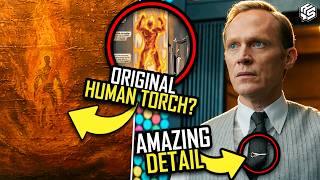
As Logan runs down the hallway, he passes the X-Men's uniforms in glass cases, much like Batman houses the Bat family's costumes. The producers did not want yellow spandex to undermine their realistic universe, but they still wanted a uniform to keep the spirit of the original comics, where the team colour coordinated. There appear to be three men's and three women's uniforms, even though the movie only has four active X-Men in Cyclops, Storm, Jean Grey and eventually Logan, with the other two likely going to Rogue and Iceman after the film. The original comic lineup was Cyclops, Jean Grey, Beast, Angel and Iceman, but Stan Lee said the producers benched Beast, Angel and Iceman in favour of Storm and Wolverine to form a team with a better dynamic in a realistic setting.
The X-Mansion locations and the students who were later recast
When Logan sneaks into the upper levels of the X-Mansion, the interiors were filmed inside the famous Casa Loma in Toronto, while the exterior shots were filmed at the Parkwood Estate in Ontario. Logan then meets Professor X at the end of his physics class, attended by Shawn Ashmore's Iceman, Alex Burton's Pyro, Sumela Kay's Kitty Pryde and Katrina Florece's Jubilee.
The sequel would recast Pyro with Aaron Stanford, Kitty Pryde with Katie Stuart and Jubilee with Kea Wong. During the montage as Xavier shows Logan around, you can spot the first live action Colossus, played by Donald MacKinnon, as Peter sketches in his sketchbook. The role was recast in X2 with Daniel Cudmore, who stayed on as Colossus for X2, X-Men: The Last Stand and Days of Future Past.
Mystique's makeup took up to eight hours, and Jean Grey inherited Beast's lines
Soon after, Mystique makes her first full transformation into her blue scaly form. To achieve the look, Rebecca Romijn sat through seven to eight hours of makeup, arriving at the studio at around 1 to 3 in the morning. They had to paint her entire body blue and apply over 100 prosthetics, including two layers of contact lenses that severely limited her vision, so I understand why it took so long.
It was worth it in my opinion, because Mystique's makeup looks fantastic here, especially compared to her last portrayal in 2019's X-Men: Dark Phoenix, "which just looks like Jennifer Lawrence at her local Comic-Con." When Jean goes over Wolverine's mutation and adamantium skeleton, you can see how much her film characterisation differs from the comics. That is in large part because many of her lines originally belonged to Beast in an earlier version of the script, before cost cutting removed Beast from the movie entirely along with Nightcrawler and Pyro, though Pyro was eventually reduced to a background character instead.
Magneto's idea of God points back to Charles Xavier
When Magneto talks about fearing God with a kidnapped Senator Kelly, he describes God as a teacher and a bringer of light, goodness and understanding. I found that interesting because those are all qualities his former best friend Charles Xavier has as a teacher at his school, which to me hints at the great respect Magneto has for him, a respect Erik does not really voice until after Xavier's death in X-Men: The Last Stand.
When Magneto steps into his machine, which taps into his biology and life force to spread mutating radiation, I could not help feeling it was essentially Magneto's anti Cerebro. Xavier tells us the two of them built Cerebro together to locate mutants. But while Cerebro was made to reach out to people, Magneto's machine was made to radically change them, so both machines reflect their creators and missions.
Jean then unlocks flashes of the day military officials gathered to watch Logan bonded with adamantium. Kevin Feige was supposed to be one of the generals in this scene, but his cameo did not make the final cut, long before he led the MCU. His first producer credit was as an associate producer on this very movie, though he did get an X-Men cameo in the pages of X-Men #21 from 2021. A cameo that did make it is Stan Lee as a hot dog vendor when a mutated Senator Kelly arrives on the beach. I also found the symbolism powerful: just as evolution brought fish onto land millions of years ago, the newly evolved Kelly emerges onto the beach. Feige would bring back that imagery with director Chloé Zhao at the start of Eternals, where the first Deviant emerges onto a beach.
The train station scenes mixed genuine reactions with practical effects
At the train station, Cyclops smiles back at a little boy who smiles at him. That moment was not planned; it was a genuine exchange between James Marsden and a big fan of Cyclops from the cartoon. The director decided to keep it and directed the boy's mother to give Cyclops a dirty look. When Scott blows the roof off the station, notice how his beams splash against the ceiling like water. Visual effects supervisor Michael Fink leaned into the idea of the beams having the concussive force of a large body of water, making sure they did not feel like a hot melting laser, because that is not how the power works in the comics.
For Magneto ripping the train car apart, the production physically tore a train car full of people in half, and most of the frightened reactions are genuine. According to Hugh Jackman, sparks started raining down from the cut as soon as they called cut, and there was genuine panic among all the actors. But luckily, the production had everything well under control and nobody died.
Sir Ian McKellen was given a bodysuit to give Magneto a larger, more intimidating physique, though Magneto hardly needs it when he can spread Wolverine's claws apart and launch him across the train. Those bendy claws were one of 15 different sets made for the movie, since different situations, like Logan accidentally stabbing Rogue through the chest, called for different claws. Later, when Magneto threatens to slowly push a bullet through a police officer's forehead, it reminded me of Michael Fassbender's Magneto pushing a coin through Kevin Bacon's forehead in First Class, and I feel like this moment inspired that one.
Why the X-Men traded yellow spandex for new suits
On the way to rescue Rogue, Cyclops asks Wolverine if he would prefer they all wore yellow spandex, a light jab at the original comic designs and the popular animated series of the time. It would have been great to see comic accurate costumes, but 2000 was a very different time for comic book movies, and the producers knew it.
20th Century Fox viewed the production as a bit of a risk, since comic book movies were becoming less popular after flops like Spawn, Ninja Turtles 3, Steel and Batman and Robin. People figured comic book movies were for kids who did not mind corniness and bad writing. So the producers set out to tell a mature, relatable story in a world resembling the one outside their windows, with costumes that made the team look like a believable strike team of elite superhumans rather than costumed wrestlers fighting crime.
Here is something funny: when the team arrives at the base of the Statue of Liberty and has to hop over a barrier, none of the actors could physically get over it because their suits were so tight. They were struggling to move and even to breathe. It was also the first time much of the crew saw all four in costume, and as soon as the director called cut, everyone screamed and clapped at the sight of the X-Men in live action.
The Statue of Liberty fight is full of clues about Mystique and Toad
Inside the Statue of Liberty museum, I love how the fake Wolverine appears from the left of the frame behind a pillar after the real Logan clearly went off to the right, a clue that this is not him before Mystique even pops her fake claws. Those claws are apparently still extremely sharp despite not being adamantium. When Wolverine cuts them off, Mystique screams in her own voice, which implies some concentration is needed for her to copy other people's voices.
That fight between Mystique and Logan was not originally planned, but after seeing how great Mystique looked in action on set, the production felt compelled to add it. When Toad faces off against Jean, he does a little jester style dance before hitting her with his slime, a nod to the court jester personality Toad had in the comics, which I thought was a nice touch.
Was Senator Kelly really dead, and what the final chess game says about Magneto
When Storm tells Magneto what happened to Senator Kelly, he asks if she is sure she saw what she saw, and that is a great point. All Storm really saw was Kelly turning into water, which does not necessarily mean he was dead. What if becoming a puddle was just his new mutation, like the 90s show The Secret World of Alex Mack? That is possibly why Magneto was unfazed by her warning. I also find it ironic that Magneto is blind to how his fears have made him the monster he feared most. By holding an innocent child captive and making her suffer for a group who believe themselves superior, his actions with the Brotherhood mirror the Nazis, who also believed their unethical behaviour was a justified means to an end.
After the X-Men save the day, the sequel tease arrives when Xavier shows Logan imagery of Alkali Lake, the site of Stryker's Weapon X complex where Wolverine got his claws, and the future death site of Jean Grey, who dies at the end of X2 before being reborn as the Phoenix in X-Men: The Last Stand. Finally, as Xavier and Magneto play chess, Magneto sacrificing all his pawns reflects his belief that anyone is expendable in his war against humanity, before he tips over his own king to concede defeat in their first battle of what became a trilogy long war for the fate of mutantkind.
So what do you think: did Senator Kelly really die, or was turning into water just his new mutation?
Watch the original
@heavyspoilers · YouTube
Adapted with AI from Heavy Spoilers' video of 11 September 2023 and reviewed by Digital Fox Talent before publication. Editorial standards · Corrections
Also on Magneto
6 creators, 15 takes →




More from @heavyspoilers
All →

Make videos? Your next one could be an article here.
We turn your videos into articles under your name, linked back to the original. You keep 60% of what they earn, non-exclusive, and you can leave whenever you like.
Become a SubPlotter →