Sovereign class: was it built for the Borg or the Cold War?
Starfleet conceived the Enterprise-E's class in the uneasy years after Wolf 359 as a political statement backed by real firepower, not as a last-minute weapon.
 Lore Reloaded (AI-assisted)23 November 2026Editor: Digital Fox Talent Editorial TeamOn YouTube since 2016 · more than 140,000 subscribers

The Federation likes to pretend that starships are just science vessels, places of curiosity, diplomacy and exploration, but that's never been the whole truth. Every hull on a Starfleet registry is also a political document, a manifesto written in duranium and warp plasma that says, "This is how we see ourselves, and this is what we're afraid of." In the late 24th century, no ship said more about the Federation's fears than the Sovereign class.
We don't meet it that way, of course. On screen, the Enterprise-E arrives as the cool new movie ship: sleek, fast, and ready to punch a hole through a Borg cube. For many fans, that's where the analysis stops. It's the upgraded Enterprise, the one that replaced the Flying Hotel. But if you look at when the ship was conceived in universe and what was happening around it, a very different story emerges.
The Sovereign Class Took Shape Before the Dominion War
The Sovereign wasn't born in the Dominion War, and it wasn't built as a last-minute reaction to the Borg. It took shape in the uneasy years before all of that, in the shadow of Wolf 359, in a quadrant that was technically at peace but quietly arming itself for something everyone could feel coming and no one wanted to name: the Dominion Cold War.
This wasn't the kind of cold war where you declare enemies and draw battle lines. It was the kind where every border incident becomes a test, every alliance feels conditional, and every new ship design is a message. The Sovereign class was a message Starfleet never wanted to say out loud. Stripped of the movie sheen and the nostalgia, it never really was a Borg killer. Starfleet treated it less like a battleship and more like a political chess piece.
To understand why it ended up looking the way it does, you have to go back to the transition moment: the years when the galaxy stopped being a playground, Starfleet realized its neighbors were arming up, and the Federation slid almost accidentally into a cold war.
Wolf 359 and the Romulan Return Exposed the Federation's Blind Spot
By the mid 2360s, the Federation was telling itself a comforting story. The great wars were behind it, diplomacy had replaced conquest, and Starfleet's greatest challenge was deciding which strange new world to visit next. Reality was starting to disagree.
In 2367, the Battle of Wolf 359 didn't just destroy 39 starships and kill over 11,000 people. It exposed something far more dangerous: Starfleet had fundamentally misread the galaxy it lived in. A single enemy vessel tore through the fleet with terrifying efficiency, and no clever diplomacy, scientific insight or heroic maneuver could undo the damage. For the first time in generations, the Federation realized it could lose. Not symbolically, not philosophically, but physically.
Wolf 359 didn't happen in isolation. Three years earlier, the Romulan Star Empire had emerged from nearly half a century of silence. After the Tomed Incident, the Romulans vanished behind the Neutral Zone, rebuilding in secret while the Federation convinced itself the problem had gone away. When they returned in 2364, they came with massive D'deridex class warbirds and a renewed appetite for influence. These weren't exploratory cruisers. They were intimidation platforms. The Romulans hadn't forgotten the balance of power; they'd been refining it.
The Klingon Civil War, the Cardassian Border and the Maquis
At the same time, the Klingon Empire was showing signs of internal fracture. Chancellor K'mpec's assassination in 2367 triggered a succession crisis that spiraled into civil war, with the Romulans backing the House of Duras and Starfleet quietly tipping the scales the other way. Gowron ultimately prevailed, but the lesson was clear. The Klingons were no longer a predictable partner, and stability in the quadrant was no longer something you could assume.
To the Federation's south, the Cardassian border war had technically ended in 2367, but peace came at a cost. The armistice and treaty created the Demilitarized Zone, carving up worlds, abandoning Federation colonists and calling it diplomacy. What followed wasn't peace; it was resentment. By 2370, those abandoned settlers would organize into the Maquis, a guerrilla movement attacking Cardassian targets and dragging Starfleet into a shadow conflict it officially pretended didn't exist.
The Dominion Arrived in a Galaxy Already Full of Espionage
Then there was the Gamma Quadrant. At first it was just rumors: traders whispering about an empire that absorbed worlds rather than negotiating, and warnings from species about a power that ruled through fear and absolute control. In 2370, those rumors became undeniable. The Jem'Hadar destroyed the Galaxy class USS Odyssey, not in a desperate battle but as a deliberate demonstration. The message was blunt: stay out or be subjugated.
Meanwhile, covert operations multiplied. Romulan intelligence nearly framed the Federation for arming Klingon rebels. Starfleet's illegal phase cloak experiment was buried for years until it almost sparked a diplomatic disaster. The Tal Shiar and the Obsidian Order launched a secret joint strike against the Dominion and were annihilated for their arrogance. Espionage wasn't an aberration anymore. It was the background noise of the era.
Individually, each of these events could be explained away. Together, they formed a pattern Starfleet could no longer ignore. Between 2365 and 2370, the Federation wasn't surrounded by enemies, but it wasn't surrounded by certainty either. Old rivals were rearming, allies were unstable, new powers had no interest in Federation ideals, and the Borg had proven that technological superiority was not a permanent condition. It was a multipolar standoff defined by deterrence, intimidation, intelligence failures and the constant fear that one misstep could ignite something catastrophic. A cold war in everything but name.
Publicly, Starfleet still talked about exploration and diplomacy. Privately, its leadership understood that projecting weakness was no longer an option. The Federation needed to look calm, confident and unshakable, even if it wasn't. That is the environment the Sovereign class was born into: not a response to a single enemy or a weapon for a war already begun, but a flagship for a galaxy where everyone was watching everyone else, no one wanted to fire first, and being unprepared was no longer survivable.
Why Starfleet Lost Faith in the Galaxy Class
Before Starfleet could build a Cold War flagship, it had to lose faith in the one it already had. The Galaxy class was never meant to fight a war. It was meant to end the idea of war entirely. When Starfleet launched the Galaxy program in the early 2360s, these ships were communities, floating cities with schools, families, concerts, arboretums and observation lounges. They carried civilians because Starfleet genuinely believed the galaxy was safe enough to bring your children to work. The Enterprise-D wasn't just a flagship. It was propaganda, a promise that the age of fear was over.
For a while, it worked. The Galaxy class excelled at diplomacy and projected confidence without aggression. When one entered a system, it didn't feel like an invasion; it felt like an invitation. But that assumption collapsed under pressure. In 2365, the USS Yamato was lost, not to enemy fire, but to a cascading systems failure caused by an alien computer virus. Starfleet briefly feared a design flaw in the class itself. That fear proved unfounded, but the optics mattered: one of Starfleet's most advanced ships had been wiped out without firing a shot.
Then came Wolf 359. The Enterprise-D survived only because it wasn't there, while the Federation watched a single Borg cube tear apart a fleet that included some of its most advanced vessels. Worse, the Borg used Starfleet's own flagship captain as a weapon. Picard's assimilation turned the symbol of Federation enlightenment into the instrument of its worst defeat. The Galaxy class wasn't just outgunned; it was compromised. Families on frontline vessels began to look reckless, children had nearly died in multiple crises aboard the Enterprise-D, and the ship's sheer size became a liability: too large to maneuver easily, too complex to repair quickly, too expensive to lose.
In 2371, the Enterprise-D was destroyed, not by a fleet or a superweapon, but by an aging Klingon Bird of Prey exploiting a moment of vulnerability. It was a humiliating end for the Federation's proudest symbol, and the flying city philosophy suddenly looked dangerously outdated. The Galaxy class had been designed for the galaxy Starfleet wanted to live in, not the one it actually occupied. Its failure wasn't weakness; it was an assumption of permanent peace. The next flagship would not be a city, would not carry families, and would not pretend danger was an anomaly. The Galaxy class had been a statement of hope. What came next would be a statement of preparedness.
The Defiant Class Broke Starfleet's Taboo on Warships
Starfleet never announced a doctrinal shift. There was no address from the Federation Council and no declaration that the age of pure exploration was over. But in the ships Starfleet began building in the late 2360s and early 2370s, the change is unmistakable. After Wolf 359, Starfleet quietly stopped asking what kind of ship best represents who we are and started asking what kind of ship ensures we survive. The answer was deterrence, not through threats or rhetoric, but through visible capability: the idea that the right ship in the right place could prevent a war simply by existing.
The first sign was the Defiant class. Officially it was an escort, a defensive platform with a deliberately modest designation. But inside Starfleet, everyone understood it was a ship designed to fight: compact, massively overarmed, armored in ways Starfleet vessels never had been, with no families and no civilian spaces. It was a warship Starfleet refused to name as such, and that distinction matters because it reveals an institution in transition, one that knew the rules had changed but wasn't ready to admit it openly.
Once that line was crossed, everything else followed. The Akira class with its torpedo heavy design, the Steamrunner with its compact reinforced hull, and the Norway and Sabre classes, fast and optimized for fleet engagements. Even aging Excelsiors were refit with modern weapons. The new philosophy favored smaller crews, higher firepower density, faster construction, redundancy over comfort and survivability over symbolism. This wasn't panic; it was calculation. Weakness invited probing, and probing invited escalation. If peace was to be preserved, it had to look expensive to challenge.
The Sovereign Was Built to Prevent Fighting, Not to Hunt the Borg
Contrary to popular belief, the Sovereign was not Starfleet's direct answer to the Borg. That role belonged to ships like the Defiant: fast, compact and expendable if necessary. The Sovereign was designed alongside these vessels as their counterpart. Where the Defiant was built to fight, the Sovereign was built to prevent fighting, to arrive first, be seen and set the tone before a shot was fired.
This is classic Cold War logic. You don't deploy your most advanced platforms only after war breaks out; you place them where their presence reshapes the strategic environment and makes escalation costly. Escorts and cruisers would handle the grinding realities of war, while the Sovereign would carry the flag alone if necessary, projecting authority, confidence and quiet menace. By the time the Dominion revealed itself as a full-scale threat, this doctrine was already in place. Starfleet needed a ship that could stand alone and say, "We are still here. We are still strong and we are no longer unprepared."
Sovereign Class Design Signaled Strength It Could Back Up
That visibility only worked because everyone knew what the ship could do. The Sovereign was not a bluff. Starfleet needed a vessel that could carry diplomats, admirals and heads of state into unstable regions while remaining capable of surviving a worst case scenario. Political first, but never politically fragile.
On paper, it isn't the largest ship Starfleet ever built. The Galaxy class exceeds it in internal volume, a consequence of carrying families and entire communities. The Sovereign is longer, leaner and far more densely packed with systems. The Galaxy was larger because it carried a civilization; the Sovereign feels larger because it carries force. Its integrated hull, elongated nacelles and narrow profile give it a predatory presence with no wasted space. Its quantum torpedo launchers sit openly on the forward hull, and phaser arrays wrap the ship in near continuous coverage. A Sovereign entering a system doesn't need to threaten anyone verbally; its silhouette does that work.
Its armament was among the most formidable Starfleet had ever fielded, and that was proven when the Enterprise-E went toe to toe with a Borg cube at Sector 001. The ship absorbed punishment, adapted and survived, contributing directly to the cube's destruction. That wasn't an anomaly but validation, and it made the deterrence credible. Yet the Sovereign was not treated as expendable. In a cold war, your most powerful assets are positioned carefully, preserved deliberately and revealed selectively.
Why the Sovereign Class Makes Sense as the Enterprise
That is why the Sovereign makes sense as the Enterprise. The Enterprise is not meant to be the first ship destroyed. It is meant to be the ship that still exists when the dust settles, the one that can fight and then immediately negotiate, and win while still representing Federation ideals afterwards.
The Sovereign class wasn't built to avoid combat. It was built so that when combat came, the Federation would not lose its voice or its flagship in the first exchange. That, more than raw firepower, is what made it Starfleet's Cold War flagship.
What other creators are saying
More on Star Trek →I rank these as my 11 favorite Star Trek production mistakes, from Bashir's white trainers to the accidental second Riker at number one, noting which were left alone and which the remasters fixed. I enjoy them purely as fun background discoveries, not flaws worth getting upset about.
Star Trek production mistakes: where to spot all 11 errors →
A Romulan War buildup, a Mirror Universe miniseries, the Borg Queen's origin and a refitted NX-01 were all part of the plans for a season that never got made
Tomorrow's Enterprise plays less like classic Kirk and Spock and more like Next Generation's All Good Things, and the people who made it are calling the future we saw continuity.
Strange New Worlds finale: did it give TOS the ending it lacked? →
Watch the original
@lorereloaded · YouTube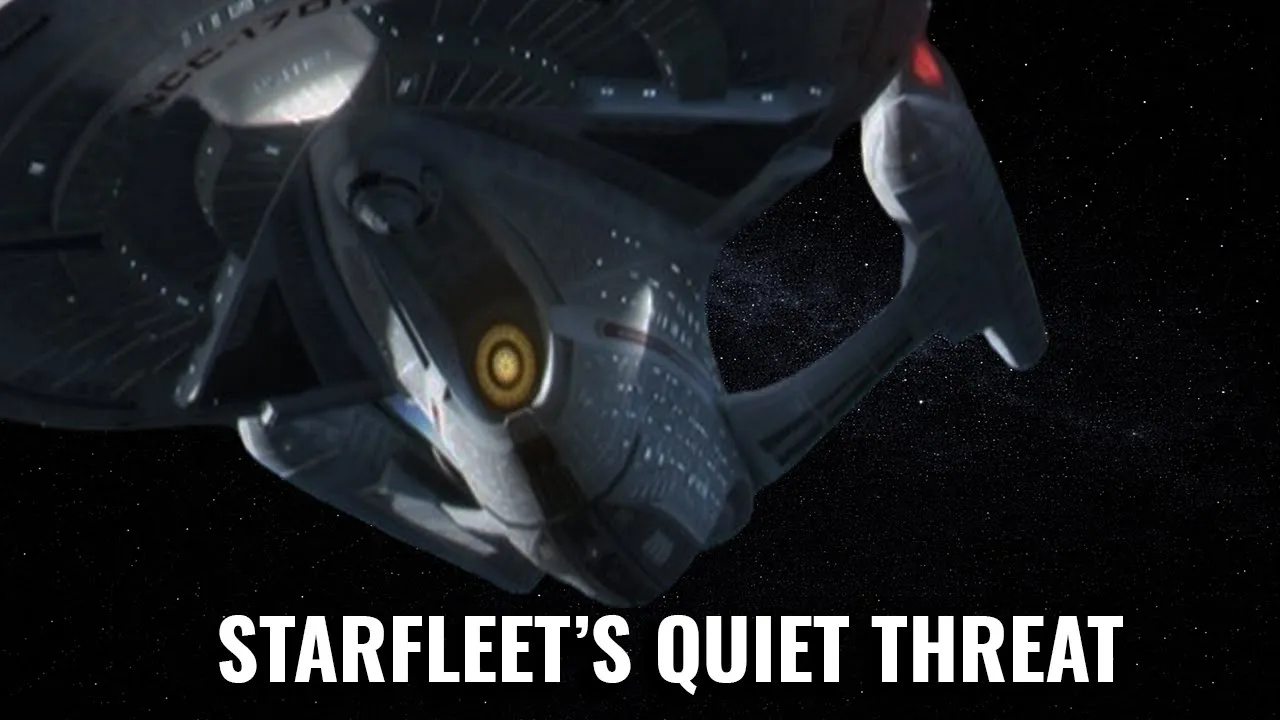
Adapted with AI from Lore Reloaded's video of 21 December 2025 and checked against the video before publication. Editorial standards · Corrections
More from @lorereloaded
All →

Make videos? Your next one could be an article here.
We turn your videos into articles under your name, linked back to the original. You keep 60% of what they earn, non-exclusive, and you can leave whenever you like.
Become a SubPlotter →