Voyager: was Janeway's Starfleet and Maquis crew unworkable?
Two crews shaped by the same broken treaty had to share one bridge in the Delta Quadrant, and the captain had to hold both together alone
 Lore Reloaded (AI-assisted)18 November 2026Editor: Digital Fox Talent Editorial TeamOn YouTube since 2016 · more than 140,000 subscribers

The hardest part of Captain Janeway's command in Star Trek: Voyager wasn't the distance, the danger or the years away from home. It was leading the Starfleet ideal and the Maquis contradiction at the same time, knowing both were real and that neither could be ignored. Star Trek: Voyager (1995) starred Kate Mulgrew, Robert Beltran and Roxann Dawson.
Janeway put the arrangement plainly: "Both crews are going to have to work together if we're to survive. That's why Commander Chakotay and I have agreed that this should be one crew. A Starfleet crew."
How Voyager's Starfleet and Maquis crews became one in a single moment
When Voyager was pulled into the Delta Quadrant, the crisis wasn't only distance. Within hours, a Starfleet vessel built on structure and protocol was responsible for a second group that had been operating outside both. The Maquis were no longer a separate force acting in opposition. They were suddenly part of the same mission, dependent on the same ship and subject to the same command decisions.
Everything changed immediately after the loss of the Caretaker array. There was no route home, no nearby support and no option to split into parallel operations. Survival meant sharing resources, space and responsibility. An integration that would have taken years under normal circumstances happened in a single moment, under pressure, with no time to negotiate the terms.
Both groups brought very different expectations onto the bridge. Starfleet officers were trained to follow a chain of command, work within established doctrine and keep long term objectives even under stress. The Maquis had spent years without that structure, relying on initiative and improvisation in conflicts where support was uncertain and trust in the Federation was already broken. Those instincts didn't disappear aboard Voyager. They followed them onto a new battlefield.
Janeway's command began in the middle of that collision. She was establishing authority over people who had spent years rejecting the system she represented, while her own officers adjusted to former enemies standing beside them at tactical stations, in engineering and on away teams. What formed was less a merger than a working agreement built on urgency. Chakotay became first officer and B'Elanna Torres took a senior engineering position. Decisions came quickly, not because the divisions were resolved but because the situation demanded stability. The ship had to function before trust could catch up.
Why the Maquis existed: the treaty between the Federation and the Cardassians
Bringing the Maquis aboard solved the immediate crisis. Systems were manned and departments stabilized. What it didn't resolve was why these people had taken up arms in the first place. The tension on Voyager didn't begin in the Delta Quadrant. It started years earlier, in a war that ended with a line drawn across someone else's home.
When the Federation and the Cardassian Union negotiated their treaty, borders shifted to create a lasting peace. In practice, entire human colonies found themselves on the Cardassian side of a line they had never agreed to cross. The Federation offered relocation and compensation. For some, that was enough. For others, it felt like abandonment. Settlements built over generations now answered to a government they didn't trust, and reports of harassment, raids and pressure from Cardassian forces made staying a life under constant threat.
Some colonists accepted the decision and moved on. Others stayed to defend what they believed was rightfully theirs, and that choice marked the beginning of the Maquis. At first they were settlers protecting their homes. Over time they became organized resistance fighters, striking Cardassian targets while avoiding direct confrontation with Starfleet. Their conflict was also with the institution that had drawn the line and expected them to live with it.
For Starfleet, the treaty was a peace won after years of tension, and officers were sent to keep stability, not to choose sides. That put them in conflict with colonists they were supposed to protect, and the more the Maquis pushed back, the more Starfleet had to treat them as a problem to contain. Former officers resigned their commissions to join the resistance and civilians learned to fight. By the time Voyager met them in the Badlands, the Maquis were the outcome of years of compromise, resentment and survival under pressure. The conflict hadn't been resolved, only paused.
Janeway kept Voyager operating as a Starfleet ship
Janeway carried more than rank onto the bridge. She carried the belief that Starfleet represented something larger than survival, a structure meant to hold when everything else was uncertain. Her decisions reflected that from the start. Destroying the Caretaker's array ensured no one else would be trapped the way Voyager had been, and it defended the sector against the Kazon, even though it cost the crew their own immediate path home.
Protocols and principles still mattered. Even cut off from the Federation, she operated as if those standards were in the room with her. Officers trained under that system understood the logic: discipline created stability. When they had lost contact with everything familiar, procedures were a way to keep the mission intact. That approach also had limits. Keeping formality and operating as a Federation vessel rather than a drifting survival ship meant decisions that weren't always the most efficient or the safest in the short term.
For the Maquis, that identity carried a different weight. They were stepping into a command structure they had rejected not long before, and now their survival depended on it. Janeway understood that authority alone wouldn't hold the ship together. Legitimacy had to be built through consistency, with every decision reinforcing that the rules existed for a reason. Over time that steadiness created predictability, and even former opponents of Starfleet could see the logic behind it. It built trust among officers who expected order and friction with those who relied on instinct.
Chakotay brought the Maquis instinct to the first officer's chair
Before he stood beside Janeway, Chakotay had already walked away from the institution she represented. His time in Starfleet taught him its structure, discipline and belief in order. Leaving meant deciding that the system he once served could no longer protect the people he cared about. That decision grew out of the same treaty that displaced the colonists. Chakotay chose to stand with those who stayed, trading command protocols for improvisation and long term strategy for immediate necessity.
His authority came from action rather than rank, built where hesitation could cost lives. By the time Voyager found the Maquis, he was leading people who trusted him to make hard choices quickly, relying on instinct, adaptability and a willingness to operate outside the lines. Stepping aboard Voyager put him back inside the structure he had left. The uniform and the chain of command returned, and his orders came from someone who embodied the system he had turned away from.
His past didn't vanish. Where Starfleet officers looked to protocol, Chakotay often looked to experience. Where the system favored caution, his instincts leaned toward action. That didn't always mean open conflict, but it created a quiet tension running through the ship's decision making. Few people on Voyager could speak both languages, and fewer could shift between them so easily. As first officer, he became a link between two worlds, able to voice concerns that might otherwise have gone unspoken, and a constant reminder of why the Maquis existed at all.
The Kazon showed the cost of getting decisions wrong
The cost of a wrong call showed itself early. Not long after Voyager was stranded, the ship began encountering the Kazon, a fractured and aggressive group controlling large parts of the region. Early meetings were cautious, then turned violent. Ambushes became common, away teams were forced to retreat, people were injured and some didn't make it back. The crew realized they were operating inside someone else's territory.
Speed created its own dangers. Voyager needed supplies, safe routes and information, and acting quickly before opportunities disappeared put the ship into direct confrontations more than once. The Kazon studied how Voyager moved, set traps, surrounded the ship and probed its defenses. Even when Voyager broke away, the aftermath meant damaged systems, injured crew and days of repairs after a single misjudged move. Every plan had to answer the same question: slow down and risk missing the chance, or move fast and risk walking into something you don't fully understand?
Sometimes the Maquis instinct clearly worked. Chakotay often pushed for decisive action when hesitation could mean getting pinned down, and quick maneuvers, sudden course changes and early disengagement let Voyager slip away from Kazon forces trying to box them in. Other moments proved Starfleet's way. Janeway's insistence on patience during first contacts led to safer outcomes than force, and restraint stopped several encounters from escalating into battles the ship might not have survived. Instinct could get them out of danger. Structure could keep them from walking into it. What formed wasn't harmony but a working tension that made the ship more adaptive.
Command without admirals: Janeway's isolation in the Delta Quadrant
Distance also removed the structure that usually surrounds a captain. There were no admirals to consult, no fleet for support and no system to absorb the pressure when things went wrong. In the Alpha and Beta Quadrants, responsibility is spread across departments and institutions, with reviews and investigations when something fails. Out here there was only the next decision and the knowledge that no one else would make it.
Success didn't bring relief, only the expectation that the next choice would carry the same weight. Loss made the isolation sharper. Every name missing from the duty rosters and every injury a different call might have avoided settled into memory, with no one to share the responsibility once the moment was over. Even victories added pressure, because each one confirmed the ship survived on the decisions made on that bridge. The crew saw confidence and direction. They couldn't see the silence after the doors closed.
Over time, that kind of command changes a person. The distance from the Federation stopped being measured in light years and became the space between what Starfleet taught and what survival demanded. Out here, Starfleet wasn't a council, a fleet or a set of regulations. It was one ship, one crew and one captain. Every time Janeway weighed patience against safety or risk against certainty, she was defining what Starfleet looked like with no one there to see it. There was no one left to enforce the ideal, only someone left to become it.
Starfleet and the Maquis on one bridge: the impossible part of Janeway's command
Voyager carried Starfleet into the Delta Quadrant along with the people who had once fought against it. Chakotay understood Starfleet better than most because he had once believed in it completely, and he understood why others lost faith. One side believed structure held civilization together. The other had survived by learning what happens when that structure doesn't protect you. Neither view was wrong. Both were shaped by experience.
There were moments when Starfleet's way saved them and moments when the Maquis way did. The line between them stopped feeling like a border and started feeling like a constant negotiation. The ship worked because those perspectives never erased each other, forcing every decision to be stronger than it would have been alone. Janeway's goal was never to make one side disappear, but to keep both moving in the same direction long enough to survive. Starfleet didn't erase the Maquis, and the Maquis didn't undermine Starfleet.
Chakotay stood as proof of what Starfleet had caused. Janeway stood as proof of what Starfleet was trying to be. Every day they shared that bridge, the two realities existed in the same room, not resolved and not forgotten, held together by the person in command. That was the impossible part: leading the ideal and the contradiction at the same time, knowing both were real and neither could be ignored.
Watch the original
@lorereloaded · YouTube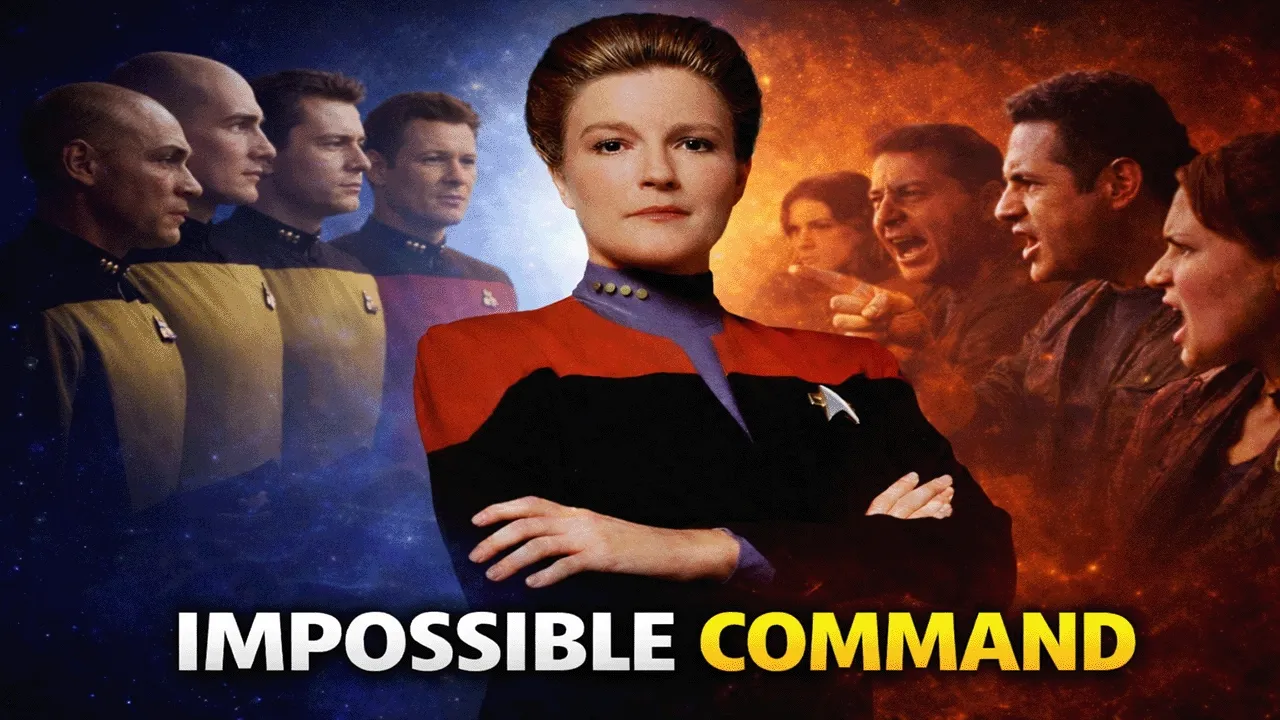
Adapted with AI from Lore Reloaded's video of 18 February 2026 and checked against the video before publication. Editorial standards · Corrections
Also on Starfleet
2 creators, 36 takes →



More from @lorereloaded
All →


Make videos? Your next one could be an article here.
We turn your videos into articles under your name, linked back to the original. You keep 60% of what they earn, non-exclusive, and you can leave whenever you like.
Become a SubPlotter →