Star Trek theory: is Q's trial meant to stop the Federation?
Q's never ending trial of humanity may be less a judgment than an attempt to stop the Federation from becoming what the Q already are
 Lore Reloaded (AI-assisted)11 November 2026Editor: Digital Fox Talent Editorial TeamOn YouTube since 2016 · more than 140,000 subscribers

Star Trek: The Next Generation (1987), starring Patrick Stewart as Jean-Luc Picard and John de Lancie as Q, opens with humanity on trial. My theory is that the Federation's path doesn't end in utopia. It may end in something resembling the Q, and Q's trial could be an effort to stop humanity from getting there.
Picard once stood in a courtroom, accused by a being who claimed the right to judge an entire species, and was told the trial never ended. Something about that premise never quite sat right. Q doesn't act like an outside observer. He doesn't study humanity the way a god studies ants. He provokes, challenges and fixates, and he keeps coming back to humanity rather than to other civilizations. Look closer and the question shifts. It's no longer why Q is interested in humanity, but why he cares so much about what it becomes.
Q's trial of humanity at Farpoint was never resolved
Picard's first encounter with Q is often remembered as a victory. Humanity is accused of being violent, impulsive and unworthy, and through argument alone Picard convinces Q to let them continue. The Enterprise moves on, exploration resumes, and the threat appears resolved. But that reading depends on something Q never says. As I see it, "humanity is never acquitted. It is postponed."
Q is explicit that the trial doesn't end at Farpoint. It begins there. The Enterprise isn't released because humanity has proven itself. It's allowed to proceed so proof can be gathered over time, under pressure, in conditions where belief is no longer theoretical. That distinction changes how every later encounter reads. None of them are random or born of curiosity. They're continuation, each one another controlled moment where humanity has to act rather than argue, in reality rather than a courtroom, where consequences can't be reasoned away.
Q returns to the same ship, captain and species
When those moments come, Q doesn't behave like an observer. He doesn't watch from a distance or collect data and move on. He intervenes directly and precisely, creates the conditions, then waits to see what breaks first: principle, logic or survival. What's unusual is how narrowly he does it. The galaxy is full of civilizations older, more powerful and more volatile than the Federation, yet Q doesn't spread his attention. He returns to the same ship, the same captain and the same species.
That isn't broad evaluation. It's focus, and more than that, familiarity. Q doesn't test humanity like something foreign. He knows where to apply pressure and anticipates reactions before they happen. He builds scenarios that force specific decisions, testing not only whether humanity survives but how it justifies survival when its own rules become inconvenient. There's a difference between studying a species and understanding it. Observation produces patterns, but understanding predicts behavior, and Q predicts behavior at the exact points where belief and action begin to diverge.
He doesn't ask what humanity stands for. He forces it to demonstrate it, under conditions where the answer isn't easy and the cost is immediate. That's not how something explores the unknown. It's how something evaluates what it already understands. If the trial never ended, these encounters are one process refining one question: not whether humanity can explore the galaxy, but whether it can be trusted with what it's becoming.
The Borg encounter and Q's controlled tests
When Q reappears after Farpoint, he doesn't revisit the terms of the trial. He escalates it. Without warning, he removes the Enterprise from known space and forces it into contact with the Borg, an enemy the Federation is completely unprepared to face. It isn't a warning delivered through explanation but an experience, immediate, violent and unavoidable. An omnipotent being has countless ways to test a species, and Q doesn't choose abstraction. He chooses situations where failure is real, then watches how humanity responds when its assumptions collapse.
The structure stays consistent each time, while the variable changes. He offers power, forcing individuals to decide whether restraint is a principle or simply a limitation. He removes structure, isolating members of Starfleet from the systems that define their behavior. He creates conflict where logic, morality and survival no longer align, then forces a choice between them. Each scenario isolates one aspect of human behavior, such as authority, responsibility, temptation or sacrifice, and applies pressure until a choice has to be made.
Q doesn't rely on scale or reshape whole civilizations. He focuses on captains, officers and singular decisions, and treats them as representative of the whole. That only works if behavior is predictable, and Q acts as if it is. He doesn't guess how Picard will respond. He targets his sense of duty, his belief in restraint and his reliance on reason over force. When Q shifts to someone else, the method changes, but the understanding behind it doesn't.
Q may be confirming an outcome he has already seen
This only works if Q already knows the outcome, not as a probability but in the exact moments decisions are made. He doesn't explore possibilities. He builds situations that force specific choices and waits for them, over and over: the same pressure, the same conflicts, the same kinds of outcomes. At that point the question isn't whether Q understands humanity. It's whether he's confirming something he's seen before.
That makes his selectivity harder to ignore. He keeps returning to humanity as if the outcome here matters more than anywhere else, which suggests priority in terms of direction rather than strength. His scenarios aren't designed to measure whether humanity can survive. The Federation has already shown it can endure, expand and adapt. What remains uncertain is whether it will remain what it claims to be when it no longer has to. If those decisions can be anticipated, they can be shaped and reproduced. "This is not how something studies the unknown. It's how something tests an outcome it expects to see."
The Federation is a trajectory toward something beyond human
The Federation doesn't present itself as a finished civilization. It presents itself as a trajectory, built on the assumption that humanity is improving and moving toward something beyond its current state. Exploration is refinement, not just expansion. Conflict is something to be reduced, managed and eventually outgrown. Success is defined not through dominance but through gradually removing the conditions that make dominance necessary. Humanity in the Federation is no longer driven by scarcity, and survival is no longer the primary concern.
The trajectory doesn't stop at social evolution. In moments often treated as exceptions, encounters with higher order entities introduce the idea that existence isn't limited to physical form, and individuals show awareness, perception and influence beyond what should be possible. These events aren't common, but they aren't isolated either. They appear just often enough to suggest direction. If humanity keeps removing limitation, it eventually reaches a point where the conditions that shaped its identity no longer exist.
The Federation's ideals of restraint, cooperation and moral responsibility exist because there's pressure to act and consequences for failing them. Remove that pressure and those principles become optional. Progress turns into transformation into something that no longer needs to be human: a state without physical constraints, where knowledge is accessed rather than learned. Purpose exists because there are obstacles to overcome. Remove them and it fades, leaving capability without direction, and the question of whether that evolution preserves anything recognizable at all.
The Q Continuum looks like a civilization that has exhausted itself
If the Federation is a trajectory, the Q Continuum begins to look like an outcome. Not a confirmed destination, but a working model of existence without limitation. The Q control space, time and matter, aren't bound by form, distance or causality, and face no scarcity or rival. By every measurable standard they've achieved total capability. But capability doesn't resolve purpose. The Continuum behaves less like a civilization that reached fulfillment and more like one that exhausted it. Its conflicts are abstract and personal, escalating without stakes because none are left.
The Q don't describe growth. They refer to stagnation, a state where everything knowable has already been experienced. The result is repetition, not enlightenment. Without limitation nothing guides behavior, and without consequence nothing restrains it, so the Continuum drifts. Their engagement with the galaxy is inconsistent, with whole civilizations ignored while others draw focused attention without clear reason. Individual Q act on personal interest rather than collective purpose.
Against that, Q's fixation on humanity stands out. His methods are consistent and deliberate, sustained over time, showing an intent the rest of the Continuum lacks. There's another oddity. Evolution leaves traces of prior states, and the Federation's changes can be tracked through cause and effect. The Q appear fully formed, without a clear origin. A system without a past isn't one that emerged. It's one that stopped remembering, which turns the question to what the Q used to be.
Q's human personality and human centered tests point to familiarity
This idea doesn't rest on one piece of evidence. It depends on repetition, on details that can each be dismissed but together begin to form direction. Start with Q himself. His personality isn't alien. It's sarcastic, curious and impatient, and he shows frustration, amusement and something resembling pride. An omnipotent being doesn't need to mirror a lesser species' emotions to communicate with it. Q chooses to engage on human terms, in tone, timing and reaction. That suggests preference, and preference suggests familiarity.
His tests are rooted in human morality: duty versus survival, truth versus outcome, restraint versus action. These aren't universal tests. They're specific to how humanity defines itself, built to provoke internal conflict, and Q anticipates the results. There are only so many explanations for that. It could be prolonged observation. It could be omniscience. Or it could be something rooted in shared origin rather than distant study. Combined with his selectivity, his behavior starts looking less like curiosity and more like confirmation.
The theory doesn't need certainty or to prove the Q are future humans in a literal sense. It only needs the connection to be plausible, and the patterns align not conclusively, not definitively, but consistently. If the connection exists even as a possibility, then the difference between humanity and the Q is no longer defined by what they are. "Only by when they are."
Q's trial may be an attempt to alter humanity's future
If the Federation's path leads toward something resembling the Q, the trial is no longer about whether humanity deserves to explore the galaxy. It's about whether it should reach what lies at the end of that exploration. Q doesn't behave like a judge delivering a verdict. He behaves like something delaying one. He intervenes before decisions are made, at points where humanity's trajectory can still shift. That's not observation. It's control, subtle and indirect but consistent.
Each encounter puts humanity where its ideals carry risk: where restraint can lead to loss, honesty can cost more than deception, and the easier path abandons what the Federation claims to stand for. Q doesn't force the outcome. He ensures a choice has to be made and measures whether humanity stays aligned with its principles when survival makes them inconvenient. These are tests of direction, not capability. If Q were only judging worthiness, the process would be complete, because the data is there. Yet the trial continues.
If the Federation is moving toward something the Q have already experienced, preventing that outcome becomes a logical objective, pursued through pressure at the moments the trajectory can still change. Q isn't judging humanity's past or measuring its present. He's trying to alter its future. The trial isn't about whether humanity is worthy of survival but whether it should be allowed to become what the Q already are. And if that outcome is inevitable, the only question left is whether it can be stopped.
What other creators are saying
More on Star Trek: The Next Generation →The actor behind Jean-Luc Picard and Charles Xavier died at his Los Angeles home following Alzheimer's disease and Lewy body dementia, his longtime spokesperson announced
A rival actor, a forgotten middle name, a Q ancestor and a development idea to kill off Will Riker and keep Thomas
Star Trek (2009) and The Force Awakens share a director, a reboot mission and the start of a trilogy
J.J. Abrams Played an Almost Identical Role in Star Trek and Star Wars →
One card plays artifacts from the top of your library, and the other rewards facing a dilemma with free spells
Zefram Cochrane and the Caretaker among Magic: The Gathering Star Trek preview cards →
Watch the original
@lorereloaded · YouTube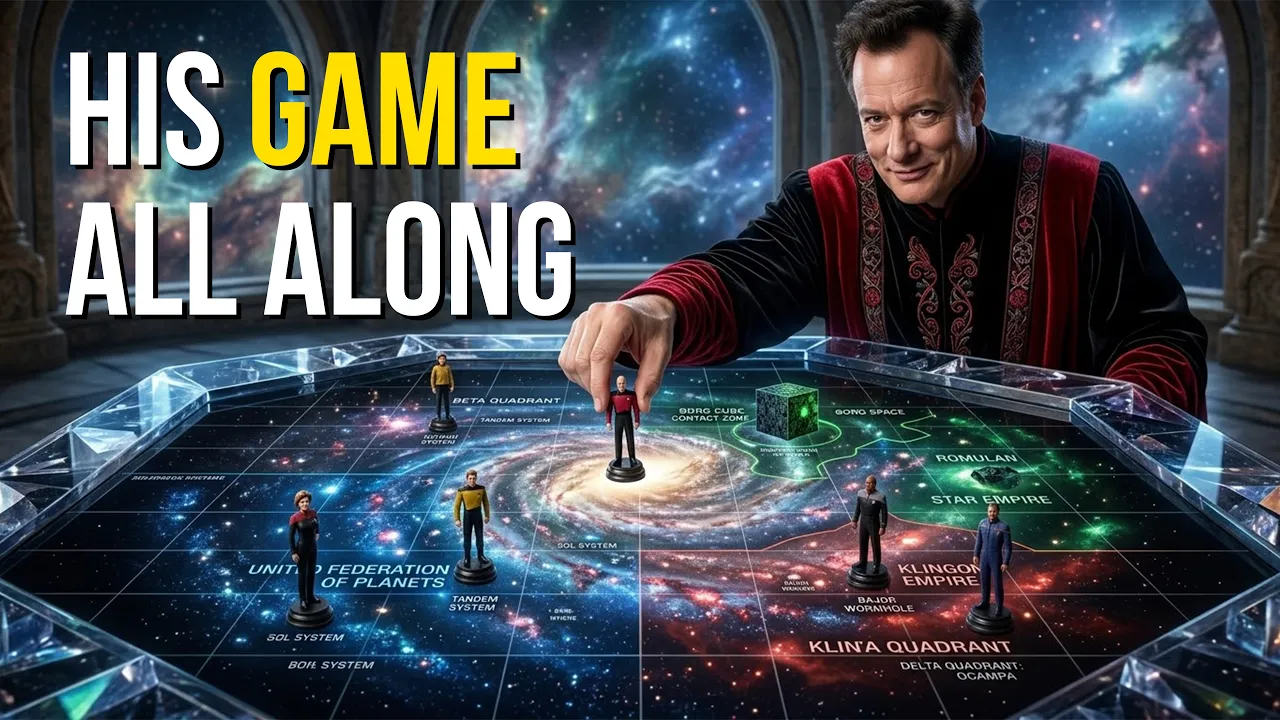
Adapted with AI from Lore Reloaded's video of 30 March 2026 and checked against the video before publication. Editorial standards · Corrections
More from @lorereloaded
All →


Make videos? Your next one could be an article here.
We turn your videos into articles under your name, linked back to the original. You keep 60% of what they earn, non-exclusive, and you can leave whenever you like.
Become a SubPlotter →