How the Ambassador Class Paved the Way for Starfleet's Galaxy Class
The ship caught between Kirk's era and Picard's tested the ideas that would define the Enterprise D, and exposed their limits along the way

For nearly a century, the USS Enterprise defined Starfleet. Kirk's Enterprise pushed the Federation into the unknown, and Picard's Enterprise became the symbol of its golden age. Ask most fans about the ships that shaped Starfleet and they'll jump straight from one to the other. That leaves a problem: how did Starfleet get there? The answer is the Ambassador class. It wasn't simply another starship. It was Starfleet's prototype for the future, and without it, the Enterprise D might never have existed.
The Federation that launched the Enterprise D wasn't the same Federation that launched Kirk's ship. It was larger, richer and more stable, with borders stretching farther than ever before. Entire generations had grown up without a major war. Starfleet wasn't only exploring anymore. It was governing a vast interstellar alliance, and the ships built during that transition had to answer a question no previous generation faced: what does an explorer look like when the frontier is no longer your greatest challenge?
The Ambassador class was the ship caught between Kirk's Enterprise and Picard's
The answer to that question wasn't the Galaxy class, not at first. Before the Enterprise D became Starfleet's flagship, another vessel carried the burden of figuring out what the future would look like. It was a ship caught between legends, too new to belong to Kirk's era and too old to belong to Picard's. It spent decades testing ideas, technologies and mission profiles that would eventually define an entire generation of Starfleet design.
Most people remember the Ambassador class for one episode, one sacrifice, one alternate timeline. But that isn't why the class mattered. The Ambassador class wasn't simply another starship. It was Starfleet's prototype for the future.
A secure Federation needed more than reliable cruisers like the Excelsior
The Ambassador class was born during one of the strangest periods in Federation history. For over a century, Starfleet had been shaped by necessity. The Constitution class was built for a frontier that barely understood itself. The Federation was smaller and weaker, surrounded by rivals that could challenge its existence. Every deep space mission carried real risk because the map was still being drawn.
Then the galaxy changed. The Klingon Empire began moving toward peace. The Romulans withdrew behind their borders. Federation territory expanded, trade routes stabilized and new member worlds joined the alliance. For the first time in its history, Starfleet found itself operating from a position of genuine security. The old ships still worked, and the Excelsior proved that. It would remain in service for generations.
But Starfleet's strategic planners were beginning to realize the future demanded more than reliable cruisers. The Federation had started administering the Alpha and Beta Quadrants, not just exploring them. Diplomats needed transportation, scientists needed laboratories and member worlds expected visible representation. Colonial networks stretched farther from the core than ever before. Starfleet vessels increasingly served as symbols of Federation authority as much as instruments of exploration.
The Ambassador class was designed around flexibility, not a single purpose
A ship could no longer merely be a ship. It needed to be a scientific platform, diplomatic center, command vessel, explorer and, if necessary, a warship. Sometimes it had to be all of those at the same time. If that sounds familiar, it should. Those are the same requirements most people associate with the Galaxy class, but Starfleet didn't begin with the Galaxy. The Ambassador came first.
In many ways, the Ambassador class represented Starfleet's first serious attempt to create a vessel capable of handling every mission the Federation might ask of it. Larger than the Excelsior class and carrying significantly expanded facilities, it was designed around flexibility. Starfleet wanted a ship that could arrive at a newly discovered civilization, conduct months of scientific research, host diplomatic negotiations and still project enough strength to discourage opportunistic aggression.
That philosophy represented a major shift. Earlier generations of starships often balanced multiple roles, but the Ambassador class was among the first to embrace the idea that a single vessel could become an entire Federation presence unto itself. What Starfleet didn't yet know was whether that vision would work. The Ambassador class wasn't the final answer. It was the experiment, and experiments exist for one reason: to discover what comes next.
Proving the concept turned the Ambassador class into Federation infrastructure
Designing the Ambassador class was the easy part. Proving the concept would work was another matter. On paper, Starfleet's vision made sense: build a larger vessel, give it more laboratories, more diplomatic facilities and more endurance, then send it farther than previous generations could comfortably operate and see what happens. The challenge was that nobody knew how these ships would perform over decades of service.
When an Ambassador class vessel entered orbit, it represented the Federation in a way earlier ships often couldn't. The Federation wanted its presence felt without appearing imperial, and the Ambassador class struck that balance remarkably well. That balance would eventually become one of the defining characteristics of the Enterprise D, but the Ambassador class was where Starfleet first learned how difficult it could be, because every new capability came with new expectations.
If a ship could host negotiations, Starfleet expected it to do so. If it could conduct advanced research, Starfleet expected that too. If it could coordinate regional operations, those responsibilities were added on. The Ambassador class was becoming something larger than a starship. "It was becoming an infrastructure. A piece of the Federation itself." And the more successful the experiment became, the more ambitious Starfleet's designers grew.
The Ambassador class helped turn Starfleet into a fleet of representatives
By the time the Ambassador class had spent years in service, Starfleet had its answer. The experiment was working. Not perfectly, but well enough that the Federation began planning its future around the lessons it was learning. As Starfleet's territory expanded, the distance between problems expanded with it. A ship might spend months responding to crises, negotiating disputes, conducting surveys and supporting colonies without ever returning to a major starbase.
That distinction became important. Starfleet wasn't trying to build specialists anymore. It was trying to build generalists, a single ship capable of representing the Federation across hundreds of different scenarios. Then came diplomacy. The Ambassador's size, facilities and mission profile made it uniquely suited for political missions. It could transport delegations, host negotiations, provide security and project legitimacy all at once.
Perhaps most importantly, it changed how Starfleet thought about prestige. For decades, prestige had come from accomplishment, when a captain or crew did something extraordinary. But what if the ship itself projected prestige? The Galaxy class would eventually perfect that concept, but the Ambassador class proved it could work. By every measurable standard, the experiment was succeeding, and that created a new problem: Starfleet started asking how far those ideas could be taken.
Where the Ambassador class fell short: scale, endurance and crew life
If the story ended there, the Ambassador class would simply be remembered as a success. But successful ships rarely teach designers as much as imperfect ones. While the Ambassador proved Starfleet's new vision could work, it also exposed the limits of that vision. The first problem was scale. The class was larger than anything Starfleet had previously committed to mass deployment, yet there still wasn't enough room to fully realize the Federation's growing ambitions. It couldn't perform all of the needed missions at once, not at the level Starfleet envisioned.
The second problem was endurance. The Ambassador class could remain on station for long periods, but planners increasingly imagined missions lasting years rather than months. Colonies were appearing beyond established infrastructure, and exploration was pushing deeper into unknown space. The question was no longer whether a ship could operate independently but how independent it could become. The Ambassador still depended on the support network that had shaped earlier starships. It stretched the model but failed to redefine it.
Then there was crew quality of life. That sounds strange today, because the Enterprise D made spacious accommodations seem normal, with civilian facilities, recreational areas and extensive personal quarters becoming part of Starfleet's public image. The Ambassador class had some of those ideas, but only some. Designers were beginning to understand that if crews spent years away from Federation space, ships would need to function as communities, not only workplaces. The Ambassador hinted at that future but never realized it.
Most importantly, the Ambassador class revealed something engineers hadn't anticipated: every successful feature encouraged requests for more. It did exactly what Starfleet asked of it. Its mistake was succeeding so thoroughly that it convinced Starfleet to dream bigger. By the 24th century, designers weren't asking how to improve the Ambassador anymore. They were asking a more dangerous question: what if they stopped balancing exploration, diplomacy, science, command and presence, and simply built enough ship to do all of them?
The Galaxy class took the Ambassador's lessons to their extremes
The answer became the most famous starship class in Federation history. People often see the Galaxy class as a revolution, a ship so massive and ambitious that it appears disconnected from everything before it. But Starfleet rarely works that way. Its greatest designs are usually evolutionary, and nowhere is that more obvious than in the relationship between the Ambassador and the Galaxy. Nearly every defining characteristic of the Enterprise D can be traced back to lessons learned during the Ambassador era.
The idea that a starship could serve as a diplomatic center, that scientific research deserved equal priority to exploration, that a vessel should project Federation values through its design rather than simply its mission: all of these were tested long before Jean-Luc Picard stepped onto a bridge. Where the Ambassador expanded scientific facilities, the Galaxy expanded them dramatically. Where the Ambassador improved crew comfort, the Galaxy made it a defining feature. Where the Ambassador hosted diplomats, the Galaxy was practically designed around them. The result was a ship capable of spending years away from Federation space.
The Ambassador class was the rough draft behind the Enterprise D
For all its success, the Galaxy class carried something else forward from the Ambassador: confidence, perhaps too much confidence. It was built during a period when Starfleet believed the future would resemble the recent past, and history seemed to be moving in only one direction. The Ambassador class helped create that optimism. Its successful service reinforced the belief that larger, more capable, more versatile ships represented the future, and for a time, they did.
The Enterprise D became the ultimate expression of everything the Ambassador class had been trying to achieve, and the Galaxy class was simply what happened when that vision was given unlimited room to grow. That leaves the Ambassador class in a strange place in history: overshadowed by the ship that followed, forgotten by many fans and rarely discussed outside a single famous episode. Yet without it, the Enterprise D we know might never have existed, "because before Starfleet could build its masterpiece, it had to build the rough draft."
What other creators are saying
More on Starfleet →From Tom Paris to Benjamin Sisko, these officers gave Starfleet good reason to take the uniform back, and some went right back to work
Star Trek officers who deserved to lose the uniform, ranked →
One card plays artifacts from the top of your library, and the other rewards facing a dilemma with free spells
Zefram Cochrane and the Caretaker among Magic: The Gathering Star Trek preview cards →
A Romulan War buildup, a Mirror Universe miniseries, the Borg Queen's origin and a refitted NX-01 were all part of the plans for a season that never got made
Tomorrow's Enterprise plays less like classic Kirk and Spock and more like Next Generation's All Good Things, and the people who made it are calling the future we saw continuity.
Strange New Worlds finale: the original series' lost ending →
Watch the original
@lorereloaded · YouTube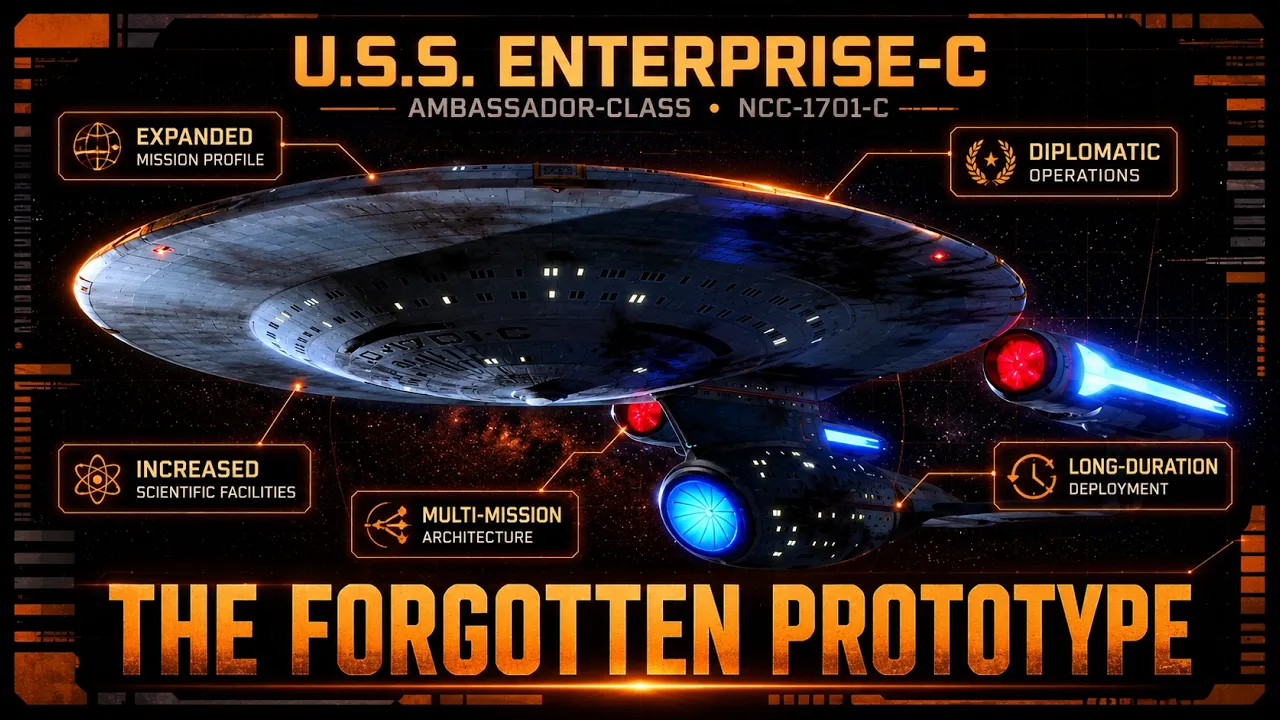
Adapted with AI from Lore Reloaded's video of 6 June 2026 and checked against the video before publication. Editorial standards · Corrections
More from @lorereloaded
All →


Make videos? Your next one could be an article here.
We turn your videos into articles under your name, linked back to the original. You keep 60% of what they earn, non-exclusive, and you can leave whenever you like.
Become a SubPlotter →