Every Doctor Doom Clue Hidden Inside 2008's Iron Man, Explained Before Avengers Doomsday
Revisiting John Favreau's original Iron Man reveals just how much Robert Downey Jr.'s new role as Victor Von Doom was quietly set up by his old one as Tony Stark.
Before Robert Downey Jr. puts on a new mask for the same task in Avengers Doomsday, I think 2008's Iron Man is essential viewing again, and not just for nostalgia. Revisiting that film makes it clear that Victor Von Doom is shaping up to be the strange kind of hero at the center of Doomsday, and the DNA of that performance is already sitting inside the very first Marvel Studios movie.
Since Tony Stark died in Avengers Endgame, I think the MCU has really missed that classic redemptive gearhead, the jerk who gets lost in his work, a paranoid futurist regretting his mistakes and obsessing over armoring his whole world from harm, and Iron Man is where that character type was invented.
Robert Downey Jr.'s History With This Fandom Goes Back Two Decades
Anyone cynical about the power of Downey's presence in the MCU is forgetting his history with this fandom, which goes back 20 years. After John Favreau presented his vision for Iron Man at Comic-Con 2006, he returned the following summer in 2007 with Downey, Kevin Feige, and others to show fans the first ever sizzle reel for Marvel Studios, which was really the first time fans saw the true vision for the studio as it would be.
I was not in that room in 2007, but I was in the room in July 2024 when Feige brought out the Russo brothers to announce Avengers Doomsday and Avengers Secret Wars, and I met several people who had been at that 2007 panel too. None of us stayed seated when Downey was revealed as Doom, with the crowd cheering at "new mask" and "same task" and Downey telling the room, "What can I tell you? I like playing complicated characters."
What We Actually Know So Far About Downey's Doctor Doom
Victor Von Doom reportedly comes from the same universe, Earth 828, as the Fantastic Four. He was their friend, described by Susan Storm as the smartest man in every room, a man broken by the loss of a wife and child. He antagonizes other Marvel heroes for living stolen lives and demands they give something back, and it appears he is either causing or exploiting incursions, the collisions of Earths from other dimensions, to build a new world he calls Latveria, also known as Battleworld, adapting Jonathan Hickman's 2015 Secret Wars storyline.
Beyond being a genius technologist, Doom is a sorcerer who taught himself the most complex forms of magic and reportedly travels with a coven of Latverian witches. He is also a monarch, much like Thor in Black Panther, ruling from a throne in Latveria. He comes from the Zapiro clan and resides in Doomstadt Castle. There is reason to believe the film could open in the Doomstadt armor room, and Doom is expected to have at least two suits and two masks in this movie. That idea of Doom as a tinkerer and armorer is exactly why revisiting Iron Man feels so useful right now.
I have theorized that when Marvel re-releases Avengers Endgame as Endgame Encore on September 25th, the studio will take the hammering sound effect that played during the Endgame credits back in 2019, tied to Tony Stark hammering in the Iron Man cave, and carry that sound forward to reveal Downey as Victor Von Doom in his own armory. I have always been drawn to the subtle ping sound effect Tony Stark uses like a scalpel rather than a sledgehammer, even though he loves his sledgehammers too.
Iron Man Opened During A Cynical, Post War On Terror Hollywood Moment
Iron Man, The Dark Knight, and Downey's other 2008 release Tropic Thunder all hit America during the later years of the war on terror, as Hollywood shifted toward a more cynical view of American imperialism. The Dark Knight asked what if mass surveillance could find Bin Laden and then be dismantled immediately. Iron Man asked what if America could kill just the terrorists in these places, and also asked where these weapons were really coming from. Tropic Thunder asked whether Hollywood elites were even the right people to be posing those questions.
John Favreau opens the film with AC/DC's Back in Black, which would become an anthem for Tony Stark later recalled in Spider-Man: Far From Home. Favreau wanted to frame Tony as a rock star blasting music in hostile territory, echoing the helicopter squadron trumpeting Ride of the Valkyries in Apocalypse Now, and it works out just as badly for Tony here. The valley shown is not really Afghanistan; it was shot in Lone Pine in Inyo County, California, beneath the Sierra Nevadas, and Tony carries himself like it's his own turf.
Tony Stark Was Built To Be A Jerk America Would Learn To Love
Tony's very first line, "I feel like you're driving me to court martial," sets up the whole film as exactly that: his court martial. Tony supplied his enemies with the weapons used against him, a war profiteer whose choices blow up in his face, and the entire movie makes him pay for it. This was Stan Lee's original intention in 1963. As Lee said in 2013, he wanted a hero nobody would like, a rich weapons manufacturer supplying the army during the Cold War, and then wanted to "shove them down their throats and make them like him." Iron Man does the same thing with the war on terror in 2008.
Kevin Feige, according to the upcoming book MCU: The Reign of Marvel Studios by Joanna Robinson, Dave Gonzalez, and Gavin Edwards, did not grow up a comic book nerd. He grew up loving Star Trek and Richard Donner's Superman, and got his start working for Donner's producer wife Lauren Schuler Donner on X-Men in 2000. Feige only started reading comics heavily in his twenties as a young producer, giving him a film producer's discipline rather than a gatekeeper mindset, and he recognized that the Ultimates era of Marvel comics, grounded in postmodern America, was the right template for phase one of the MCU.
The 10 Rings Attack Sets Up Both Tony's Trauma And Obadiah's Villainy
Tony's caravan is hit by a warhead stamped with the Stark Industries logo, landing right next to him, something Wanda and Pietro Maximoff will similarly experience in WandaVision. He has reached a point where his own top of the line body armor is weaker than his own weaponry, meaning he needs a new suit to protect himself from himself. Tony wakes in a cave with the 10 Rings banner behind him, and while the true 10 Rings will not be explored until Shang-Chi in 2021, the original intent back in 2008 was to set up the Mandarin as the villain of the sequel.
Really, the villain of this movie is Tony's own ego and his past as a warmonger, which in the third act becomes embodied by Obadiah Stane as the past of Stark Industries, described as "a hulked out form of the shell our hermit crab grew out of."
The Apogee Awards Video Bio Hides Photoshopped History And A Manhattan Project Nod
The film structurally works like Citizen Kane, a story of a billionaire who seems to die in the opening minutes and is unpacked through the eyes of his business relationships, lovers, and the press, though as a man of metal in search of a heart, it can also be read as an origin story of the Tin Man of Oz. At the Apogee Awards, a video biography shows young Tony with Howard Stark in Wired and Popular Mechanics, including a photo of young Robert Downey Jr. with a young Bill Gates that was actually photoshopped over a real photo originally featuring Paul Allen.
The MIT Technology Review cover shows young Tony sketching the robotic arm that becomes Dum-E, and the accompanying article reports Howard Stark worked on the team of engineers that helped deliver the atom bomb, a detail Tony later confirms by telling a reporter Howard worked on the Manhattan Project. A newspaper shown in the montage reports Howard and Maria Stark's 1991 deaths, later depicted in Civil War, and includes a quote from Obadiah Stane, who was in league with the 10 Rings and may well have also supported Hydra's use of the Winter Soldier to remove a corporate leader in his way.
Terrence Howard's Casting And Later Recasting Echo In The Film Itself
Terrence Howard plays James Rhodes, the future War Machine, and coming into this film he was fresh off an Oscar nomination for Hustle and Flow and was the highest paid member of the cast. Reportedly, for Iron Man 2 he was offered a pay cut of 50 to 80 percent according to Entertainment Weekly and was ultimately recast with Don Cheadle, suggesting both sides may have left the experience unhappy.
When Tony's name is announced for the Apogee Award, the score quietly plays the 1960s animated Iron Man theme, which also plays on the casino floor and later becomes Rhodey's ringtone for Tony. Obadiah accepts the award on Tony's behalf, saying "Well, I'm not Tony Stark," a line that likely eats at him and gets thrown back in his face later in one of the film's best exchanges about Tony building his first suit "in a cave, with a box of scraps."
The Rights To Iron Man Bounced Around Hollywood For Over A Decade
Kevin Feige met John Favreau on the set of 2003's Daredevil, where Favreau played Foggy Nelson, and that same year Favreau released Elf. It was still a gamble for Marvel to hand Iron Man to Favreau and Downey, who was still seen by Hollywood as a redemptive figure recovering from public legal issues in the 1990s. The bigger risk actually had nothing to do with either man: in the 1990s Marvel had sold film rights to Spider-Man, the X-Men, the Fantastic Four, and the Hulk to other studios, and only after 2003's Daredevil did Marvel executives decide to take control of their characters and form their own studio.
Iron Man's rights had gone from Universal in 1990 to Fox in 1996, with Nicolas Cage and Tom Cruise both looking at the project, Quentin Tarantino approached to write and direct in 1999, then a sale to New Line where Joss Whedon was talked to about directing, before the rights finally reverted to Marvel in 2005. Marvel Studios then took out a $525 million loan from Merrill Lynch, putting up properties like Black Panther and Doctor Strange as collateral, meaning Feige would have lost everything if the film failed. The cast described a stressful, heavily improvised production, with Jeff Bridges calling it "a $200 million student film." The film ultimately grossed $585.8 million worldwide on a $140 million budget.
Jarvis, Pepper, And The MCU's Early Distrust Of The Media
Christine Everheart, introduced as a Vanity Fair reporter in Vegas, later becomes a WHIH reporter in the MCU, and the next morning she is shown wearing the same red shirt Tony wore the night before, meaning she traveled with him from Vegas to Malibu, something Tony later references to Rhodey by saying he "got caught doing a piece for Vanity Fair." At the Malibu house, Christine activates Jarvis, voiced by Paul Bettany, whom Tony named after Edwin Jarvis, Howard Stark's butler played by James D'Arcy in Agent Carter, who also cameos in Avengers Endgame. Pepper's correction that it's "Jarvis," not "Jesus," plays differently once Jarvis eventually becomes the very Jesus-like Vision.
I think this points to something built into early MCU DNA: it distrusts the media. Richard Donner's Superman, Sam Raimi's Spider-Man, and even Tim Burton's Batman all center on journalists trying to do right, but the MCU is built around engineers, soldiers, and royals instead, which I think reflects a post war on terror, post Jon Stewart era America that just did not trust the press anymore.
The Stark Family Crest And Rhodey's Uniform Speech Foreshadow Tony's Arc
On the plane, the Stark family crest shows a double headed eagle, historically an imperial symbol for an empire perpetually at war, and I noticed it also carries three stars at the top, matching the shape of Captain America's original shield before Howard introduced the circular version, suggesting Tony grew up with a father who worshipped Steve Rogers. A drunk Rhodey tells Tony about the importance of team colors and the uniform, a lesson Tony will not truly understand until he joins the Avengers, set to a Ghostface Killah track; Ghostface reportedly loved the Iron Man character and was set to cameo in the film as a Dubai tycoon, though the scene was ultimately cut.
Tony asks whether it's better to be feared or respected, misquoting Machiavelli's actual question of fear versus love, which fits a warmonger who does not yet understand love. He mentions his proprietary repulsor technology tied to the Jericho missiles, and says his father's philosophy was to build "the weapon you only have to fire once," a description that ironically also describes Captain America, a weapon fired many times until Tony himself later fires him from the Avengers.
Yinsen, The Cave, And Plato's Allegory Explain Tony's Rebirth
In the cave, Obadiah is shown awake and nervous, worried about the outcome of his plan to have Tony attacked. Tony's visible breath in the cave was a detail added by production designer J. Michael Riva after watching footage of real Taliban fighters and learning how cold these caves get. Yinsen, changed from a Vietnamese character in the comics much like the Mandarin was altered, saves Tony's life by removing shrapnel and installing an electromagnet powered by a car battery, warning him he is "the walking dead" with about a week before the shrapnel reaches his heart, meaning Tony lives on borrowed time from this point through Avengers Endgame.
Tony being trapped in this cave mirrors Plato's allegory of the cave, in which an unenlightened person mistakes shadows on a wall for reality until a philosopher king unchains them into the light. While still in the cave, Tony ignites the palladium ring inside his miniaturized arc reactor, a Eureka moment that reignites his soul while the surrounding lights flicker uncertainly. Raza leads the 10 Rings, a faction that speaks Arabic, Farsi, Urdu, Russian, and Hungarian, making clear they are not meant to represent any single real world group, and Raza is shown being puppeted by the western industrialist Obadiah.
Tony hammers his armor together, evoking Hephaestus, the Greek god of the forge, tying back to Plato's myth of the three metals, where humanity was born of gold, silver, or bronze and iron. Despite his billions, Tony succeeds because he builds and labors like the iron caste. Tom Morello of Rage Against the Machine cameos as the first terrorist Tony's Mark I suit faces. Tony finds Yinsen dying before he can see the family he was trying to get home to, torches his own weapons with satisfaction, and crashes into a sand dune, outgrowing the Mark I "like a hermit crab."
Burger King, Coulson, And Tony's Public Break From Weapons Manufacturing
Back in the States, Tony asks Happy for a Burger King cheeseburger, and it becomes clear he actually eats a second burger during the press conference and pulls a third from his pocket, showing he already does not trust Obadiah. Robert Downey Jr. has said in an interview that in 2003, while driving with drugs in the car, he pulled over for a disgusting Burger King burger and, sitting with it and a big soda, decided something bad was about to happen, then threw his drugs into the ocean and got clean, which gives this small detail real weight.
Agent Coulson is revealed in a comedic reveal shot, representing the Strategic Homeland Intervention Enforcement and Logistics Division, SHIELD, whose original yellow and black logo appears later. Tony invites Obadiah and the press to sit on the floor before rising to announce he is shutting down the weapons manufacturing division of Stark International. Obadiah responds by calling the company "iron mongers," a nod to his comic book villain identity, part of a broader in context approach where characters are referred to by their real names in personal scenes and only by superhero names publicly.
Practical Effects, Howard Hughes, And The Workshop That Defines Tony Stark
Obadiah dismisses arc reactor technology as something "built to shut the hippies up," and with the film set in 2009, thirty years earlier lines up with 1979, the end of detente before Reagan's renewed nuclear brinkmanship, suggesting that's when Stark Industries' arms deals and Obadiah's rise both surged. Mad Money's Jim Cramer cameos discussing Stark's plummeting stock price, part of the Ultimates influenced idea that the MCU exists in our real world, later expanded with the Elon Musk cameo in Iron Man 2.
Stan Winston Studio built the film's practical effects, including the evolving Iron Man suits, and my favorite is the arc reactor replacement surgery scene, where Winston's team built a prosthetic chest piece angled over Downey's real body, hid the seams with overhead lighting, and delivered genuine, visceral body horror. Tony has Pepper perform the surgery rather than a surgeon because he trusts no one else after realizing someone in his own circle tried to have him killed.
The workshop tinkering sequences draw on eccentric billionaire Howard Hughes, and were shot on a soundstage at the former Howard Hughes airport where Hughes built the Spruce Goose. A photo beside Tony's Roadster shows him as a kid working on the same car with his father, tying his hands on work ethic back to Howard. Stunt performer Greg Fitzpatrick handled much of the wire work, though Downey performed a number of stunts himself, drawing on his experience playing Charlie Chaplin in 1992's Chaplin and channeling Chaplin and Buster Keaton's physical comedy.
Salieri, Ray's Pizza, And The Mark II's Groundbreaking Flight
The piece Obadiah plays on piano is by Antonio Salieri, the composer rumored to have plotted against his rival Mozart, mirroring Obadiah's jealousy of the prodigy Tony. Obadiah brings back Ray's Pizza from New York, a nod to Favreau's love of the pizzeria that also appears in Elf. Favreau specifically rigged Downey to be suspended from the boots during the repulsor testing sequence, because audiences can always spot wire work from the back or hips, so it looks like the foot thrusters themselves are propping him up.
This film also invented the now standard heads up display technique, cutting smoothly from the inside of Tony's helmet to Downey's eyes so viewers instinctively understand what Tony sees. During the Mark II's driveway exit, the HUD flashes a red warning about the wall just before Tony scrapes it, a blink and you miss it detail establishing how attentive the effects are throughout. Flying past the Santa Monica Pier, the HUD shows Mach 0.04, and Tony later attempts to break the SR-71 Blackbird's flight record, causing his suit to freeze, a design flaw he later exploits against Obadiah and later builds workarounds for in future suits. He ends the flight by crashing through the piano Obadiah played earlier.
Gulmira, Pepper's Blue Dress, And The Roots Of The Rescue Armor
Tony rebuilds the suit as the gold titanium alloy Mark III, mixing in hot rod red from his Roadster, inspired by a news report on his own firefighters' benefit, framing him as a first responder. Stan Lee cameos at the benefit as himself, and Tony accidentally schedules an appointment with Coulson that later allows Coulson to conveniently escort Pepper away from Obadiah. I think Pepper's blue dress at this event may have inspired Tony's later design for her blue Rescue armor in Avengers Endgame, since this is the moment he sees her not just as beautiful but as the person who framed his old arc reactor as proof he has a heart.
Christine Everheart returns with photos of Stark weapons in Gulmira, Yinsen's hometown, prompting Tony to suit up in the Mark III, its repulsor glowing visibly from chest to gauntlet. In the resulting mission, air traffic control refers to the pilots as Whiplash 1 and Whiplash 2, likely nodding to the future villain Ivan Vanko, alongside an earlier joke about Rhodey hooking up with someone named Ivan. Tony's HUD shows Mach 0.57 before he goes supersonic, a jump that, realistically, should turn his body to soup inside the suit.
Big Lebowski Easter Eggs And The Ninth Symphony Betrayal
Behind Tony in the workshop sits an early version of Captain America's shield, suggesting Tony was quietly trying to build his own version of his father's favorite hero's icon. When Pepper steals files on Obadiah's dealings, the documents are full of Big Lebowski references, including a vessel called the MSC Lebowski, a mention of Creedence tapes, and the Dude visible beneath a barcode on a shipping manifest. The engineer overseeing Obadiah's operation, William Ginter Riva, is played by Peter Billingsley, Ralphie from A Christmas Story and a longtime producing partner of Downey's, who later returns in Spider-Man: Far From Home as part of Mysterio's team.
Obadiah paralyzes Tony with a high frequency device, telling him "This is your ninth symphony," referencing the curse of the ninth, the superstition that a composer's ninth symphony will be their last. Tony Stark does eventually die in Avengers Endgame, which happens to be Downey's ninth MCU film. Dum-E helps Tony reach the original arc reactor Pepper had encased, meaning Pepper effectively saves his life twice through that earlier surgery, and Dum-E saves him a second time simply by having left a cluttered workspace instead of throwing the old reactor away.
The Final Battle Forces Tony To Destroy His Own Past
Tony launches out through the same hole he previously crashed through past Obadiah's piano, mirroring his earlier exit from the cave, framing this as a resurrection. He confronts Obadiah, who has rebuilt Tony's original Mark I armor into the Iron Monger suit, forcing Tony to destroy an old version of himself much like his father's Manhattan Project looms over his own legacy. The fight takes place on the Howard Stark Memorial Parkway, a road that Tony's father literally and metaphorically put him on, and Tony wins by applying every lesson learned across the film: luring Obadiah into high altitude icing, blinding him with flares as he did the F-22s, and dismantling his armor as he dismantled the Jericho missiles back in the cave.
Tony's final move is to talk Pepper through overloading his own giant arc reactor, a machine his father built as a non-nuclear clean energy device rather than a weapon, meaning heart power from his father effectively purges Stark Industries of its warmongering original sin.
"I Am Iron Man" And The Post Credits Scene That Built A Genre
Reading a newspaper photo of Iron Man that closely resembles a leaked real world set photo taken a year before release, Tony seizes control of the narrative at a press conference by saying, "Truth is, I am Iron Man," a line Downey reportedly adlibbed. Before this, superheroes were typically expected to keep secret identities, but the MCU largely made its heroes public figures, reflecting how recent Marvel comics events like Civil War had explored heroes coming out of the shadows. Every reporter jumps to their feet except Christine Everheart, the one Tony is effectively answering. I think there is something meaningful in Downey looking directly into the camera on that line, a signal to audiences that they were in safe hands, one that echoes forward to Tony facing "inevitability" in Avengers Endgame.
The post credits scene, now a cemented MCU genre trope, introduces Samuel L. Jackson as Nick Fury of SHIELD, telling Tony he has "become part of a bigger universe." An alternate version of the scene reportedly referenced Spider-Man, the Hulk, and the X-Men. Jackson's face had actually been used as the model for the modern comic book Nick Fury after the character was changed from white, and Jackson had said he would be glad to play the role if it were ever offered, before eventually landing it here.
What Iron Man Suggests About Robert Downey Jr.'s Doom And Marvel's Future
One clue for why the Russo brothers wanted Downey back as Doctor Doom may come from that opening montage detail about Howard Stark's Manhattan Project work in Marvel's main 616 continuity. I do not necessarily buy the rumors of two Victors in Doomsday, one played by Cillian Murphy, Downey's Oppenheimer co-star, but I do like the idea that these are all men who opened Pandora's boxes that could bring about their own worlds' extinction.
Revisiting this earlier MCU era, where actors like Terrence Howard could be recast entirely, is a reminder of an industry reality I think Marvel is reacquainting fans with in Doomsday, where one of the best working actors in the business is going to fully divorce himself from the iconic role of Tony Stark. I believe that is part of Marvel's bigger plan with Downey as Doom, to also free the studio up to recast Tony Stark starting in 2028, and I feel confident that by 2035 there will be a new Tony Stark in the MCU, though I cannot say exactly how I know that.
The opening montage's mention of Tony winning awards at MIT for Dum-E and U also matters, since the upcoming Vision Quest series is expected to finally show both characters in human form, alongside rumors that Raza from this film could return there too. An earlier cut of the Nick Fury post credits scene had Fury complain about dealing with "gamma accidents, radioactive bug bites, and assorted mutants" on top of Tony Stark, and with Spider-Man: Brand New Day now bringing radioactive bug bites and mutants into the picture, I think anyone writing off Marvel as desperate in 2026 is missing that Kevin Feige's complete original vision for this franchise is really only just getting started.
What do you think Robert Downey Jr.'s Doctor Doom owes to Tony Stark, and are you buying the theory that Marvel is quietly setting up a recast of Iron Man down the road?
Watch the original
@newrockstars · YouTube
Adapted with AI from New Rockstars' video of 21 August 2026 and reviewed by Digital Fox Talent before publication. Editorial standards · Corrections
Also on Doctor Doom
8 creators, 103 takes →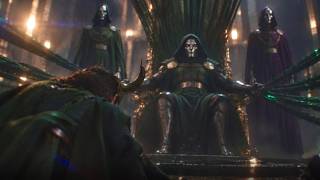


More from @newrockstars
All →


Make videos? Your next one could be an article here.
We turn your videos into articles under your name, linked back to the original. You keep 60% of what they earn, non-exclusive, and you can leave whenever you like.
Become a SubPlotter →