Rings of Power season 1 review: what failed, what worked
Weak pacing, a Galadriel arc that never earns sympathy and a Harfoot plot that goes nowhere hurt the show, but Elrond and Durin's friendship holds up

Nearly a year after its first season ended, The Lord of the Rings: The Rings of Power is widely seen as a colossal failure. After rewatching the series and spending a week studying dozens of people's responses, I don't think every part of it was a historic failure. Some parts didn't work, some were quite decent, and there's one major lesson every studio should take from it.
The show is Amazon's Prime Video series, which debuted in 2022 with Morfydd Clark as Galadriel, Robert Aramayo as Elrond and Charlie Vickers as Halbrand. My biggest problems are with its pacing, Galadriel's arc and the Harfoot storyline. Its strongest thread is the friendship between Elrond and Durin.
Why Tolkien fans had good reason to be upset with The Rings of Power's changes
The Lord of the Rings isn't an IP created by Amazon, or even by Peter Jackson. It exists because of J.R.R. Tolkien, whose Middle Earth has been around for almost a hundred years and has won over millions of fans. Like any adaptation, The Rings of Power had to balance staying faithful to Tolkien's world with making changes for a new medium. Every reasonable person knows some changes are needed. Even the Lord of the Rings movies, which are borderline universally beloved, changed things from the books.
The same logic applies to not changing too much. The show carries The Lord of the Rings in its title because that name has millions of fans, and Amazon gave it the largest budget in TV history knowing most people would tune in because of that title. If you're profiting off the name, I think you owe it to the IP to stay as faithful as possible. I don't blame Tolkien fans for being upset with most of the changes, because I think many were made for poor reasons.
Compare that with the films. Peter Jackson left out Tom Bombadil, explaining that the character bore little relevance to the overall plot of The Fellowship of the Ring and did nothing to advance the main story. Fans may have wanted him, but they understood the change was made with good intention. I'm not a Tolkien expert. I haven't read The Silmarillion or the appendices. But just because many of us won't spot every change doesn't make those changes a good idea.
Nerd of the Rings, which I'd recommend for hardcore Tolkien fans, pointed to a showrunner quote about not wanting book fans to be five or so episodes ahead, and asked "why change such a massive part of the story purely to create a mystery?" A compelling story, they argued, doesn't "need the crutch of a mystery." I couldn't agree more. House of the Dragon, like The Rings of Power, adapts summaries of a world's history, and I knew almost everything that would happen. Seeing it play out almost exactly like the books made it more enjoyable for me. Hearing the opposite thinking from The Rings of Power's showrunners was jarring. From here on, though, I'm judging the show as its own thing, since most people who saw it don't know the source material.
The Rings of Power's pacing problem: the tree branch versus the airline approach
Pacing matters enormously. The first cut of the original Star Wars had the same story but was borderline unwatchable because scenes were in a different order and missing elements left the final battle without tension. The Rings of Power has four main plot lines: Galadriel, Halbrand and Númenor; Elrond and Durin; the Southlands with Arondir; and the Harfoots. Multiple plot lines aren't bad in themselves. Game of Thrones had many and was mostly fantastic, and its approach to building a series is quite similar, even though Tolkien's world is very different from George R.R. Martin's.
Game of Thrones begins with almost everyone at Winterfell, and the story branches out from there. I call that the tree branch approach. The Rings of Power starts with Galadriel, then cuts to Arondir in the Southlands, then the Harfoots, then Elrond. Galadriel and Elrond cross paths in the first episode, but their stories don't branch from the same place. Mapped out, the plots look like a chart of airline routes, so I call it the airline approach. The tree branch asks the audience to follow one thread at first. The airline approach demands they track them all immediately, which can overwhelm a first time audience in a fantasy series with so much lore to establish.
The airline approach doesn't automatically doom a story. Game of Thrones has Daenerys out east from the start, but that thread has direction: the Targaryens were overthrown and want the Iron Throne back. Stannis in season two is the same, since we know he's raising an army to take the throne. The main story also keeps referencing Daenerys, and how to handle her causes a rift between Robert and Ned. After a whole season of The Rings of Power, we still don't know the Harfoots' purpose. Yes, a wizard shows up, but assuming a side story will eventually tie in is true of any side story. If you removed the Harfoots entirely, nothing in the other stories would change except, I guess, seeing a meteor fall.
How I'd rework the season: cut the Harfoots and open with Galadriel and Elrond
Rather than a rewrite, I'd shift things around. I would cut the Harfoots from season one entirely, but not from the show. Nori and the wizard are clearly going to matter later, and I assume the wizard will meet Galadriel and Elrond and maybe even Sauron. So say season two opens with one or two episodes telling the whole Nori and wizard story. It was dragged out far longer than needed, and you can't convince me it couldn't be told in around 75 minutes, the upper end of an episode in this series. You could keep the meteor shots from everyone else's perspective in season one for mystery, and maybe end with a glimpse of the wizard as a tease.
For the rest, I'd spend the first three or four episodes only on Númenor and Khazad-dûm, following Galadriel and Elrond, characters the audience already knows from the movies. Then, instead of having Galadriel, Halbrand and the Númenóreans arrive in the middle of a battle, they'd arrive at the start of the Southlands story. Galadriel could warn Arondir about Sauron's plans before the holes are found, Arondir is captured and Theo finds the sword. The Númenóreans could wait elsewhere in the Southlands until Galadriel fetches them, and everyone arrives back for the battle right before the volcano erupts.
I get the vibe the storytellers wanted a grand scale because the movies had one. What they missed is that the trilogy took its time. Almost all of The Fellowship of the Ring follows Frodo, and we only meet new characters when he does. The Two Towers expanded the scope. The Rings of Power tried to do everything in the first episode, and it didn't work.
Galadriel's vengeance arc fails because we never see her at her best
Galadriel gets the most screen time by far, so her story matters most. The writers use her to teach a lesson about vengeance. She leads elves into the northern wastelands and they mutiny. Gil-galad, Elrond and others arrange to send her to Valinor because she's doing more harm than good, and even after acknowledging she was basically exiled, she keeps bullying, threatening, intimidating and insulting people on her hunt for Sauron. Late on, she advises Theo not to be consumed by darkness, and sacrificing her brother's dagger to forge the rings is meant to symbolize letting go of vengeance.
I like the idea of this arc, but there were so many ways to do it better. When a hero trends toward darkness, we usually see them at their best first. Frodo's fall to the ring is painful because we know he's good hearted. Galadriel never gets that. As a child in the prologue, she jumps on an elf boy who destroys her paper boat. As an adult she's no different. The writers wanted a story about vengeance consuming a person, but they told a story about an already vengeful person, and those aren't the same. Calling her unlikable is a vague complaint; my point is there's no version of her we ever liked to root for.
My changes would be minor. The opening expedition happens without her. In Lindon, we meet the kind, loving Galadriel from the movies, who has somewhat made peace with Sauron's absence. When the elves bring back a hint of his return, she denies it, still traumatized by her brother's death. Gil-galad's offer of Valinor becomes a genuine honor she's longed for. Jumping off the ship then becomes a noble sacrifice of her happiness to learn the truth. She would turn into the bully gradually, with her talk of genocide against the Orcs in her sixth episode confrontation with Adar showing how far she's fallen. Her admission to Halbrand that she can't stop, in the fifth episode I believe, feels wasted because she doesn't change afterwards; I'd move it to after Mount Doom erupts.
Galadriel never suffers the consequences of her actions
The cardinal rule of storytelling is that characters suffer the consequences of their actions. In the Southlands, Galadriel doesn't. Mount Doom erupts whether or not she arrives: Adar hands over the key and it's activated with or without her. I like her scenes with Theo in the seventh episode, but she has no real reason to change because she made no mistakes. You could argue the dead Númenóreans count, or Elendil hating her over Isildur's supposed death, but we all know Isildur isn't dead, so it's not a real consequence.
Saving Halbrand could matter later, but in season one it causes nothing bad. It's strange that Halbrand, who is Sauron, had no impact on the creation of Mordor. Imagine Galadriel vouching for him as king all season, then he betrays her and lets the key be used, maybe even switching it for the hatchet. Mordor would be Sauron's doing, which we probably all would have liked, and Galadriel's fault. Season two had a chance to remedy this, since Halbrand asks how the other elves would feel knowing Sauron lives because of her.
As for the dagger, I don't get the vibe she'll stop hunting Sauron. Knowing he's alive and that she's personally responsible gives me more reason to think she'll continue. There's an interesting story at the foundation of her arc; the writers misfired almost entirely in bringing it to form.
Elrond and Durin's friendship is the heart of The Rings of Power
When I think of The Lord of the Rings, I think of friendship: people from all corners of the world coming together against evil. Legolas and Gimli might be my favorite relationship in the movies, and Sam's loyalty to Frodo led to the ring's destruction. In The Rings of Power, Elrond and Durin's friendship is the only one with heart even remotely close to that. When Celebrimbor needs a workforce, Elrond suggests the dwarves, and the world building at Khazad-dûm is better than elsewhere. The stone breaking contest was so perfect for Dwarven culture, whether it was Tolkien's idea or Amazon's.
Elrond gets a well handled mini arc. Durin is angry because Elrond hasn't visited in 20 years, missing his wedding and the birth of his kids. As an immortal elf, Elrond doesn't value time like other species and didn't realize how much he was hurting his friend. In just the second episode he faces a consequence, something Galadriel never does, and he apologizes sincerely. When Gil-galad and Celebrimbor ask whether the dwarves have mithril, his loyalty is tested: betray a friendship he just rebuilt, or help his people? It's a great moral dilemma.
The relationship development is what makes it work. Durin hinting that he only tells his real name to close friends and family, the made up story about the table they laugh over, and Elrond swearing on his father's memory to keep the mithril secret all build the friendship. So do actions: Durin defying his father to search the mines, Elrond refusing Gil-galad without hesitation, and Durin telling his father Elrond is like a brother. It's not a master class, but almost every scene they share I found incredibly engaging. Unlike Galadriel, Elrond has a strong moral compass but isn't perfect. The plot is more contrived: the elves need mithril by spring or must leave or die, Celebrimbor oddly needs Halbrand to suggest alloys, and the rings work by looping on themselves. The characters carried it, and I was looking forward to more of them.
Arondir, Bronwyn and Adar: decent characters in a Southlands plot without a story
A lot of the Southlands was okay. Arondir was likable, if not well developed, and probably the closest we'll get to Legolas: a stoic elf with impressive moves who chose to stay and fight when he had no reason to. I find it hilarious the whole plot began because a sick cow reached Bronwyn and spewed black goo. Bronwyn and Theo were fine, but I don't buy Bronwyn as a leader; she walked in with an orc's head and everyone followed, and her speeches weren't convincing. The elf and human romance could have gone badly but was done well. I also wondered whether the Southlands contained more than a few towns, as I always got the vibe its people were quite few.
Adar was the most interesting part. Maybe it's because most characters aren't three dimensional, but I found this fallen elf who gave the Orcs a home quite complex. The best scene is when he verbally outclasses Galadriel, and sending the traitor humans to fight instead of his Orcs genuinely surprised me. My biggest issue is that there's no character work here, no arc or lesson, just plot. Tying it to Galadriel's arc would give it thematic weight, and Arondir works better as a supporting character to someone more thematically rich.
Nori and the Harfoots don't have the Hobbits' big hearts
It's unfair to ask an audience to stay invested in a subplot for a whole season without knowing why it matters. The only other defense I've heard is the added mystery around Sauron's identity, and adding mystery to surprise hardcore fans is a bad idea. I think the Harfoots were included so Amazon could sell the show as having Hobbits. One of the showrunners said you can't have a Lord of the Rings story without Hobbits, which is like saying you can't have a Star Wars story without Jedi. Some of the best Star Wars works have none.
On its own, the story was fine. Nori never annoyed me; she's the opposite of Frodo, craving adventure, and her bond with the stranger has potential. But there's no real story, just events until she leaves with him. The writers seemed to want the Harfoots to evoke the Hobbits' small size and big hearts, yet one could argue they're among the most cold hearted people in Middle Earth. They leave stragglers to die, then read their names in a prayer. One Harfoot woman suggests sabotaging the Brandyfoot cart so the family gets left behind, which is straight up evil.
The lesson studios should learn from The Rings of Power
One year later, the series hadn't aged well with fans. It was planned for five seasons, so the writers could right the ship, but part of me doubted they would. There are great aspects: the music was often spectacular, it almost never looks cheap, it's easily the most impressive looking TV series by a mile, and the acting was superb even when the characters weren't.
The lesson is the baggage of adaptation. Don't title your series The Lord of the Rings and expect everyone to be happy with your changes, or with your reasons for them. Some hated stories win fans over time. I have a very tough time believing The Rings of Power will go that route, but with only around 20 percent of the story told, it's not impossible.
What other creators are saying
More on The Rings of Power →From the cymatics title sequence to the palantír and the Great Wave, the Tolkien details hidden in Episodes 3 and 4 of The Rings of Power
Missing polenta, no scales, out of date flour and a stubborn tin: my attempt at lembas bread from a book of recipes from the world of Tolkien
Tolkien lembas bread recipe: Alex's baking attempt goes wrong →
A breakdown of why raw spellcasting is not the full story in this wizard duel
Watch the original
@thegoldman25 · YouTube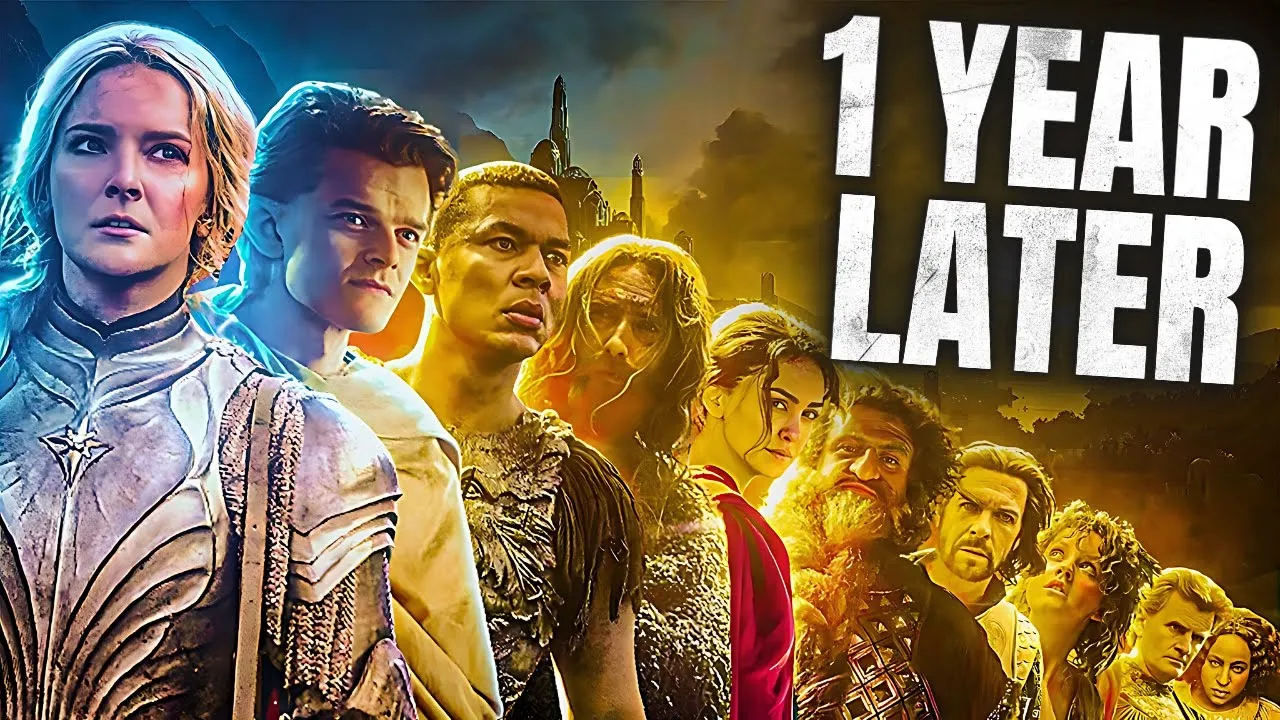
Adapted with AI from The Gold Man's video of 26 September 2023 and checked against the video before publication. Editorial standards · Corrections
More from @thegoldman25
All →


Make videos? Your next one could be an article here.
We turn your videos into articles under your name, linked back to the original. You keep 60% of what they earn, non-exclusive, and you can leave whenever you like.
Become a SubPlotter →