The Akira Class Was the Ship That Made Starfleet Dangerous
Never a flagship and never the face of an era, the Akira often found itself near the front when Starfleet expected a fight, and that reveals how the Federation changed after Wolf 359

The Akira class was never Starfleet's flagship, yet it was the ship that made Starfleet dangerous. The danger didn't come from a single weapon or a single battle. It came from what the Akira represented: a Federation that still preferred peace, but no longer assumed peace would always be enough.
Anytime Starfleet wanted to party, an Akira class was usually invited. That's not an official doctrine, and no admiral ever put it in writing. But once you start looking at where the Akira class appears in Star Trek, the pattern becomes difficult to ignore. The truth is, it's probably the moment Starfleet itself began to change.
Starfleet kept sending the Akira class where failure wasn't an option
A Borg cube attacks Earth, and the Akira is there. The Dominion War erupts, and the Akira is there. Romulan warbirds threaten a Starfleet vessel, and once again an Akira finds itself in the middle of the fight. Again and again, Starfleet sends Akiras into situations where failure isn't an option.
That's strange. The Akira was never Starfleet's flagship. It wasn't the Federation's most advanced design. It wasn't even the most famous ship of its generation. Unlike the Enterprise, it never became a household name. It wasn't the face of an era, and it didn't star in its own series. Most casual fans could probably identify a Galaxy class or an Intrepid class long before they could name an Akira.
Yet when Starfleet faced some of the most dangerous situations of the late 24th century, the Akira had a habit of appearing. When a Borg cube threatened the heart of the Federation itself, Starfleet committed every available asset it could gather, and among the ships sent to intercept the cube was the Akira. As the Dominion War grew into a conflict that threatened the survival of the Federation, Akira class vessels repeatedly appeared in fleet formations and major combat operations. While other ships came and went, the Akira consistently remained part of Starfleet's frontline response.
The USS Prometheus incident put one Akira against three Romulan warbirds
Then there's the incident involving the USS Prometheus. When Romulan forces seized the prototype vessel, Starfleet dispatched two Defiant class escorts and an Akira class cruiser to intercept three D'deridex warbirds and recover the stolen ship.
The deployment itself is revealing. The Defiants focused their efforts on the captured Starfleet vessel, while the Akira found itself confronting the Romulans directly. That's three warbirds against a single Akira class. Whether you agree with the tactical wisdom of that decision or not, Starfleet clearly believed the ship could survive the assignment.
The Akira wasn't merely present during these events. Starfleet repeatedly trusted it with difficult jobs. It didn't handle diplomatic missions, it wasn't there for ceremonial appearances, and it wasn't used for exploratory showcases meant to represent the Federation at its best. Over time, a pattern emerges. When Starfleet expected uncertainty, it sent a Galaxy. When it expected diplomacy, it might send an Ambassador or an Intrepid. When it expected a fight, the Akira often found itself near the front of the formation. To understand why, we have to look at the moment the Federation discovered that being powerful and being dangerous were not the same thing.
The Galaxy class projected confidence, but not fear
For most of its history, Starfleet believed strength and danger were the same thing. By the middle of the 24th century, the Federation had one of the largest economies in the Alpha Quadrant. Its industrial base stretched across hundreds of worlds, and its fleet protected thousands of light years of territory. Even Starfleet's dedicated exploration vessels often carried enough firepower to challenge the warships of rival powers.
The Galaxy class illustrates the problem perfectly. The Enterprise D was arguably one of the most capable starships ever built. It carried enormous scientific facilities, extensive diplomatic accommodations, advanced defensive systems, and enough firepower to defeat most threats it encountered. Yet that wasn't what people noticed when they looked at it. They noticed the schools, the families, the civilians and the diplomatic receptions. The Galaxy class projected confidence, optimism and security. What it did not project was fear.
Wolf 359 shattered Starfleet's assumptions about the galaxy
Then the Borg arrived. Wolf 359 wasn't simply a military defeat. It was a psychological shock. For decades, Starfleet had operated on the assumption that any threat could eventually be solved through some combination of diplomacy, innovation, exploration or superior resources. Even when conflicts occurred, the Federation generally believed it had the strategic depth to recover.
The Borg shattered those assumptions. One cube, 39 starships destroyed, thousands dead. And perhaps most importantly, there was the realization that the Federation's enemies were not necessarily impressed by Starfleet's reputation. For the first time in generations, Starfleet met an enemy that looked at everything the Federation had built and simply wasn't afraid.
That changed how Starfleet thought about the future. Almost overnight, ship design priorities began to shift. The Defiant class emerged as an emergency response to a problem that could no longer be ignored. The Sovereign class reflected a growing recognition that exploration alone could not define the fleet's future. New designs placed greater emphasis on survivability, tactical flexibility, rapid deployment and sustained combat operations.
Starfleet wasn't abandoning its principles, and it wasn't becoming a military in the traditional sense. But it was beginning to understand that peace required more than good intentions. It required deterrence, and that meant building ships capable of convincing potential enemies that attacking the Federation would come at an unacceptable cost.
The Akira class was built for a more dangerous galaxy
The Akira class was one of the clearest expressions of that new philosophy. Unlike the Galaxy class, it didn't look like a ship built for an era of confidence. It looked like a ship built for a galaxy that had become dangerous. The reason the Akira mattered is that it was one of the first ships designed for the reality Starfleet discovered after Wolf 359, a reality where exploration alone was no longer enough.
Its profile is lower, wider and more compact. Even visually, it sends a different message. It doesn't look like a vessel built around diplomatic receptions and long term civilian habitation. It looks like a ship designed to arrive somewhere quickly, solve a problem, and move on to the next one. By the 2370s, Starfleet's strategic environment had changed dramatically. Threats could emerge with little warning, borders stretched across vast distances, and fleet response times mattered more than ever.
The Federation needed ships that could deploy rapidly, operate independently, and survive in situations where combat was not merely possible but increasingly likely. The Akira fit that requirement almost perfectly. Unlike the Defiant, it wasn't tied to a single mission profile. Unlike the Galaxy class, it wasn't burdened by the expectations of being Starfleet's public face. It occupied a middle ground that made it extraordinarily useful: powerful enough to fight, flexible enough to perform multiple missions, durable enough to stay in frontline service, and perhaps most importantly, available in numbers that let Starfleet deploy it repeatedly.
The Akira wasn't designed to be a symbol. Ultimately, it was the ship Starfleet sent when it needed results. Over time, that reputation began to change how the rest of the galaxy viewed Starfleet itself, because the Akira wasn't merely evidence that Starfleet had become stronger. It was evidence that Starfleet had become willing to build ships for a more dangerous galaxy.
Why Starfleet's problem was credibility, not power
The Galaxy class was powerful. So was the Nebula class. Even older vessels like the Excelsior class remained formidable opponents in the right circumstances. The problem was credibility. Before Wolf 359, Starfleet's reputation was built on exploration. Its most famous captains were diplomats, scientists and pioneers. Its greatest achievements were first contacts, discoveries and peaceful resolutions to crises. Even when Starfleet fought wars, those conflicts often looked like temporary interruptions to a larger mission of exploration and cooperation.
For decades, that image worked. The Federation became one of the dominant powers in the Alpha and Beta Quadrants without ever fully embracing the appearance of a military state. But appearances matter. Deterrence, especially in international politics, isn't simply about having power. It's about convincing potential enemies that you're willing and able to use that power if necessary.
By the 2370s, Starfleet had a growing problem. Its enemies knew the Federation preferred peace, and they knew Starfleet would always attempt diplomacy first. Those values made the Federation admirable, but they didn't always make it intimidating. The Akira class helped change that perception. Compared to the Galaxy class, even before learning anything about its capabilities, observers understood that the Akira had been designed with conflict in mind. Ships send messages long before they fire their first shot.
The Akira, Defiant and Sovereign signaled a fleet in transformation
Throughout history, military powers have often built weapons not merely to win wars, but to prevent them. Their existence changes calculations, and the Akira served a similar purpose. Perhaps most importantly, the Akira wasn't alone. It appeared alongside Defiants, Sovereigns, Steamrunners, Sabers and Norway class vessels. Together, those ships represented a fleet undergoing transformation.
That is what made Starfleet dangerous. Not a single weapon, not a single battle, not even a single ship. The danger came from what the Akira represented: a Federation that still preferred peace, but no longer assumed peace would always be enough.
What other creators are saying
More on Starfleet →From Tom Paris to Benjamin Sisko, these officers gave Starfleet good reason to take the uniform back, and some went right back to work
Star Trek officers who deserved to lose the uniform, ranked →
One card plays artifacts from the top of your library, and the other rewards facing a dilemma with free spells
Zefram Cochrane and the Caretaker among Magic: The Gathering Star Trek preview cards →
A Romulan War buildup, a Mirror Universe miniseries, the Borg Queen's origin and a refitted NX-01 were all part of the plans for a season that never got made
Tomorrow's Enterprise plays less like classic Kirk and Spock and more like Next Generation's All Good Things, and the people who made it are calling the future we saw continuity.
Strange New Worlds finale: the original series' lost ending →
Watch the original
@lorereloaded · YouTube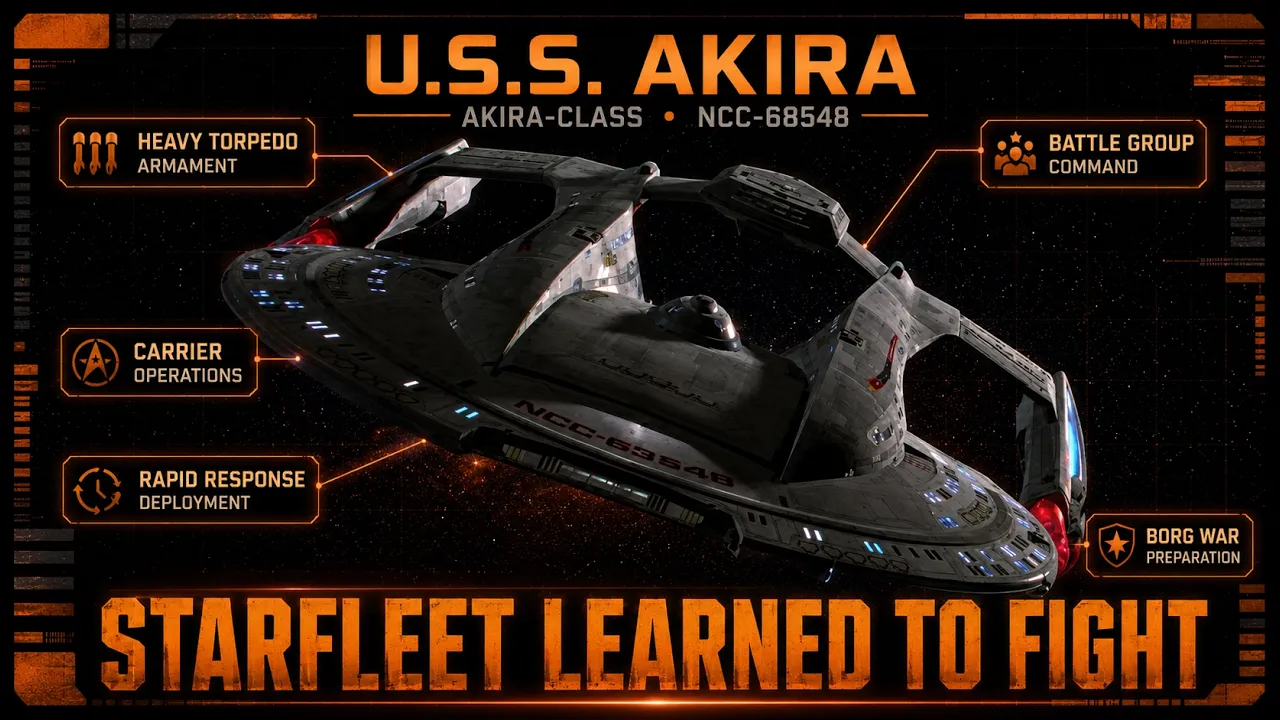
Adapted with AI from Lore Reloaded's video of 24 June 2026 and checked against the video before publication. Editorial standards · Corrections
More from @lorereloaded
All →


Make videos? Your next one could be an article here.
We turn your videos into articles under your name, linked back to the original. You keep 60% of what they earn, non-exclusive, and you can leave whenever you like.
Become a SubPlotter →