Is Starfleet really a navy? Lore Reloaded makes the case
Security, fighter pilots, engineers, doctors and intelligence officers all exist in Starfleet, but by the 24th century command has absorbed them all
 Lore Reloaded (AI-assisted)26 November 2026Editor: Digital Fox Talent Editorial TeamOn YouTube since 2016 · more than 140,000 subscribers

Starfleet tells the galaxy it isn't a military, but beneath its humanitarian image it's structured around one central reality: it's a navy. Security officers, fighter pilots, scientists and engineers, medics and intelligence officers all have their place. By the 24th century, though, the command division has quietly absorbed the other branches, and Starfleet behaves like a naval power that speaks the language of exploration.
Starfleet insists it isn't a military, but the Borg and the Dominion War say otherwise
Captains insist they are explorers, scientists and diplomats, not soldiers. Jean-Luc Picard once said exactly that, framing Starfleet as a peaceful organization devoted to discovery rather than conquest. On the surface, it's a convincing image. Combat is the minor purview of a captain. Ships are named after scientists and cities, crews wear bright uniforms, and they spend as much time cataloging nebulae as confronting hostile powers. To most of the Federation's citizens, Starfleet symbolizes hope, curiosity and unity.
That image cracks the moment the Federation is threatened. When the Borg advanced on Earth, Starfleet didn't send negotiators. It deployed an armada. During the Dominion War, hundreds of ships fought across star systems, and thousands of Starfleet officers died in brutal, prolonged campaigns. These weren't minor security skirmishes or exploratory mishaps. They were full scale wars. Admirals planned invasions, captains commanded fleets, and officers fought and bled like any soldier would.
Starfleet has always lived with this contradiction. It preaches peace yet trains for war, and it denies being a military while wielding the power of one. The contradiction isn't accidental. It's carefully maintained, because admitting the truth would shatter the Federation's image as a benevolent society. The Federation can claim moral superiority precisely because it hides the steel beneath the velvet. Starfleet has to be gentle enough to win the trust of new civilizations, yet powerful enough to destroy anyone who threatens them. That duality has allowed the Federation to survive, but it has also blurred the truth of what Starfleet is.
Starfleet's ranks, numbered fleets and starships follow naval tradition
Everything about Starfleet's organization reflects a navy. It uses naval ranks: ensigns, lieutenants, commanders, captains, commodores and admirals. Those ranks are tied to operational authority. Captains are sovereign commanders of their ships, and admirals oversee fleets, sectors and theaters of war. These aren't ceremonial positions. They hold legal and strategic power.
That becomes undeniable in wartime. During the Dominion War, Starfleet deployed numbered fleets, including the Second, Fifth, Seventh and Ninth, exactly like real world naval forces. Admirals Ross and Nechayev coordinated campaigns involving hundreds of starships, planning logistics, assigning task forces and orchestrating simultaneous offensives. Battles like the first Chin'toka assault weren't heroic one offs. They were complex naval operations.
The ships themselves are designed and crewed like naval vessels. Each functions as a command of its own, with a chain of authority running through the captain, executive officer, operations chiefs, tactical officer, helmsman, engineers and medical officers. They can operate autonomously for years, patrol borders, enforce treaties and, if ordered, conduct planetary assaults or blockade enemy space. While underway, the captain's authority is absolute: they can arrest officers, invoke martial law, and even launch strategic weapons if communications are cut. That level of autonomy is a naval tradition carried directly into Starfleet.
Even the culture reflects it. Officers serve tours of duty, ships are commissioned, and crews call their vessels she. Service aboard them carries the prestige and burden once reserved for historic warships, and each starship carries the Federation flag into deep space as a national symbol. Every other branch exists to support this navy. Security guards it, fighter pilots shield it, scientists and engineers build its weapons and warp cores, and medical officers keep its crews alive. None of them can project power on their own. When people picture the Federation and Starfleet, they picture starships, and that is no accident.
Starfleet security officers are its closest equivalent to Marines
If starships are Starfleet's sword, security is the hand gripping it. Every vessel carries a detachment of security personnel trained to protect the ship, defend the crew and respond with force when diplomacy fails. They are rarely celebrated, seldom seen on the bridge and almost never at the negotiating table. Yet they are the first to draw phasers when things go wrong. On starships they serve under a chief of security, leading armed response teams to repel boarders, secure critical systems and accompany away teams into hostile territory. On stations and starbases they act as a garrison, patrolling corridors, running drills and operating detention facilities. While most officers study stellar cartography or warp mechanics, security cadets spend their academy years in combat simulations, training in phaser combat, hand to hand fighting and boarding actions.
During the Dominion War, Starfleet deployed security personnel as frontline infantry. The siege of AR-558 shows some of them entrenched on a remote world, holding a vital communications relay under constant attack. To be fair, the defenders weren't only security officers. They included engineers, operations staff and scientists, ordinary personnel forced to become soldiers. Security officers were trained for this, but most of their comrades weren't, and they paid the price. Federation regulations said combat tours shouldn't last more than 90 days, but the siege stretched on for months.
Even the uniforms mark security as outsiders. They wear gold, not command red, and as Michael Eddington once said, "you don't get to be a captain wearing a gold uniform." That wasn't only bitterness. It was the truth: security officers can't rise to starship command through their own branch. They protect the people who explore, but they don't get to lead them.
The imbalance is old. Before the Federation existed, Earth's early Starfleet relied on the Military Assault Command Operations, the MACOs, a separate force of professional soldiers brought aboard the Enterprise NX-01 during the Xindi crisis. Under Major Hayes, they conducted boarding missions, guarded critical decks and fought in close quarters. When the Federation formed, the MACOs were dissolved and absorbed into Starfleet, and their doctrine became the foundation of modern security. We occasionally glimpse rarer ground combat specialists too, like Colonel West in Star Trek VI: The Undiscovered Country, whose army style rank and black ops planning session imply hidden military units within Starfleet. Still, security has no independence. It doesn't command fleets or dictate policy. Its job is to make sure the officers who explore come home alive, and without it, no starship would last a day.
Starfleet's fighter pilots form an airwing that appears only in total war
Starfleet's war machine also includes an easily overlooked starfighter element. These pilots have no distinct uniforms and no admirals of their own, but in war they become Starfleet's fastest and most disposable weapon. In the retaking of Deep Space 9, Starfleet launched waves of small attack fighters to pierce Cardassian formations. In Sacrifice of Angels, eight successive squadrons dove into Jem'Hadar lines like hornets so the larger ships could follow through. These one or two person Federation attack fighters are small, fast and lightly armed with phasers and micro torpedoes. Their job is to overwhelm, disrupt and harass long enough for the big ships to deliver the killing blow.
The Peregrine class design used in the war had already appeared as a training craft at Starfleet Academy, flown by cadet flight teams like the one in The First Duty. Starfleet has always cross trained officers in small craft operations. In peacetime these pilots fly shuttles and runabouts. In wartime they become the closest thing Starfleet has to an air force, but it's ad hoc and temporary: no fighter corps and no standing squadron on carriers. Their craft are often modified courier ships or stripped down runabouts, and even at their peak they flew from starbases and ship tenders under a fleet admiral or starship captain.
Fighters are tactical, not strategic. They can sting but can't conquer, and buy time but can't hold territory. Starfleet invests in them only when it must, because they represent the one thing it tries not to be: expendable. Still, they can turn the tide by darting through shield gaps, drawing fire and sowing chaos. During the final Dominion offensive, Klingon commanders insisted Starfleet's fighter squadrons lead their joint assault waves. Yet these pilots leave no legacy, no monuments and no starship named in their honor. Starfleet doesn't want to need them, but when war erupts, it always does.
Starfleet's scientists and Corps of Engineers built the Defiant and Prometheus
If the navy is Starfleet's muscle, science and engineering are its mind and memory. Long before it was a fleet of warships, Starfleet was a fleet of scientists, chartered to seek out new life and new civilizations. Most never fire a phaser in anger, but their work decides whether Starfleet survives its wars. Every starship carries a science division under a chief science officer, Spock on the original Enterprise and Jadzia Dax on Deep Space 9, leading exobiologists, astrophysicists, stellar cartographers and xenotechnologists who analyze anomalies and develop countermeasures on the fly.
Behind them stands the Starfleet Corps of Engineers, rarely seen but constantly felt. It builds starbases, warp relays, planetary power grids and the starships themselves. In Star Trek II, the Corps constructed the Genesis research facility at Regula I. On Deep Space 9, we see the genius of Chief O'Brien, and in Voyager's alternate future episode Timeless, Harry Kim works as a Corps design specialist advancing warp theory. Sometimes those miracles become weapons. When the Borg threatened the Federation, Starfleet ordered its first true warship, the Defiant class: small, overpowered, stripped of comforts, a gun with a warp core. The later Prometheus class was a multivector assault vessel that could split into three sections in battle.
Even the controversial projects began here. Genesis was a Federation science initiative, but Starfleet engineers built the facility, maintained the torpedo casing and ran the simulations. In The Next Generation's The Pegasus, Starfleet's R&D division covertly developed a phasing cloak in violation of the Treaty of Algeron, in secret labs hidden even from most of the admiralty. This work is woven into civilian science too: the Daystrom Institute collaborates with officers, most famously Commander Bruce Maddox's research on artificial life, and new warp cores, shields and quantum torpedoes usually began as classified experiments at Daystrom or Utopia Planitia. Starfleet's ships aren't the fastest or strongest in the quadrant, but they are the most adaptable, because its engineers can rewire a starship on a week's notice.
Starfleet Medical can override captains and works as a military medical corps
Starfleet can survive without diplomats, and even without scientists, but without its medics it dies. Starfleet Medical trains personnel, sets standards of care and leads medical research across hundreds of worlds. Every starship carries a chief medical officer and a staff of nurses, orderlies and specialists who handle everything from alien biology to unknown outbreaks. Dr. McCoy improvised treatments for species never encountered before, and Voyager's crew survived the Delta Quadrant largely because the EMH had access to Starfleet's medical databanks.
These doctors are commissioned officers who can override a captain on medical grounds. In The Next Generation's Lonely Among Us, Dr. Crusher points out that a medical officer has the legal authority to relieve any commanding officer deemed medically unfit. That power exists because Starfleet knows how fragile its crews are. The branch also runs its own training facilities, and Dr. Crusher once left the Enterprise to head Starfleet Medical on Earth, overseeing its training and research arms.
In the Dominion War, Starfleet Medical coordinated mass casualty treatment across dozens of sectors, worked on vaccines for engineered plagues and researched countermeasures for biological weapons, mobilizing labs and hospital ships as a military medical corps. It oversees all medical research in Starfleet, clears new treatments and genetic therapies, and maintains protocols for medical ethics, acting as a surgeon general's office, field hospital corps and research institute in one. Starfleet can replace ships, but it can't replace people, which is why its officers outrank line command on medical matters.
Starfleet Intelligence is secret, but unlike Section 31 it answers to the rules
Unlike Section 31, Starfleet Intelligence isn't a rogue outfit. It's an official division reporting to Starfleet Command, though it works from classified facilities and runs covert missions across the Alpha Quadrant. In The Search, Part I, it briefs Sisko's crew on the Dominion threat. In Homefront and Paradise Lost, its analysis warns the Federation Council about possible Changeling infiltration on Earth, and Admiral Ross relies on its briefings during the war.
It's less an organization than a network, with officers embedded in logistics, security, operations and science postings, some openly as liaisons and others under deep cover. It runs counterespionage against the Tal Shiar and Klingon Imperial Intelligence, operates listening posts along the border, and keeps threat dossiers on ship classes, weapons loadouts and doctrine. Crucially, it still needs authorization for assassinations, biological warfare or treaty violations, and answers for it when it breaks the rules. Intelligence bends the rules; Section 31 ignores them. Feared and resented, it is still the reason the Federation rarely walks blind into an ambush.
By the 24th century, the navy has absorbed Starfleet's other branches
Starfleet is often described as one force with one mission, but that's a myth. It's a patchwork of specialized branches, and by the 24th century that patchwork is no longer balanced. Every major decision flows through captains and admirals. Science officers make discoveries under a captain's orders. Security officers fight but never command. Medical staff save lives but can't shape missions. Intelligence officers depend on admirals to act on their warnings. Starfleet still looks like a web of equals, but it behaves like a navy.
Civilian oversight has eroded too. The Federation Council and Diplomatic Corps can override Starfleet on paper but rarely do, staying hands off outside major crises and trusting the admiralty with day to day policy. The navy filled that vacuum. Captains now define missions, and admirals shape policy. Starfleet is no longer a coalition of equal branches but a naval empire wrapped in the language of exploration, and its other divisions all know it.
The paradox survives. Starfleet still calls itself peaceful while building warships, and still trains scientists, doctors and idealists, then places them under hardened officers who must be ready to kill. Its strength now comes from unity enforced by hierarchy. The navy commands, the rest comply, and if the Federation survives, it will be because its captains and the system that forged them continue to wield that power in the name of something better than power itself.
What other creators are saying
More on Starfleet →I rank the Motion Picture refit Enterprise first, barely edging out the Enterprise D, with the Defiant, Enterprise E, and original Enterprise close behind, judging each ship purely on how it looks on screen rather than its crew or battles.
Star Trek ship design ranking: is the refit Enterprise best? →
A Romulan War buildup, a Mirror Universe miniseries, the Borg Queen's origin and a refitted NX-01 were all part of the plans for a season that never got made
Tomorrow's Enterprise plays less like classic Kirk and Spock and more like Next Generation's All Good Things, and the people who made it are calling the future we saw continuity.
Strange New Worlds finale: did it give TOS the ending it lacked? →
Watch the original
@lorereloaded · YouTube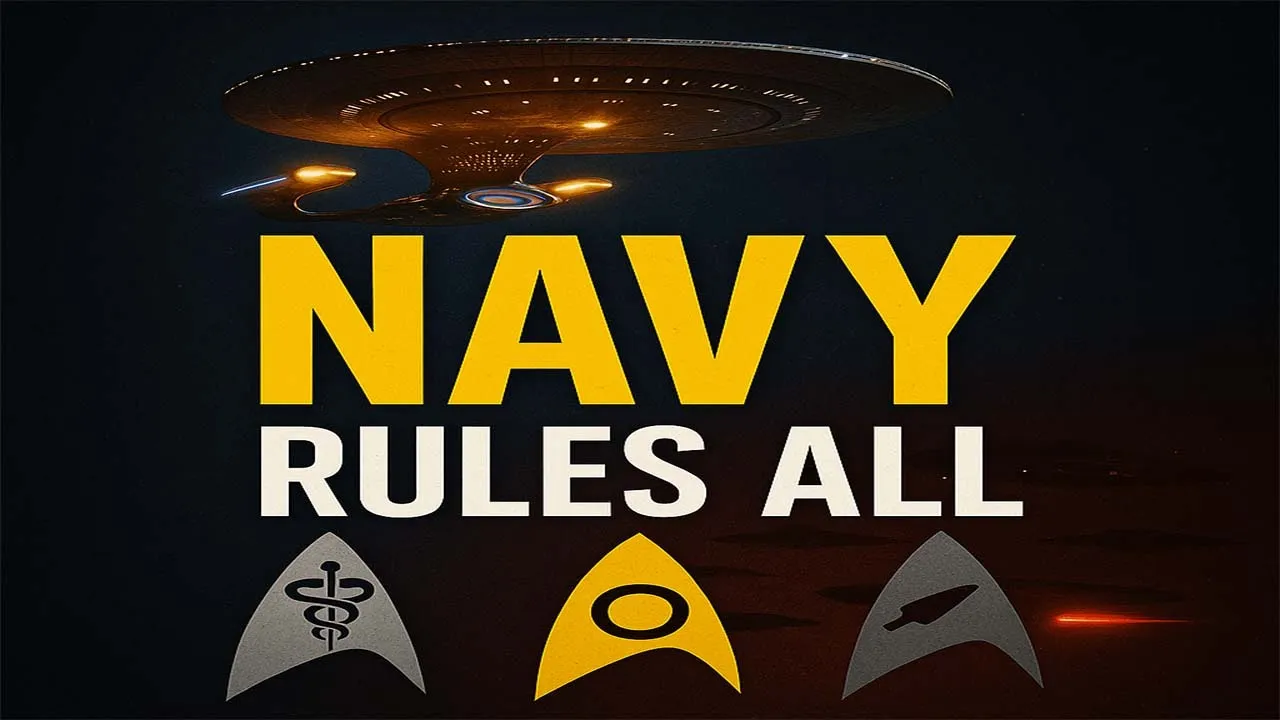
Adapted with AI from Lore Reloaded's video of 13 September 2025 and checked against the video before publication. Editorial standards · Corrections
More from @lorereloaded
All →


Make videos? Your next one could be an article here.
We turn your videos into articles under your name, linked back to the original. You keep 60% of what they earn, non-exclusive, and you can leave whenever you like.
Become a SubPlotter →