Why the Klingon Bird of Prey Explains How Klingons Wage War
The Klingon Empire could field huge warships, but its smaller, replaceable raider shows how Klingons choose to fight: independently, unseen and on their own terms.

The Klingon Empire built warships that could overpower anything in the quadrant: huge cruisers, command flagships, and weapons designed to dominate entire fleets. Yet that isn't how the Klingons chose to fight. When they really go to war, they don't lead with their biggest ships, they don't rely on overwhelming force, and they don't even fight fair. They choose something smaller, faster and replaceable: the Bird of Prey.
The Bird of Prey is a ship that strikes from the dark and disappears before the battle ever truly begins. Klingon war was never about control. Ultimately, it was about efficiency, the moment of attack, the choice to engage, and the right to win or die on your own terms. No ship in the Empire reflects that better.
Why the Bird of Prey suits a Klingon Empire that was never unified
The Klingon Empire doesn't fight like a unified machine, and it never really has. It isn't a centralized military the way Starfleet is. There's no single doctrine every captain is expected to follow and no rigid structure dictating how every battle must be fought. To be clear, the Empire does have a military. The Klingon Defense Force has a name, a command structure and a chain of authority. It just doesn't function the way we expect a unified force to, because the Empire itself isn't unified in that way.
The Empire is a coalition of great houses, each with its own ships, its own commanders and its own ambitions. The Defense Force doesn't replace that system. It sits on top of it. It coordinates when it has to and unifies when there's a common enemy, but it doesn't dictate how every captain fights. It can't, because Klingon authority isn't enforced through structure. It's enforced through strength, loyalty, reputation, and who's willing to follow you into battle. Even within the Defense Force, every ship is still, in a very real way, its own command.
The Bird of Prey fits that world perfectly, not because it's the strongest ship in the fleet, but because it doesn't need anyone else to function. It doesn't require a formation to be effective. It doesn't depend on a command ship to give it purpose. It doesn't wait for orders before it acts. It's a ship built for initiative, for a captain who sees an opening and takes it.
Klingon warfare is built around opportunity, not coordination. Where Starfleet plans and empires organize, Klingons commit. They attack when the moment feels right, disengage when honor or survival demands it, and expect every captain to make that decision for themselves. The ship doesn't enforce discipline. It assumes instinct and aggression. So Klingon war never becomes about systems or strategy. It stays personal: every battle is a choice, every engagement is a statement, and every victory or defeat belongs to the one who gave the order.
The cloaking device lets a Bird of Prey choose when the battle begins
If the first question is who makes the decision to fight, the next is when and how. The Bird of Prey doesn't just give Klingon captains freedom. It gives them control over the moment of battle. The cloaking device isn't an advantage on this ship. It's the assumption. A Bird of Prey doesn't enter a fight by being seen. It enters a fight by choosing to be seen. It approaches unseen, studies, waits, and strikes on its own terms: not when the enemy is ready, not when the battlefield is fair, but when the opportunity feels right.
Klingon warfare isn't about holding ground or trading fire. It's all about timing. Strike first, hit hard, and disappear before the enemy can respond. Then do it again, and again, until the fight is over or the enemy breaks. This isn't sustained combat. It's pressure, relentless and unpredictable. That's why the Bird of Prey doesn't need to be the strongest ship in the fight. It rarely fights a fair one.
Compare that to the Vor'cha class attack cruiser, a vessel built to remain in the fight, trade blows and hold position, or the Negh'Var warship, a ship that projects power simply by being present. Those ships define control. "The bird of prey defines choice." It decides when the battle begins and when it ends, and in doing so it reshapes what Klingon war is. It isn't a contest of endurance or a test of coordination, but a series of moments where a single captain chooses to strike and forces the enemy to live with the consequences.
The Klingons build more Birds of Prey instead of bigger ships
Most empires respond to war the same way. As the threat grows, their ships grow with it: bigger hulls, stronger weapons, more specialized roles. War becomes a ladder, and every step up demands something new. The Klingons don't climb that ladder. The Bird of Prey doesn't scale upward. It scales outward. When the Empire needs more force, it doesn't redesign its fleets. It builds more Birds of Prey, with the same platform, the same philosophy and the same way of fighting applied again and again across the battlefield.
That means Klingon war doesn't change when the stakes rise. It just becomes more of itself: more ambushes, more independent strikes, more captains choosing their moment instead of waiting for orders. You don't need to retrain an empire to use it or rethink doctrine. Every new ship reinforces the same behavior. So the Klingons don't specialize the way other powers do. Instead of fleets where each ship has a narrow role to play, they build fleets where every ship can fight, every captain can act, and every engagement can happen without permission.
It isn't efficient and it isn't coordinated, but it is consistent, and consistency matters more than perfection when your entire philosophy is built around initiative. The enemy isn't facing a single fleet. They're facing dozens of independent threats operating on the same instinct, all capable of choosing their moment and all willing to strike without warning. That's what makes the Bird of Prey dangerous. It isn't firepower or design, but the fact that you never have to change it. You just have to build more of them.
What looks like Klingon chaos is the strategy
From the outside, Klingon warfare doesn't look organized. Ships don't move in perfect formation, attacks don't follow a predictable pattern, and engagements don't unfold the same way twice. It looks like chaos, and for most empires that would be a problem, because chaos is inefficient. It's hard to coordinate and harder to control. But the Klingons aren't trying to control the battlefield. They're trying to disrupt it.
The Bird of Prey makes that possible because every ship operates with the same assumption: "You don't wait for the plan, you are the plan." The result is a pattern of behavior repeated across dozens of ships. Find weakness, exploit it, disappear, over and over again. To an enemy, that doesn't feel like a strategy. It feels like instability, as though the fight is slipping out of their control, because it is. You're not fighting one mind. You're fighting dozens, each choosing a different moment, a different angle and a different way to break you.
The Bird of Prey ensures that they all can. It doesn't force them into formation, and it doesn't restrict how they engage. It gives them just enough firepower and just enough freedom to turn unpredictability into a weapon. So what looks like chaos isn't a breakdown of strategy. It is the strategy.
Where the Bird of Prey struggles: sustained war and the Negh'Var
The Bird of Prey makes Klingons dangerous, but it also makes them limited. Everything that gives this ship its strength, its independence, its flexibility and its ability to choose the moment of battle, comes at a cost. It struggles in fights it can't control. When there's no opportunity to exploit, no moment to choose and no way to disengage and reset, the Bird of Prey is forced into the kind of war it was never built for: sustained combat, coordinated engagements, and battles where endurance matters more than timing.
In those moments, its advantages disappear. It isn't the strongest ship in a straight fight, and it isn't built to hold a line. It was designed to avoid all of that. So when the Empire is forced into a prolonged war and can't rely on surprise, initiative or isolated strikes, it has to change. That's where ships like the Negh'Var warship begin to matter: larger vessels, heavier weapons, and a stronger emphasis on presence, coordination and sustained pressure. That isn't because Klingons prefer that kind of war, but because the Bird of Prey can't carry it on its own.
That creates a tension inside the Empire, between the way the Klingons want to fight and the way they sometimes have to. It's independence against coordination, personal glory against collective survival. The Bird of Prey doesn't resolve that tension. It exposes it. It represents a form of warfare that works best when the Empire is in control of the fight, and begins to break down when the fight stops playing by Klingon rules.
How the Bird of Prey trained Klingon culture to choose its moment
The Klingon Bird of Prey wasn't the Empire's most powerful ship. It wasn't the largest or the most advanced, and it wasn't built to win every kind of war. It didn't have to be. Over time, it did something far more important. It made Klingon war predictable, not in outcome but in behavior. Every captain trained on it learns the same lessons: don't wait, don't hesitate, choose your moment, and then act. Every battle becomes personal, decided not by distant command structures or perfectly coordinated fleets, but by the person sitting in the chair.
That changes what victory means. It isn't about holding territory, about minimizing losses, or even about efficiency. It's about decisiveness, about proving that when the moment came, you had the will to take it. The Bird of Prey reinforces that over and over, across generations, across conflicts, and across an Empire that never fully unified the way others did. Even when larger ships take the field, and even when wars demand coordination or endurance, that instinct never really goes away, because it's been trained into the culture and built into the expectation of what it means to be in command.
The Empire didn't just build a ship that could fight this way. It built a system where fighting this way became normal, where independence was assumed, aggression was rewarded, and hesitation could cost you everything. Once that becomes your baseline, it doesn't matter how advanced your ships become or how your enemies evolve. You'll always come back to the same question: when do I strike? And the Bird of Prey answers it the same way it always has. "Whenever you choose."
What other creators are saying
More on Star Trek →I think the Training Day and Crimson Tide influences could make a genuinely compelling, darker Starfleet story with a new crew, and I'm cautiously excited, but I don't trust Paramount's Trek track record and need to see it filmed before believing in it.
Star Trek (2009) and The Force Awakens share a director, a reboot mission and the start of a trilogy
J.J. Abrams Played an Almost Identical Role in Star Trek and Star Wars →
One card plays artifacts from the top of your library, and the other rewards facing a dilemma with free spells
Zefram Cochrane and the Caretaker among Magic: The Gathering Star Trek preview cards →
A Romulan War buildup, a Mirror Universe miniseries, the Borg Queen's origin and a refitted NX-01 were all part of the plans for a season that never got made
Watch the original
@lorereloaded · YouTube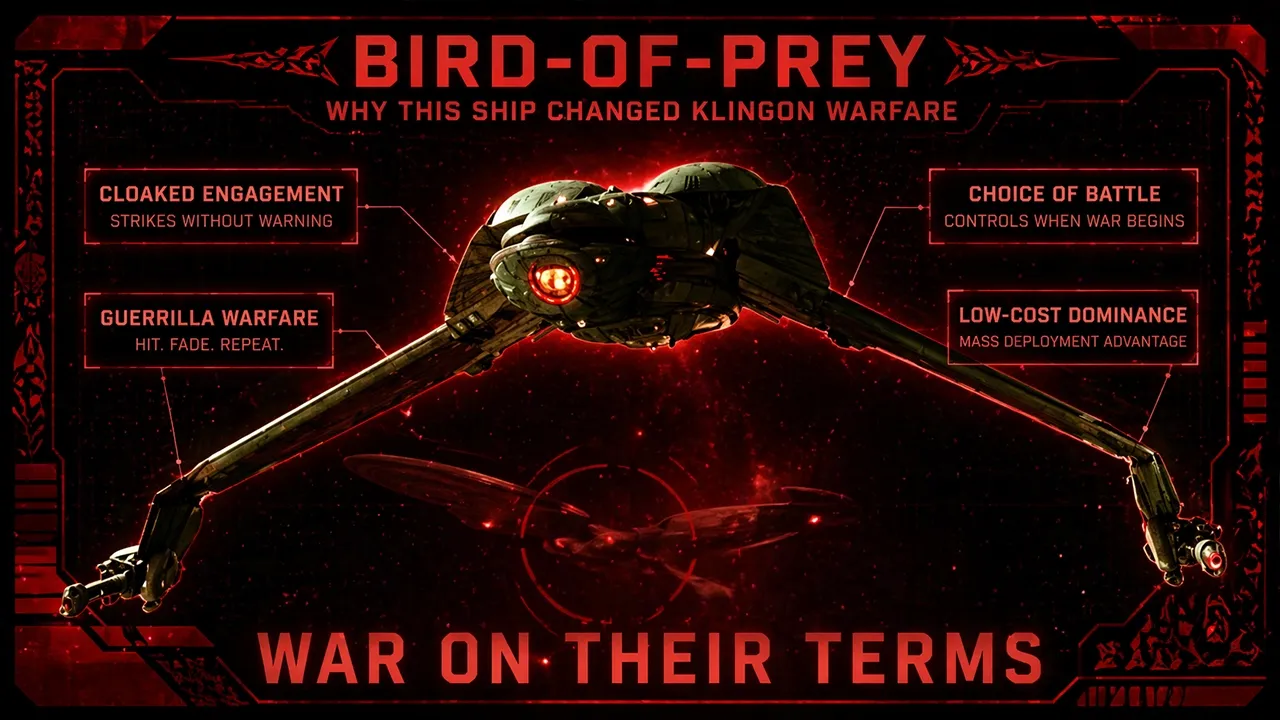
Adapted with AI from Lore Reloaded's video of 23 April 2026 and checked against the video before publication. Editorial standards · Corrections
More from @lorereloaded
All →


Make videos? Your next one could be an article here.
We turn your videos into articles under your name, linked back to the original. You keep 60% of what they earn, non-exclusive, and you can leave whenever you like.
Become a SubPlotter →