Batman Forever review: does the chaos earn it a 7.9/10?
Tim Burton was pushed out, Michael Keaton walked away, and Val Kilmer clashed with Joel Schumacher, yet the 1995 sequel still earns a 7.9 out of 10 final score
 Breakdowns & Blockbusters (AI-assisted)21 November 2026Editor: Digital Fox Talent Editorial TeamOn YouTube since 2023 · more than 240,000 subscribers

Batman Forever was supposed to steer a dark, brooding franchise into a family friendly cash cow. Instead it delivered a neon soaked fever dream, and once I weigh the movie alongside its behind the scenes drama and production woes, it rises to a 7.9 out of 10.
This time I'm putting Batman Forever (1995), starring Val Kilmer, Jim Carrey and Tommy Lee Jones, through All Things Considered. I score each film out of 10 in three categories: the quality of the movie itself, the behind the scenes drama among the cast and crew, and the production woes, from studio meddling to on set disasters. Then I average it all out for a final score. A bad movie that's a five out of 10 might rise to an eight once I factor in the production hell that went into making it.
How McDonald's Happy Meals and Batman Returns pushed Tim Burton out
To understand Batman Forever's production woes, you have to go back to the summer of 1989, when the first film came out. Batman wasn't only a movie. It was a cultural phenomenon, and that iconic black and gold logo was everywhere: T-shirts, posters, toys, lunchboxes. Warner Bros. didn't only have a hit movie. It had a merchandising machine, and naturally it wanted more. Heading into the sequel, the studio was already locking in big deals, including a partnership with McDonald's to squeeze every last dollar out of the Batman IP.
There was one problem: Tim Burton. He didn't want to come back. He'd had a lousy experience on the first film, with producer Jon Peters rewriting parts of the movie without him, and he felt he'd already been there and done that. To get him back, Warner Bros. gave him carte blanche and told him he could do whatever he wanted.
The result was not the fun family friendly superhero movie you'd pair with a Happy Meal. Batman Returns was dark. Parents toss their baby into a river, the Penguin bites a man's nose off, Christopher Walken's character throws his secretary out of a high rise window and is later electrocuted via a kiss and a taser, there's a full plot to murder Gotham's firstborn children, and the Penguin drools black goo as he dies. Warner Bros. received a ton of complaints from parents, and McDonald's was furious, ultimately pulling its Happy Meal toys. Worst of all, the movie didn't make as much at the box office as its predecessor, nor did it move as many Batman toys and products.
So when Burton met with Warner Bros. about a third film, executives kept nudging him toward making something smaller and more personal next. Eventually it clicked: they weren't giving him advice, they were pushing him out. Burton read the room and stepped aside, clearing the way for Joel Schumacher.
Why Michael Keaton walked away from Batman Forever
That created another problem. Michael Keaton, Batman himself, was loyal to Burton. After reading the Batman Forever script, he didn't like it or the lighter tone the film was taking. When he met with Schumacher, he felt the director didn't understand the character.
Schumacher told the actor, "I don't understand why everything has to be so dark." Keaton replied, "Do you know how this guy became Batman?" Keaton dropped out, which created yet another problem. Rene Russo had already been cast as Dr. Chase Meridian, but after replacing Keaton with Kilmer, the studio felt she was too old to be Kilmer's love interest, and she was replaced with Nicole Kidman.
The Batman Forever casting merry go round: Robin, Two-Face and the Riddler
The casting merry go round didn't end there. Marlon Wayans had been cast to play Robin in Batman Returns before his part was cut from the film. Because he'd signed a pay or play two picture deal, when Schumacher replaced him with Chris O'Donnell, Wayans still got paid for two films he never appeared in.
Billy Dee Williams had played Harvey Dent in the 1989 film, a role he only accepted because he hoped to one day play Two-Face in a sequel. Schumacher was dead set on recasting him. Tommy Lee Jones was coming off an Oscar, Schumacher had just worked with him on The Client, and the film's producer had worked with him on The Fugitive and on another film that also saw Jones play an eccentric villain. So Billy Dee was out and Tommy Lee Jones was in.
Then there's Robin Williams. Back on the 1989 film, Williams wanted to play the Joker badly enough that he campaigned for the role, seeing it as the perfect fit for his manic energy. But Warner Bros. had its sights on Jack Nicholson, and when negotiations stalled, the studio used Williams as leverage, telling Nicholson that if he didn't take the deal, they were giving it to Robin Williams. Nicholson signed on, infuriating Williams, who realized he'd been used as nothing more than a bargaining chip.
For Batman Forever, Warner Bros. saw a chance to make things right and offered Williams the Riddler. Negotiations dragged as his agent held out for a big payday. When Williams questioned the strategy, his agent reassured him that nobody in Hollywood could do what Williams could do. Famous last words. Warner Bros. disagreed, because sitting right there was Jim Carrey, who was significantly cheaper at the time and exploding in popularity thanks to Ace Ventura and The Mask. Williams was out and Carrey was in.
The unreleased Schumacher cut and a 7.7 for production woes
When Schumacher turned in his first cut, it was significantly longer and darker, with significantly less camp. Warner Bros., having learned its lesson on Batman Returns, pushed him to cut it down and lighten it up. That first version has become the infamous unreleased Schumacher cut.
Between a studio so panicked over Happy Meal sales that it pushed out the visionary architect of its franchise, a legendary casting merry go round, and executives forcing their new director to butcher his own darker cut to fit a more toy friendly mandate, Batman Forever earns a 7.7 out of 10 for production woes. It's a clear example of what happens when a studio prioritizes marketability over the movie itself.
Tommy Lee Jones told Jim Carrey: "I cannot sanction your buffoonery"
The real battles in this movie weren't happening in Gotham City. They were happening off screen, starting with a clash between the two villains. Before they'd even filmed a scene together, Carrey walked into a restaurant, spotted Jones eating there and went over to say hello. Allegedly, the blood drained from Jones's face. He stood up shaking, hugged Carrey and told him, "I hate you. I really don't like you."
When Carrey pulled up a chair and asked what the problem was, Jones delivered the now legendary line: "I cannot sanction your buffoonery." Schumacher later speculated that Jones felt threatened by Carrey's rapidly rising star power. Carrey believed it may also have stemmed from lingering resentment after Dumb and Dumber overshadowed Jones's Cobb at the box office, since both were released at the same time.
Val Kilmer and Joel Schumacher's shoving match, and an 8.7 for drama
That was nothing compared to the war between Schumacher and Val Kilmer. Despite being warned about Kilmer's difficult reputation on sets like The Doors and Tombstone, Schumacher cast him anyway, a decision he quickly came to regret. Kilmer was allegedly rude and badly behaved toward the crew, mistreating the first AD, the cameraman and the costume department, whom he would regularly go ballistic on.
The tension eventually exploded into a shoving match between the director and his leading man. After Schumacher chewed Kilmer out and told him his behavior wouldn't be tolerated one more second, Kilmer gave him the silent treatment for two straight weeks, a period Schumacher described as absolute bliss. Unsurprisingly, Kilmer didn't return for the sequel. Schumacher later called him psychotic and summed up his departure this way: "He sort of quit and we sort of fired him."
Between an Oscar winner shaking with rage over his co-star's buffoonery, a leading man terrorizing the crew, and a physical shoving match followed by two weeks of silence, Batman Forever earns an 8.7 out of 10 for behind the scenes drama. It's a masterclass in how a neon soaked family friendly blockbuster hid some of the most toxic, ego driven chaos in Hollywood history.
Batman Forever's neon Gotham works, but Elliot Goldenthal's score doesn't
The movie itself doesn't fully feel like a sequel, and it doesn't feel like a reboot either. It's stuck somewhere in the middle. It keeps Michael Gough as Alfred and Pat Hingle as Commissioner Gordon, but it recasts Bruce Wayne and Harvey Dent while aggressively changing the tone of the universe. Gone is Burton's Gothic, shadowy Gotham. Instead we get towering statues, neon lights and a city that feels like an absolute acid trip. It's a bold swing, and it's a vibe, which gives the film its own identity.
What doesn't work for me is the score, especially compared with Danny Elfman's score for the 1989 film, which I'd put among the greatest of all time. Elliot Goldenthal's music here sounds like circus music. It's loud, it's bombastic, and it completely lacks the brooding mystery of its predecessor.
Val Kilmer's Batman is fine, while Tommy Lee Jones overacts
As for Val Kilmer as Batman, he's fine, but not memorable. He plays Bruce Wayne more like a quiet, introspective nerd than a charming billionaire playboy hiding his dark side. The result is a performance that's good but never stands out, which is surprising, because Kilmer is an incredible character actor. Here he feels boxed in, almost like he's stuck playing the straight man while everyone else gets to let loose and chew the scenery.
And chew the scenery they did. Tommy Lee Jones is either trying to channel Jack Nicholson's Joker or desperately trying to outdo Jim Carrey's Riddler. The unfortunate thing is that his Harvey Dent could have been amazing if he'd played the character straight, which would have worked a lot better opposite Carrey's manic energy.
The Riddler's plan was ahead of its time, and Robin is a bright spot
What's brilliant and way ahead of its time is the Riddler's master plan: a device that turns people into TV watching zombies so he can steal their personal information and beam it into his own brain. That's essentially what social media platforms do to us today.
Nicole Kidman, besides looking absolutely stunning, plays a character who is very much a product of her time. She's so infatuated with hooking up with Batman that it's her whole personality, and she feels taken right out of a Sex and the City episode. Chris O'Donnell's Robin, though, is a bright spot. His story runs parallel to Bruce's in a way that adds something to the film, giving Bruce a chance to confront his own past while guiding someone else through it, which gives the story some much needed weight.
Why Batman Forever was everything I wanted as a kid, and its 7.2 film score
When this movie came out, I was the target audience. I was a kid. I loved the 1989 Batman, but at the time I hated Returns. Plus, Batman Forever arrived just as Jim Carrey became the biggest star on the planet, and I was a huge Carrey fan too. So this movie was everything I wanted, and years later it's held up decently well for what it is: a family friendly Batman movie.
On the film quality scale, Batman Forever earns a 7.2 out of 10. Despite its flaws, like nipples on the bat suit, it's a fun, stylish, neon infused adrenaline shot the franchise needed at the time to keep going. It's a shame it was immediately followed by the over the top Batman and Robin, which nearly killed the franchise for good.
Batman Forever's final score: 7.9 out of 10
Factor in a studio overcorrecting after Batman Returns, pushing out the director who defined the franchise, losing its Batman, reshuffling major casting decisions, clashing egos behind the scenes, and a movie that manages to be both a sequel and a soft reboot at the same time. All things considered, Batman Forever rises to a 7.9 out of 10. It's a flashy, chaotic course correction that saved the franchise in the moment, even if it planted the seeds for its downfall.
What other creators are saying
More on Jim Carrey →A man walking away mid-kiss and a pricey bird swatted aside had us laughing
Our take on Ace Ventura: Pet Detective and the $25,000 bird that got swatted away →
Motion capture suits, facial dots and a lowered floor shaped the performances in the 2009 film
How Jim Carrey and Gary Oldman Played Multiple Roles in A Christmas Carol (2009) →
I think Pattinson's Bond deal likely killed any future Batman films, leaving DC with two lame duck movies, his Batman sequel and Corenswet's Man of Tomorrow, both potentially dead ends with no clear path forward, which I find shocking.
Pattinson as Bond: does it leave DC with two dead-end movies? →
I think The Batman is phenomenal and builds its characters better than any other Batman story, with Bruce, Selina and the Riddler working perfectly together, and I believe DC needs authorship like Reeves' to earn passionate love rather than mere apathy, so if DC lets Reeves do his thing this universe is destined for greatness.
The Batman: why Matt Reeves' Batman, Catwoman and Riddler work →
Watch the original
@breakdownsandblockbusters · YouTube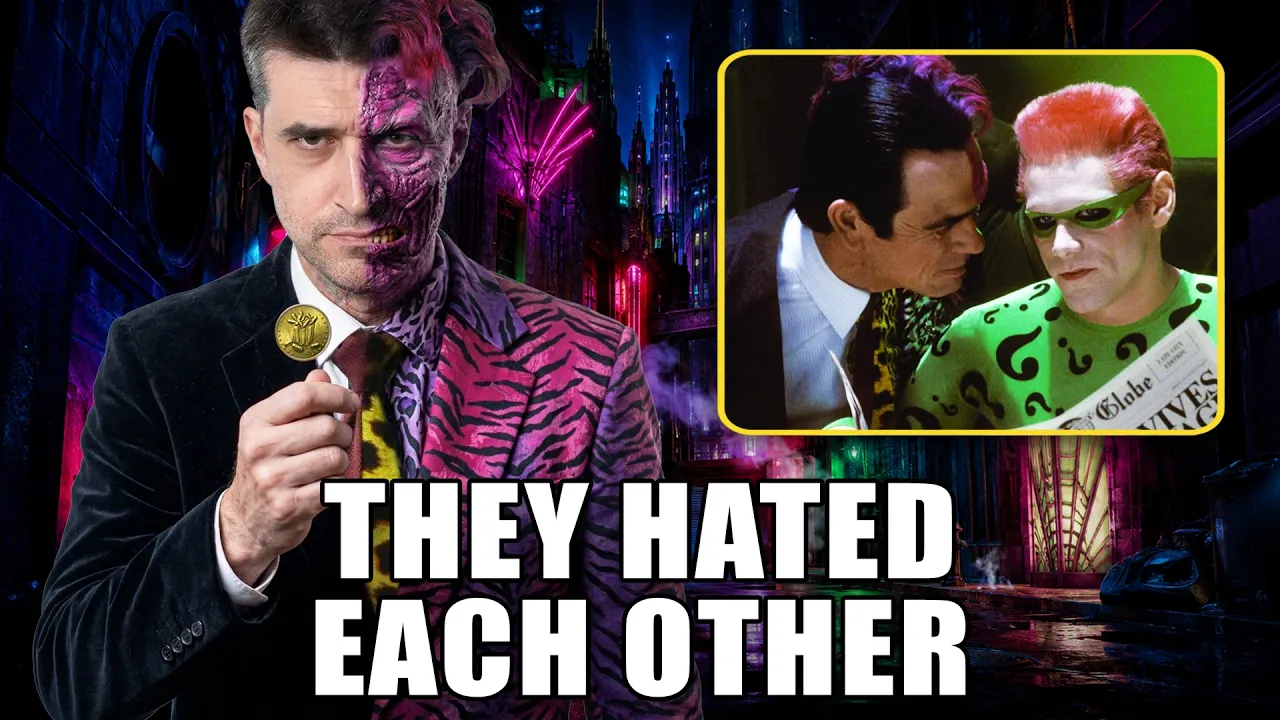
Adapted with AI from Breakdowns & Blockbusters' video of 22 April 2026 and checked against the video before publication. Editorial standards · Corrections
More from @breakdownsandblockbusters
All →


Make videos? Your next one could be an article here.
We turn your videos into articles under your name, linked back to the original. You keep 60% of what they earn, non-exclusive, and you can leave whenever you like.
Become a SubPlotter →